

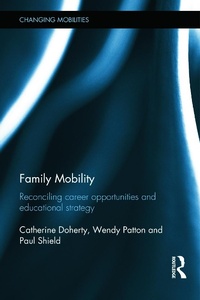
Family Mobility
Reconciling Career Opportunities and Educational Strategy
1st Edition
Published on 18. July 2014
Book
Hardback
222 pages
978-0-415-71412-9 (ISBN)
Description
Family mobility decisions reveal much about how the public and private realms of social life interact and change. This sociological study explores how contemporary families reconcile individual members' career and education projects within the family unit over time and space, and unpacks the intersubjective constraints on workforce mobility.
This Australian mixed methods study sampled Defence Force families and middle class professional families to illustrate how families' educational projects are necessarily and deeply implicated in issues of workforce mobility and immobility, in complex ways. Defence families move frequently, often absorbing the stresses of moving through 'viscous' institutions as private troubles.
In contrast, the selective mobility of middle class professional families and their 'no go zones' contribute to the public issue of poorly serviced rural communities. Families with different social, material and vocational resources at their disposal are shown to reflexively weigh the benefits and risks associated with moving differently. The book also explore how priorities shift as children move through educational phases. The families' narratives offer empirical windows on larger social processes, such as the mobility imperative, the gender imbalance in the family's intersubjective bargains, labour market credentialism, the social construction of place, and the family's role in the reproduction of class structure.
This Australian mixed methods study sampled Defence Force families and middle class professional families to illustrate how families' educational projects are necessarily and deeply implicated in issues of workforce mobility and immobility, in complex ways. Defence families move frequently, often absorbing the stresses of moving through 'viscous' institutions as private troubles.
In contrast, the selective mobility of middle class professional families and their 'no go zones' contribute to the public issue of poorly serviced rural communities. Families with different social, material and vocational resources at their disposal are shown to reflexively weigh the benefits and risks associated with moving differently. The book also explore how priorities shift as children move through educational phases. The families' narratives offer empirical windows on larger social processes, such as the mobility imperative, the gender imbalance in the family's intersubjective bargains, labour market credentialism, the social construction of place, and the family's role in the reproduction of class structure.
More details
Series
Language
English
Place of publication
London
United Kingdom
Publishing group
Taylor & Francis Ltd
Target group
College/higher education
Product notice
sewn/stitched
Cloth over boards
Illustrations
7 s/w Abbildungen, 7 s/w Zeichnungen, 8 s/w Tabellen
8 Tables, black and white; 7 Line drawings, black and white; 7 Illustrations, black and white
Dimensions
Height: 234 mm
Width: 157 mm
Thickness: 18 mm
Weight
454 gr
ISBN-13
978-0-415-71412-9 (9780415714129)
Copyright in bibliographic data and cover images is held by Nielsen Book Services Limited or by the publishers or by their respective licensors: all rights reserved.
Schweitzer Classification
Other editions
Additional editions
Catherine Doherty | Wendy Patton | Paul Shield
Family Mobility
Reconciling Career Opportunities and Educational Strategy
Book
12/2019
1st Edition
Routledge
€65.30
Shipment within 15-20 days
Catherine Doherty | Wendy Patton | Paul Shield
Family Mobility
Reconciling Career Opportunities and Educational Strategy
E-Book
08/2014
1st Edition
Routledge
€59.49
Available for download
Catherine Doherty | Wendy Patton | Paul Shield
Family Mobility
Reconciling Career Opportunities and Educational Strategy
E-Book
08/2014
1st Edition
Routledge
€59.49
Available for download
Persons
Catherine Doherty is a Senior Research Fellow in the Faculty of Education at Queensland University of Technology. She works in the sociology of education with an interest in mobile populations and educational markets. As well as this project, she has published research on international students in higher education, and international curriculum in secondary schools.
Wendy Patton is a professor and dean in the Faculty of Education at Queensland University of Technology, widely published in theoretical approaches to career studies across different populations in terms of age, socioeconomic background, and employment experience. She is currently the Series Editor of an International Career Development Book series by Sense Publishers.
Paul Shield is a Senior Research Fellow in the Faculty of Education at Queensland University of Technology with expertise in quantitative methodologies. He has contributed to major systemic reviews of educational reform and a wide variety of educational studies.
Wendy Patton is a professor and dean in the Faculty of Education at Queensland University of Technology, widely published in theoretical approaches to career studies across different populations in terms of age, socioeconomic background, and employment experience. She is currently the Series Editor of an International Career Development Book series by Sense Publishers.
Paul Shield is a Senior Research Fellow in the Faculty of Education at Queensland University of Technology with expertise in quantitative methodologies. He has contributed to major systemic reviews of educational reform and a wide variety of educational studies.
Content
1.The Family in More Mobile Times 2. Work/Family/Education Articulations in Space with Mobility Systems 3. Making Sense of Mobility in Family Narratives 4. Seeking Continuity in Circumstances not of our Choosing 5. Optimising Location In Circumstances of our Choosing 6. Movers and Stayers 7. Mobius Markets 8. Professionals' Public/Private Dilemmas in Rural Service 9. Families Moving on to get Ahead Appendix 1: Original Item Sets for their Corresponding Constructs