

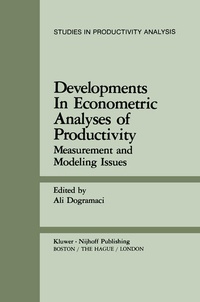
Developments in Econometric Analyses of Productivity
Measurement and Modeling Issues
Published on 1. November 2011
Book
Paperback/Softback
176 pages
978-94-009-7408-1 (ISBN)
Description
1 Econometric Approaches to Productivity Measurement: A Brief Overview.- 1.1 Introduction.- 1.2 Index of Total Factor Productivity.- 1.3 Total Factor Productivity versus Labor Productivity.- 1.4 Influence of Imported Intermediate Inputs on Productivity Measures.- 1.5 Frontier Functions.- 1.6 Productivity of Inputs Used, Elasticity of Substitution, and Economies of Scale.- 1.7 Final Remarks.- References.- 2 Intertemporal Changes in the Levels of Regional Labor Productivity in Canadian Manufacturing.- 2.1 Introduction.- 2.2 A Conceptual Framework for Interregional and Intertemporal Productivity Comparisons.- 2.3 Interpreting Labor Productivity Growth.- 2.4 Trends in Labor Productivity.- 2.5 Labor Productivity in Two-Digit Regional Manufacturing Industries.- 2.6 Differences in the Levels of Labor Productivity.- 2.7 Labor Productivity Levels in Ontario and Quebec Two-Digit Industries.- 2.8 Summary.- References.- 3 Growth Accounting in an Open Economy.- 3.1 Introduction.- 3.2 Value Added.- 3.3 Deliveries to Final Demand.- 3.4 Aggregation over Sectors in an Open Economy.- 3.5 Conclusion.- References.- 4 A Comparison of Alternative Frontier Cost Function Specifications.- 4.1 Introduction.- 4.2 The Frontier Cost Function.- 4.3 Data and Estimation Procedures.- 4.4 Frontier Estimation Results.- 4.5 Conclusion.- Notes.- References.- Appendix to Chapter 4.- 5 A Factor Augmenting Approach for Studying Capital Measurement, Obsolescence, and the Recent Productivity Slowdown.- 5.1 Introduction.- 5.2 Explanations of the Recent Slowdown.- 5.3 The Trouble with Pollution and Energy.- 5.4 The Relevance of Technical Change Measures.- 5.5 Theory of Estimating Technical Change.- 5.6 The Cost Function.- 5.7 Technical Change Series.- 5.8 Data and Estimation.- 5.9 Results.- 5.10 Conclusions.- References.- 6 Simultaneous Estimation of Factor Substitution, Economies of Scale Productivity, and Non-Neutral Technical Change.- 6.1 Introduction.- 6.2 Specification.- 6.3 Functional Form.- 6.4 Estimation.- 6.5 Data.- 6.6 Empirical Results.- 6.7 Scale Effects.- 6.8 Changing Input Prices.- 6.9 Technological Change.- 6.10 Summary and Conclusions.- References.- 7 Lie Group Methods and the Theory of Estimating Total Productivity.- 7.1 Introduction and Summary.- 7.2 Holotheticity and the Scale Effect: Lie Group Theory.- 7.3 Estimation Procedures.- 7.4 Estimation of the Scale Effect.- 7.5 The Lie Operator Technique for Estimating Productivity.- 7.6 The Effect of Technical Progress Represented by New Forms of the Production Function.- References.- Name Index.
More details
Series
Edition
Softcover reprint of the original 1st ed. 1983
Language
English
Place of publication
Dordrecht
Netherlands
Target group
Professional and scholarly
Research
Illustrations
176 p.
Dimensions
Height: 229 mm
Width: 152 mm
Thickness: 11 mm
Weight
287 gr
ISBN-13
978-94-009-7408-1 (9789400974081)
DOI
10.1007/978-94-009-7406-7
Schweitzer Classification
Other editions
Additional editions
Ali Dogramaci
Developments in Econometric Analyses of Productivity
Book
11/1982
Kluwer Academic Publishers
€109.13
Article exhausted; check different version
Content
1 Econometric Approaches to Productivity Measurement: A Brief Overview.- 1.1 Introduction.- 1.2 Index of Total Factor Productivity.- 1.3 Total Factor Productivity versus Labor Productivity.- 1.4 Influence of Imported Intermediate Inputs on Productivity Measures.- 1.5 Frontier Functions.- 1.6 Productivity of Inputs Used, Elasticity of Substitution, and Economies of Scale.- 1.7 Final Remarks.- References.- 2 Intertemporal Changes in the Levels of Regional Labor Productivity in Canadian Manufacturing.- 2.1 Introduction.- 2.2 A Conceptual Framework for Interregional and Intertemporal Productivity Comparisons.- 2.3 Interpreting Labor Productivity Growth.- 2.4 Trends in Labor Productivity.- 2.5 Labor Productivity in Two-Digit Regional Manufacturing Industries.- 2.6 Differences in the Levels of Labor Productivity.- 2.7 Labor Productivity Levels in Ontario and Quebec Two-Digit Industries.- 2.8 Summary.- References.- 3 Growth Accounting in an Open Economy.- 3.1 Introduction.- 3.2 Value Added.- 3.3 Deliveries to Final Demand.- 3.4 Aggregation over Sectors in an Open Economy.- 3.5 Conclusion.- References.- 4 A Comparison of Alternative Frontier Cost Function Specifications.- 4.1 Introduction.- 4.2 The Frontier Cost Function.- 4.3 Data and Estimation Procedures.- 4.4 Frontier Estimation Results.- 4.5 Conclusion.- Notes.- References.- Appendix to Chapter 4.- 5 A Factor Augmenting Approach for Studying Capital Measurement, Obsolescence, and the Recent Productivity Slowdown.- 5.1 Introduction.- 5.2 Explanations of the Recent Slowdown.- 5.3 The Trouble with Pollution and Energy.- 5.4 The Relevance of Technical Change Measures.- 5.5 Theory of Estimating Technical Change.- 5.6 The Cost Function.- 5.7 Technical Change Series.- 5.8 Data and Estimation.- 5.9 Results.- 5.10 Conclusions.- References.- 6 Simultaneous Estimation of Factor Substitution, Economies of Scale Productivity, and Non-Neutral Technical Change.- 6.1 Introduction.- 6.2 Specification.- 6.3 Functional Form.- 6.4 Estimation.- 6.5 Data.- 6.6 Empirical Results.- 6.7 Scale Effects.- 6.8 Changing Input Prices.- 6.9 Technological Change.- 6.10 Summary and Conclusions.- References.- 7 Lie Group Methods and the Theory of Estimating Total Productivity.- 7.1 Introduction and Summary.- 7.2 Holotheticity and the Scale Effect: Lie Group Theory.- 7.3 Estimation Procedures.- 7.4 Estimation of the Scale Effect.- 7.5 The Lie Operator Technique for Estimating Productivity.- 7.6 The Effect of Technical Progress Represented by New Forms of the Production Function.- References.- Name Index.