

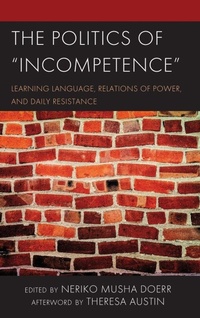
The Politics of Incompetence
Learning Language, Relations of Power, and Daily Resistance
Published on 24. June 2024
Book
Hardback
194 pages
978-1-6669-3623-0 (ISBN)
Description
"Incompetence" is not an objective state lacking competence nor a kind of deficiency that needs to be filled. Rather, it is a constructed state that is productive, working in tandem with its opposite, "competence." Perception of incompetence/competence works as what Michel Foucault (1977) calls a technology of "normalization" that pushes individuals to aspire to follow a shared norm, while hierarchically differentiating individuals according to their proximity to the aspired norm. The notion of incompetence is thus "productive" in that it turns individuals into specific kinds of "subjects" (Foucault 1977). The Politics of "Incompetence": Learning Language, Relations of Power, and Daily Resistance further investigates other productive processes around the perception of "incompetence" specifically through its intersections with various ideologies-"academic achievement," teacher-student hierarchy, "native speaker" ideology, normative unit thinking, and privilege of vulnerability-as such intersections generate new knowledge, new reflection on one's assumptions and privilege, new space for marginalized language, and more. This volume opens up a new area of study-productive cultural politics of "incompetence"-by focusing on language learning in diverse contexts: Japanese as a Foreign Language classrooms in US colleges, Italian language tourism in Italy, and indigenous Maori language revitalization at an Aotearoa/New Zealand school.
Reviews / Votes
Recognizing that ideologies of language are embedded in second language instruction, the contributors to this deeply thoughtful collection ask us to consider 'incompetence' in a new way. The authors challenge readers to move beyond the usual instrumental goal of teaching language as a static, abstract object to be mastered by urging us to value idiosyncratic and messy language learning experiences. Detailed case studies from different ethnographic contexts forward the argument that language learning is a journey that should engage with forms of incompetence as a productive resource. -- Laura Miller, University of Missouri-St. LouisMore details
Language
English
Place of publication
United States
Publishing group
Bloomsbury Publishing Plc
Target group
Professional and scholarly
Illustrations
1 BW Illustration, 1 Table
Dimensions
Height: 235 mm
Width: 157 mm
Thickness: 15 mm
Weight
443 gr
ISBN-13
978-1-6669-3623-0 (9781666936230)
Copyright in bibliographic data and cover images is held by Nielsen Book Services Limited or by the publishers or by their respective licensors: all rights reserved.
Schweitzer Classification
Other editions
Additional editions
Neriko Musha Doerr
The Politics of Incompetence
Learning Language, Relations of Power, and Daily Resistance
E-Book
06/2024
1st Edition
Lexington Books
€90.99
Available for download
Persons
Content
Introduction: Incompetence and Power by Neriko Musha Doerr, Yuri Kumagai, and Cori Jakubiak
Chapter 1: Identities of (In-)Competence and Plurilingual Repertoires: Three Stories of Digital Storytelling in a Japanese Language Classroom by Keiko Konoeda
Chapter 2: "Incompetence" as a Productive Force for Making the Invisible Visible: Linguistic Landscapes Project as a Dialogic Space in a Japanese Language Classroom by Yuri Kumagai with Yuko Takahashi
Chapter 3: Discourse of Incompetence, Unit Thinking, and Uses and Risks of the Translanguaging Framework: Language Politics in Aotearoa/New Zealand by Neriko Musha Doerr
Chapter 4: Studying La Bella Lingua as an Edu-Tourist: An Auto-Ethnographic Account of (In)competence by Cori Jakubiak
Afterword: Towards Understanding Production and Perceptions of (In)Competence by Theresa Austin
Chapter 1: Identities of (In-)Competence and Plurilingual Repertoires: Three Stories of Digital Storytelling in a Japanese Language Classroom by Keiko Konoeda
Chapter 2: "Incompetence" as a Productive Force for Making the Invisible Visible: Linguistic Landscapes Project as a Dialogic Space in a Japanese Language Classroom by Yuri Kumagai with Yuko Takahashi
Chapter 3: Discourse of Incompetence, Unit Thinking, and Uses and Risks of the Translanguaging Framework: Language Politics in Aotearoa/New Zealand by Neriko Musha Doerr
Chapter 4: Studying La Bella Lingua as an Edu-Tourist: An Auto-Ethnographic Account of (In)competence by Cori Jakubiak
Afterword: Towards Understanding Production and Perceptions of (In)Competence by Theresa Austin