

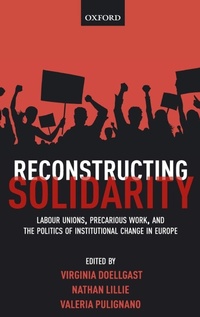
Reconstructing Solidarity
Labour Unions, Precarious Work, and the Politics of Institutional Change in Europe
Published on 18. January 2018
Book
Hardback
270 pages
978-0-19-879184-3 (ISBN)
Description
Work is widely thought to have become more precarious. Many people feel that unions represent the interests of protected workers in good jobs at the expense of workers with insecure employment, low pay, and less generous benefits. Reconstructing Solidarity: Labour Unions, Precarious Work, and the Politics of Institutional Change in Europe argues the opposite: that unions try to represent precarious workers using a variety of creative campaigning and organizing tactics.
Where unions can limit employers' ability to 'exit' labour market institutions and collective agreements, and build solidarity across different groups of workers, this results in a virtuous circle, establishing union control over the labour market. Where they fail to do so, it sets in motion a vicious circle of expanding precarity based on institutional evasion by employers. Reconstructing Solidarity examines how unions build, or fail to build, inclusive worker solidarity to challenge this vicious circle and to re-regulate increasingly precarious jobs. Comparative case studies from fourteen European countries describe the struggles of workers and unions in industries such as local government, retail, music, metalworking, chemicals, meat packing, and logistics. Their findings argue against the thesis that unions act primarily to protect labour market insiders at the expense of outsiders.
Where unions can limit employers' ability to 'exit' labour market institutions and collective agreements, and build solidarity across different groups of workers, this results in a virtuous circle, establishing union control over the labour market. Where they fail to do so, it sets in motion a vicious circle of expanding precarity based on institutional evasion by employers. Reconstructing Solidarity examines how unions build, or fail to build, inclusive worker solidarity to challenge this vicious circle and to re-regulate increasingly precarious jobs. Comparative case studies from fourteen European countries describe the struggles of workers and unions in industries such as local government, retail, music, metalworking, chemicals, meat packing, and logistics. Their findings argue against the thesis that unions act primarily to protect labour market insiders at the expense of outsiders.
Reviews / Votes
[Reconstructing Solidarity] is an important contribution to our understanding of trade union solidarity under institutional change in Europe. Its theoretical approach is one of its main strengths. On an interdisciplinary basis, the authors combine the comparative employment relations literature with that of comparative political economy and critical sociology. * Teresa Cappiali, Lund University, Transfer * A noteworthy feature of the overview chapter is a chart that summarizes-for main outcomes and comparative findings-the nine research-based chapters of the book. The chapters are rich in the variety of research focus yet the coeditors manage to pull them all into their ambitious comparative framework. * ILR Review *More details
Language
English
Place of publication
Oxford
United Kingdom
Target group
College/higher education
Professional and scholarly
Dimensions
Height: 240 mm
Width: 161 mm
Thickness: 19 mm
Weight
573 gr
ISBN-13
978-0-19-879184-3 (9780198791843)
Copyright in bibliographic data and cover images is held by Nielsen Book Services Limited or by the publishers or by their respective licensors: all rights reserved.
Schweitzer Classification
Other editions
Additional editions

Virginia Doellgast | Nathan Lillie | Valeria Pulignano
Reconstructing Solidarity
Labour Unions, Precarious Work, and the Politics of Institutional Change in Europe
E-Book
01/2018
1st Edition
OUP eBook
€37.99
Available for download

Virginia Doellgast | Nathan Lillie | Valeria Pulignano
Reconstructing Solidarity
Labour Unions, Precarious Work, and the Politics of Institutional Change in Europe
E-Book
01/2018
1st Edition
OUP eBook
€37.99
Available for download
Persons
Virginia Doellgast is Associate Professor of Comparative Employment Relations at Cornell University's School of Industrial and Labor Relations. Her research focuses on the impact of collective bargaining and labour market institutions on inequality, job quality, and worker voice. Past projects include comparative studies of organizational and work restructuring in the European and US telecommunications and call centre industries. She is the author of Disintegrating Democracy at Work: Labor Unions and the Future of Good Jobs in the Service Economy (Cornell University Press, 2012).
Nathan Lillie is Professor of Social and Public Policy at the University of Jyvaeskylae, Finland. His research relates to migration and posted work, free movement in the European Union, and trade union strategies. Past projects include an ERC-funded multi-country study on industrial relations around posted work. In his current project, Protecting Mobility through Improving Labour Rights Enforcement in Europe, he is working together with stakeholders on improving labour protection and access to industrial democracy for posted workers.
Valeria Pulignano is Professor in Sociology of Labour and Industrial Relations, and Scientific Coordinator of CESO at KU Leuven. Her research focuses on the changing nature of employment (industrial) relations and labour markets and its implication for workers voices. She examined the transformations of labour markets and employment (industrial) relations and its impact on workers' representation, working conditions, and job quality in Europe. Projects include change in production and work organization in the auto industry; transnational labour coordination and solidarity; employment relationships in MNCs; corporate restructuring and trade unions; flexibility and employment security; and dualisation and inequality in labour markets. She co-edited (with James Arrowsmith) The Transformation of Employment Relationships (Routledge, 2013).
Nathan Lillie is Professor of Social and Public Policy at the University of Jyvaeskylae, Finland. His research relates to migration and posted work, free movement in the European Union, and trade union strategies. Past projects include an ERC-funded multi-country study on industrial relations around posted work. In his current project, Protecting Mobility through Improving Labour Rights Enforcement in Europe, he is working together with stakeholders on improving labour protection and access to industrial democracy for posted workers.
Valeria Pulignano is Professor in Sociology of Labour and Industrial Relations, and Scientific Coordinator of CESO at KU Leuven. Her research focuses on the changing nature of employment (industrial) relations and labour markets and its implication for workers voices. She examined the transformations of labour markets and employment (industrial) relations and its impact on workers' representation, working conditions, and job quality in Europe. Projects include change in production and work organization in the auto industry; transnational labour coordination and solidarity; employment relationships in MNCs; corporate restructuring and trade unions; flexibility and employment security; and dualisation and inequality in labour markets. She co-edited (with James Arrowsmith) The Transformation of Employment Relationships (Routledge, 2013).
Editor
Associate Professor of Comparative Employment RelationsAssociate Professor of Comparative Employment Relations, The ILR School, Cornell University, USA
Professor of Social and Public Policy, Department of Social Sciences and PhilosophyProfessor of Social and Public Policy, Department of Social Sciences and Philosophy, University of Jyvaeskylae, Finland
Professor of Sociology of Labour and Industrial RelationsProfessor of Sociology of Labour and Industrial Relations, Centre for Sociological Research, KU Leuven, Belgium
Content
1: Virginia Doellgast, Nathan Lillie, and Valeria Pulignano: From dualization to solidarity: Halting the cycle of precarity
2: Damian Grimshaw, Stefania Marino, Dominique Anxo, Jerome Gautie, Laszlo Neumann and Claudia Weinkopf: Negotiating better conditions for workers during austerity in Europe: Unions' local strategies towards low pay and outsourcing in local government
3: Ines Wagner and Bjarke Refslund: Cutting to the bone: Workers' solidarity in the Danish-German slaughterhouse industry
4: Carlotta Benvegnu, Bettina Haidinger, and Devi Sacchetto: Restructuring labour relations and employment in the European logistics sector: Unions' responses to a segmented workforce
5: Valeria Pulignano and Nadja Doerflinger: Labour markets, solidarity and precarious work: Comparing local unions' responses to management flexibility strategies in the German and Belgian metalworking and chemical industries
6: Chiara Benassi and Lisa Dorigatti: The political economy of agency work in Italy and Germany: Explaining diverging trajectories in collective bargaining outcomes
7: Adam Mrozowicki, Branko Bembic, Kairit Kall, Malgorzata Maciejewska, and Miroslav Stanojevic: Union campaigns against precarious work in the retail sector of Estonia, Poland, and Slovenia
8: Ian Greer, Barbara Samaluk, and Charles Umney: Better strategies for herding cats? Forms of solidarity among freelance musicians in London, Paris and Ljubljana
9: Maite Tapia and Jane Holgate: Fighting precariousness: Union strategies towards migrant workers in the UK, France, and Germany
10: Sonila Danaj, Erka Caro, Laura Mankki, Markku Sippola, and Nathan Lillie: Unions and Migrant Workers: The Perspective of Estonians in Finland and Albanians in Italy and Greece
11: Steven Vallas: Conclusions. The Puzzle of Precarity: Structure, Strategies, and Worker Solidarity
2: Damian Grimshaw, Stefania Marino, Dominique Anxo, Jerome Gautie, Laszlo Neumann and Claudia Weinkopf: Negotiating better conditions for workers during austerity in Europe: Unions' local strategies towards low pay and outsourcing in local government
3: Ines Wagner and Bjarke Refslund: Cutting to the bone: Workers' solidarity in the Danish-German slaughterhouse industry
4: Carlotta Benvegnu, Bettina Haidinger, and Devi Sacchetto: Restructuring labour relations and employment in the European logistics sector: Unions' responses to a segmented workforce
5: Valeria Pulignano and Nadja Doerflinger: Labour markets, solidarity and precarious work: Comparing local unions' responses to management flexibility strategies in the German and Belgian metalworking and chemical industries
6: Chiara Benassi and Lisa Dorigatti: The political economy of agency work in Italy and Germany: Explaining diverging trajectories in collective bargaining outcomes
7: Adam Mrozowicki, Branko Bembic, Kairit Kall, Malgorzata Maciejewska, and Miroslav Stanojevic: Union campaigns against precarious work in the retail sector of Estonia, Poland, and Slovenia
8: Ian Greer, Barbara Samaluk, and Charles Umney: Better strategies for herding cats? Forms of solidarity among freelance musicians in London, Paris and Ljubljana
9: Maite Tapia and Jane Holgate: Fighting precariousness: Union strategies towards migrant workers in the UK, France, and Germany
10: Sonila Danaj, Erka Caro, Laura Mankki, Markku Sippola, and Nathan Lillie: Unions and Migrant Workers: The Perspective of Estonians in Finland and Albanians in Italy and Greece
11: Steven Vallas: Conclusions. The Puzzle of Precarity: Structure, Strategies, and Worker Solidarity