

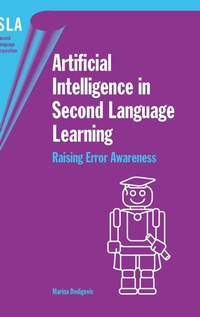
Artificial Intelligence in Second Language Learning
Raising Error Awareness
Published on 7. October 2005
Book
Hardback
312 pages
978-1-85359-830-2 (ISBN)
Description
This volume argues that adults can learn English as a second language if their typical errors are corrected systematically and in line with their preferred style of learning. The remedy designed for this purpose relies on artificial intelligence. The book describes original research which demonstrates the success of this approach.
Reviews / Votes
"The book treats a fascinating topic in a unique manner in the way it combines all the fields related to Computer Assisted Language Learning. It will be a valuable contribution to the field." -- Dr Christine Appel, Lecturer, Dublin City University, Ireland The most praise-worthy aspect of Dodigovic's book is that it provides a comprehensive overview of theoretical issues and concepts of the interface of artificial intelligence and second language learning. It is noteworthy that this is the first comprehensive, single-authored book in the cross-disciplinary field of NLP and CALL. Dodigovic not only covers a vast amount of related and relevant research, but also provides her own studies on which she bases her analysis and the development and particular design of the artificially intelligent system that is being introduced in this book. This volume is certainly a must-read for anyone interested in cross-disciplinary research of language learning and artificial intelligence. -- Trude Heift, Simon Fraser University * ReCALL, Volume 18/2, 2006 * The book is a very comprehensive, detailed and interdisciplinary account of the Research and Development process of a successful example of Intelligent CALL software. The field of CALL can benefit to a great extent from sound research-based and pedagogically-driven projects such as the one described here. Books such as this will no doubt help us ascertain which areas of language learning are most successfully dealt with by the use of CALL technologies. -- Rafael Seiz Ortiz, Universidad Politecnica de Valencia, Spain * EUROCALL Newsletter, Issue No. 10, September 2006 * The author manages to cover the diverse topics in a successful and engaging manner. -- Monica Ward * Computer Assisted Language Learning, Oct 2005, Vol. 18 Issue 4 *More details
Series
Language
English
Place of publication
Bristol
United Kingdom
Publishing group
Channel View Publications Ltd
Target group
Professional and scholarly
Dimensions
Height: 240 mm
Width: 161 mm
Thickness: 21 mm
Weight
637 gr
ISBN-13
978-1-85359-830-2 (9781853598302)
Copyright in bibliographic data and cover images is held by Nielsen Book Services Limited or by the publishers or by their respective licensors: all rights reserved.
Schweitzer Classification
Other editions
Additional editions
Book
10/2005
Multilingual Matters
€48.70
Shipment within 10-20 days
E-Book
10/2005
1st Edition
Multilingual Matters
€24.49
Available for download
Complete work / Part of the work

David Singleton | Simone E. Pfenninger
Second Language Acquisition Collection (Vols 1-20)
Book
Multilingual Matters
€1,032.48
The article will not be published
Person
Dr Marina Dodigovic is an assistant professor of English and TESOL at the American University of Sharjah. She has worked both as an academic in English and applied linguistics and as a computer programmer. Her research interests include Computer Assisted Language Learning (CALL), academic English and the analysis of learner needs. She has synthesised her skills in these areas to become an author and developer in CALL, with several software packages, a book and a number of other publications in her name.
Content
Acknowledgements
Introduction
1 Can Another Language Be Learnt?
2 Where Does Research End and CALL Development Begin?
3 Why the Web?
4 Can Computers Correct Language Errors?
5 How to Develop an Artificially Intelligent Language Tutor?
6 How Does it Work?
Conclusion
Appendices
Bibliography
Index
Introduction
1 Can Another Language Be Learnt?
2 Where Does Research End and CALL Development Begin?
3 Why the Web?
4 Can Computers Correct Language Errors?
5 How to Develop an Artificially Intelligent Language Tutor?
6 How Does it Work?
Conclusion
Appendices
Bibliography
Index