

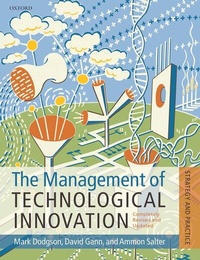
The Management of Technological Innovation
Strategy and Practice
Published on 7. February 2008
Book
Paperback/Softback
408 pages
978-0-19-920853-1 (ISBN)
Description
The management of technological innovation (MTI) is one of the most important challenges facing businesses today. Innovation has become the fundamental driver of competitiveness for firms of all sizes in virtually all business sectors and nations.
The first edition of this book has become one of the most popular texts for students of innovation and technology management. This new edition sees David Gann and Ammon Salter join Mark Dodgson as authors, drawing on their combined experience of 60 years of researching and teaching MTI. It combines the most relevant theoretical analysis with contemporary and historical empirical evidence to provide a comprehensive, yet concise and readable, guide to the challenges of MTI.
By explaining the innovation process the book reveals the broad scope of MTI and its importance for company survival, growth and sustainability. It describes how MTI has to be managed strategically and how this is successfully achieved by formulating and implementing strategy and delivering value. Chapters provide frameworks, tools and techniques, and case studies on managing: innovation strategy, communities, and networks, R&D, design and new product and service development, operations and production, and commercialization.
Based on robust analysis, the book provides a wide range of empirical evidence from a huge diversity of case studies, with around fifty case studies newly written for this edition. It analyses MTI in all parts of the world, in companies large and small, and in services, manufacturing, and resource-based business sectors.
This new edition has been fully revised and updated to reflect the latest teaching and research, and to ensure its continuing relevance to the contemporary world of MTI. It will be an important resource for academics, students, and managers throughout the world, is a recommended text for students of innovation and technology management at postgraduate and undergraduate level, and is particularly valuable for MBA courses.
The first edition of this book has become one of the most popular texts for students of innovation and technology management. This new edition sees David Gann and Ammon Salter join Mark Dodgson as authors, drawing on their combined experience of 60 years of researching and teaching MTI. It combines the most relevant theoretical analysis with contemporary and historical empirical evidence to provide a comprehensive, yet concise and readable, guide to the challenges of MTI.
By explaining the innovation process the book reveals the broad scope of MTI and its importance for company survival, growth and sustainability. It describes how MTI has to be managed strategically and how this is successfully achieved by formulating and implementing strategy and delivering value. Chapters provide frameworks, tools and techniques, and case studies on managing: innovation strategy, communities, and networks, R&D, design and new product and service development, operations and production, and commercialization.
Based on robust analysis, the book provides a wide range of empirical evidence from a huge diversity of case studies, with around fifty case studies newly written for this edition. It analyses MTI in all parts of the world, in companies large and small, and in services, manufacturing, and resource-based business sectors.
This new edition has been fully revised and updated to reflect the latest teaching and research, and to ensure its continuing relevance to the contemporary world of MTI. It will be an important resource for academics, students, and managers throughout the world, is a recommended text for students of innovation and technology management at postgraduate and undergraduate level, and is particularly valuable for MBA courses.
Reviews / Votes
...an excellent account of the main tools and techniques involved in managing 21st century innovation processes. It is essential reading for anyone getting a business degree as well as those on executive courses. * Irving Wladawsky-Berger, IBM * Not only is this an excellent text for students, it also provides deep practical understanding for managers in business * Malcolm Skingle, GSK * This book provides an essential reference point for students and those on executive development courses, showing how managing innovation unlocks future prosperity - as well as creating fun and vibrancy in the workplace. * Ray O'Rourke, Chairman and CEO, Laing O'Rourke * Dodgson, Gann, and Salter have written the first indispensable innovation textbook for the 21st century. It combines advanced tools and techniques on managing open, distributed innovation processes, along with the latest on intellectual property and public policy, * Professor Henry Chesbrough, author of the bestselling books, Open Innovation and Open Business Models, Haas School of Business, UC Berkeley * This is an outstanding book which gives the management of innovation its rightful role in understanding modern capitalism and its restless nature. Everyone who is interested in the theory and practice of technological innovation should place this book on their reading list. * Professor Stan Metcalfe, University of Manchester *More details
Edition
Revised edition
Language
English
Place of publication
Oxford
United Kingdom
Target group
Professional and scholarly
Edition type
Revised edition
Illustrations
numerous figures and tables
Dimensions
Height: 245 mm
Width: 188 mm
Thickness: 22 mm
Weight
779 gr
ISBN-13
978-0-19-920853-1 (9780199208531)
Copyright in bibliographic data and cover images is held by Nielsen Book Services Limited or by the publishers or by their respective licensors: all rights reserved.
Schweitzer Classification
Other editions
Additional editions
Mark Dodgson | David M. Gann | Ammon Salter
The Management of Technological Innovation
Strategy and Practice
Book
02/2008
Oxford University Press
€220.30
Shipment within 15-20 days
Previous edition
Book
07/2000
Oxford University Press
€105.23
Article exhausted; check for reprint
Persons
Mark Dodgson is Director of the Technology and Innovation Management Centre at University of Queensland Business School and Visiting Professor at Imperial College Business School London.
He was previously Senior Fellow at the Science and Technology Policy Research Unit at the University of Sussex (1985-93), and Professor of Management and Executive Director of the National Graduate School of Management at the Australian National University (1993-2002).
Mark is a Fellow of the Royal Society of Arts and the Academy of the Social Sciences in Australia. He is an International Fellow at the UK's Advanced Institute of Management Research.
He is the author of 10 books on innovation management and policy. Mark is a member of the Editorial Board of 8 academic journals, including Research Policy.
Mark is a Director of the TPD Group.
David Gann heads the Innovation and Entrepreneurship Group at Tanaka Business School (TBS), Imperial College London. He holds the Chair in Innovation and Technology Management jointly at TBS and the Department of Civil and Environmental Engineering. He is responsible for a large research portfolio, with many projects involving collaborative agreements with firms and organisations in design, manufacturing, engineering, construction, ICT services and healthcare industries. He is Director of the EPSRC funded Innovation Studies Centre and the Innovation and Productivity Grand Challenge.
David is a member of the Advisory Panels of Computer Science Corporation and Laing O'Rourke. He is Chairman of the Think Play Do Group a spin-out company from Imperial College and University of Queensland. He holds an Honorary Professorship at the University of Queensland and is Visiting Professor at Southampton University. David is a Fellow of the Royal Society of Arts.
Ammon Salter is a Reader at the Tanaka Business School, Imperial College London and a Ghoshal Research Fellow of the Advanced Institute of Management Research. He is the co-director of the EPSRC-funded Innovation Studies Centre. He holds a D.Phil. in Science and Technology Policy from SPRU - Science and Technology Policy Research at the University of Sussex. He worked at SPRU from 1998 to 2002, as part of the Complex Products and Systems Research Centre (CoPS).
Ammon's research has been sponsored by variety of governments, including HM Treasury, the Department of Trade and Industry, the European Commission, the Russell Group of Universities, and the Ove Arup Foundation. He also has worked closely with a range of industrial organizations, including Sun Microsystems, Arup, Ricardo and Atkins. He has published in a wide range of leading journals, including the Cambridge Journal of Economics, Strategic Management Journal, Industrial and Corporate Change and Research Policy.
He was previously Senior Fellow at the Science and Technology Policy Research Unit at the University of Sussex (1985-93), and Professor of Management and Executive Director of the National Graduate School of Management at the Australian National University (1993-2002).
Mark is a Fellow of the Royal Society of Arts and the Academy of the Social Sciences in Australia. He is an International Fellow at the UK's Advanced Institute of Management Research.
He is the author of 10 books on innovation management and policy. Mark is a member of the Editorial Board of 8 academic journals, including Research Policy.
Mark is a Director of the TPD Group.
David Gann heads the Innovation and Entrepreneurship Group at Tanaka Business School (TBS), Imperial College London. He holds the Chair in Innovation and Technology Management jointly at TBS and the Department of Civil and Environmental Engineering. He is responsible for a large research portfolio, with many projects involving collaborative agreements with firms and organisations in design, manufacturing, engineering, construction, ICT services and healthcare industries. He is Director of the EPSRC funded Innovation Studies Centre and the Innovation and Productivity Grand Challenge.
David is a member of the Advisory Panels of Computer Science Corporation and Laing O'Rourke. He is Chairman of the Think Play Do Group a spin-out company from Imperial College and University of Queensland. He holds an Honorary Professorship at the University of Queensland and is Visiting Professor at Southampton University. David is a Fellow of the Royal Society of Arts.
Ammon Salter is a Reader at the Tanaka Business School, Imperial College London and a Ghoshal Research Fellow of the Advanced Institute of Management Research. He is the co-director of the EPSRC-funded Innovation Studies Centre. He holds a D.Phil. in Science and Technology Policy from SPRU - Science and Technology Policy Research at the University of Sussex. He worked at SPRU from 1998 to 2002, as part of the Complex Products and Systems Research Centre (CoPS).
Ammon's research has been sponsored by variety of governments, including HM Treasury, the Department of Trade and Industry, the European Commission, the Russell Group of Universities, and the Ove Arup Foundation. He also has worked closely with a range of industrial organizations, including Sun Microsystems, Arup, Ricardo and Atkins. He has published in a wide range of leading journals, including the Cambridge Journal of Economics, Strategic Management Journal, Industrial and Corporate Change and Research Policy.
Author
Director, Technology and Innovation Management Centre, University of Queensland Business School, University of Queensland Business School
Head of Innovation and Entrepreneurship, Imperial College London
Professor of Technology and Innovation Management, Imperial College London; Research Director, UK Innovation Research Centre
Content
1. What is the Management of Technological Innovation and why is it Important? ; 2. The Business Context for Innovation ; 3. Technological Innovation ; 4. Innovation Strategy ; 5. Networks, Communities and Technological Collaboration ; 6. The Management of Research and Development ; 7. The Management of Product and Service Innovation ; 8. Innovation in Operations and Processes ; 9. Delivering Value from Innovation ; 10. Five Future Challenges