

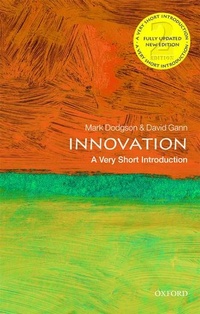
Innovation
A Very Short Introduction
2nd Edition
Published on 23. August 2018
Book
Paperback/Softback
176 pages
978-0-19-882504-3 (ISBN)
Description
What is innovation? How is innovation used in business? How can we use it to succeed?
Innovation, the ways ideas are made valuable, plays an essential role in economic and social development, and is an increasingly topical issue. Over the last 150 years our world has hit an accelerated rate of transformation. From aeroplanes to television and penicillin, and from radios to frozen food and digital money, the fruits of innovation surround us.
This Very Short Introduction looks at what innovation is and why it affects us so profoundly. It examines how it occurs, who stimulates it, how it is pursued, and what its outcomes are, both positive and negative. Considering innovation today, and discussing future disruptive technologies such as AI, which have important implications for work and employment, Mark Dodgson and David Gann consider the extent to which our understanding of innovation has developed over the past century and how it might be used to interpret the global economy.
ABOUT THE SERIES: The Very Short Introductions series from Oxford University Press contains hundreds of titles in almost every subject area. These pocket-sized books are the perfect way to get ahead in a new subject quickly. Our expert authors combine facts, analysis, perspective, new ideas, and enthusiasm to make interesting and challenging topics highly readable.
Innovation, the ways ideas are made valuable, plays an essential role in economic and social development, and is an increasingly topical issue. Over the last 150 years our world has hit an accelerated rate of transformation. From aeroplanes to television and penicillin, and from radios to frozen food and digital money, the fruits of innovation surround us.
This Very Short Introduction looks at what innovation is and why it affects us so profoundly. It examines how it occurs, who stimulates it, how it is pursued, and what its outcomes are, both positive and negative. Considering innovation today, and discussing future disruptive technologies such as AI, which have important implications for work and employment, Mark Dodgson and David Gann consider the extent to which our understanding of innovation has developed over the past century and how it might be used to interpret the global economy.
ABOUT THE SERIES: The Very Short Introductions series from Oxford University Press contains hundreds of titles in almost every subject area. These pocket-sized books are the perfect way to get ahead in a new subject quickly. Our expert authors combine facts, analysis, perspective, new ideas, and enthusiasm to make interesting and challenging topics highly readable.
Reviews / Votes
This is one of the most thoughtful, succinct and useful introductions to innovation I have read. * David Willetts, formerly UK Minister for Universities and Science, author of A University Education. *More details
Series
Edition
2nd Revised edition
Language
English
Place of publication
Oxford
United Kingdom
Target group
College/higher education
Edition type
Revised edition
Illustrations
11 black and white images
Dimensions
Height: 175 mm
Width: 114 mm
Thickness: 15 mm
Weight
131 gr
ISBN-13
978-0-19-882504-3 (9780198825043)
Copyright in bibliographic data and cover images is held by Nielsen Book Services Limited or by the publishers or by their respective licensors: all rights reserved.
Schweitzer Classification
Other editions
Additional editions
E-Book
08/2018
2nd Edition
OUP eBook
€9.49
Available for download
E-Book
08/2018
2nd Edition
OUP eBook
€9.49
Available for download
Previous edition
Book
03/2010
Oxford University Press
€9.89
Article exhausted; check for reprint
Persons
Mark Dodgson's research interests are in the areas of corporate strategies and govenment policies for technology and innovation. He has authored over 50 articles and book chapters, as well as written seven books. Mark is currently Professor of Innovation Studies at the University of Queensland.
David Gann, CBE, is Professor and Vice-President (Innovation) at Imperial College London, and is responsible for a large portfolio of research in collaboration with firms in design, manufacturing, engineering, and construction.
Together they edited The Oxford Handbook of Innovation Management, (OUP, 2014), with Nelson Phillips.
David Gann, CBE, is Professor and Vice-President (Innovation) at Imperial College London, and is responsible for a large portfolio of research in collaboration with firms in design, manufacturing, engineering, and construction.
Together they edited The Oxford Handbook of Innovation Management, (OUP, 2014), with Nelson Phillips.
Content
Preface
1: Josiah Wedgwood: the world's greatest innovator
2: Joseph Schumpeter's gales of creative destruction
3: London's wobbly bridge: learning from failure
4: Stephanie Kwolek's new polymer: from labs to riches
5: Thomas Edison's organizational genius
6: Innovating the future
References Further reading Index
1: Josiah Wedgwood: the world's greatest innovator
2: Joseph Schumpeter's gales of creative destruction
3: London's wobbly bridge: learning from failure
4: Stephanie Kwolek's new polymer: from labs to riches
5: Thomas Edison's organizational genius
6: Innovating the future
References Further reading Index