

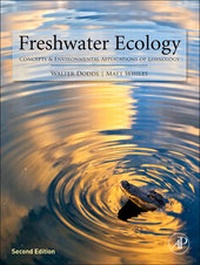
Freshwater Ecology
Concepts and Environmental Applications of Limnology
2nd Edition
Published on 3. November 2010
Book
Hardback
829 pages
978-0-12-374724-2 (ISBN)
Description
Freshwater Ecology, Second Edition, is a broad, up-to-date treatment of everything from the basic chemical and physical properties of water to advanced unifying concepts of the community ecology and ecosystem relationships as found in continental waters.With 40% new and expanded coverage, this text covers applied and basic aspects of limnology, now with more emphasis on wetlands and reservoirs than in the previous edition. It features 80 new and updated figures, including a section of color plates, and 500 new and updated references. The authors take a synthetic approach to ecological problems, teaching students how to handle the challenges faced by contemporary aquatic scientists.This text is designed for undergraduate students taking courses in Freshwater Ecology and Limnology; and introductory graduate students taking courses in Freshwater Ecology and Limnology.
Reviews / Votes
"[A] very good text, especially in terms of the biotic ecological processes that it covers. In many ways, this textbook provides a really refreshing blend of ecological concepts as they apply to aquatic ecology, in addition to the basic knowledge of freshwater ecosystem organisms that a student would need to apply the concepts... We think that it is a successful, innovative and, for the most part, modern view of the study of inland waters. As seems to be the case with many current texts, this one makes full use of a variety of presentation methods: boxes, biographies, methods boxes and sidebars (which, incidentally, are not on the side). Some are more successful than others. Each chapter also ends with summary points to guide students but, more interestingly, with a series of questions. We found that most of these questions were quite useful and thought-provoking. As in much of ecology, they were often open to a variety of answers and we felt that they would be useful for promoting discussion amongst students. The authors are both primarily stream ecologists and one can often sense greater enthusiasm from them when lotic processes and organisms are discussed. Certain concepts (e.g. disturbance, fish and invertebrate ecology) are explored in greater detail, probably reflecting the authors' backgrounds and interests. However, that said, the discussion of lentic environments is not short-changed and this text would serve any general undergraduate limnology course very well. In fact, in some ways this bias has enabled the authors to provide a refreshing and balanced look at the field, as many older texts have a lake-centric focus." -- Limnology and Oceanography Bulletin, March 2011More details
Series
Edition
2nd edition
Language
English
Place of publication
San Diego
United States
Publishing group
Elsevier Science Publishing Co Inc
Target group
College/higher education
Professional and scholarly
Undergraduate students taking courses in Freshwater Ecology and Limnology
Introductory graduate students taking courses in Freshwater Ecology and Limnology
Dimensions
Height: 235 mm
Width: 191 mm
Weight
1580 gr
ISBN-13
978-0-12-374724-2 (9780123747242)
Copyright in bibliographic data and cover images is held by Nielsen Book Services Limited or by the publishers or by their respective licensors: all rights reserved.
Schweitzer Classification
Other editions
New editions
Walter K. Dodds | Matt R. Whiles
Freshwater Ecology
Concepts and Environmental Applications of Limnology
Book
06/2019
3rd Edition
Academic Press
€127.50
Shipment within 15-20 days
Additional editions
Walter K. Dodds | Matt R. Whiles
Freshwater Ecology
Concepts and Environmental Applications of Limnology
Book
10/2017
2nd Edition
Academic Press
€75.63
The article will not be published
Walter K. Dodds | Matt R. Whiles
Freshwater Ecology
Concepts and Environmental Applications of Limnology
E-Book
11/2010
2nd Edition
Academic Press
€71.95
Available for download
Previous edition
Book
03/2002
Academic Press
€88.04
Article exhausted; check for reprint
Persons
Walter. K. Dodds received his Ph.D. in Biology in 1986 from the University of Oregon. From 1987 to 1990 he was a post doctoral fellow in the Department of Biology at Montana State University. In 1990 he accepted an Assistant Professor position in the Division of Biology at Kansas State University, in 1995 he was promoted to Associate Professor and in 2002 to full Professor. Over the years, Dodds has taught Limnology, Advanced Aquatic Ecology, Microbial Ecology, Principles of Biology, Conservation Biology, Environmental Problems, Origins of Life, Herbivory, Presentations in Ecology, Aquatic Ecology, Stream Ecology, Algal Identification, Algal Ecology, Bacteriology and Freshwater Biology. He has professional memberships in the American Association for the Advancement of Science, the American Society of Limnology and Oceanography, the American Society of Microbiology, the North American Benthological Society, the Phycological Society of America and Sigma Xi. Dodds has grants from agencies including the National Science Foundation, the United States Environmental Protection Agency, the United States Geological Survey, the Kansas Department of Wildlife and Parks and the Kansas Department of Health and Environment. He has been involved in the Konza Prairie Long-Term Ecological Research (LTER) program and provides leadership for the Konza LTER Aquatic and Hydrological Group and the Konza LTER Research Experience for Undergraduates program.
Dodds' recent research has focused on Aquatic Ecology on Konza Prairie, Nitrogen Uptake Retention and Cycling in Stream Ecosystems, Quality and Quantity of Suspended Solids in Kansas Rivers, and Nutrients and Algae in Streams. Dodds has been invited to present seminars at over 20 US agencies and universities, as well as agencies and universities in Australia, New Zealand and Canada. He has presented at numerous national and international scientific conferences and has produced over 80 peer reviewed publications.
Dodds' recent research has focused on Aquatic Ecology on Konza Prairie, Nitrogen Uptake Retention and Cycling in Stream Ecosystems, Quality and Quantity of Suspended Solids in Kansas Rivers, and Nutrients and Algae in Streams. Dodds has been invited to present seminars at over 20 US agencies and universities, as well as agencies and universities in Australia, New Zealand and Canada. He has presented at numerous national and international scientific conferences and has produced over 80 peer reviewed publications.
Content
Why Study Continental Aquatic Systems? ; Properties of Water; Movement of Light, Heat, and Chemicals in Water; Hydrology and Physiography of Groundwater Habitats; Hydrology and Physiography of Wetland Habitats; Physiography of Flowing Water; Lakes and Reservoirs: Physiography; Types of Aquatic Organisms; Microbes and Plants Chapter 10. Multicellular Animals ; Evolution and Biodiversity of Freshwaters; Aquatic Chemistry Controlling Nutrient Cycling: Redox and O2; Nitrogen, Sulfur, Phosphorus, and Other Nutrients; Response to Stress, Toxic Chemicals and Other Pollutants on Aquatic Ecosystems; Unusual or Extreme Habitats and Related Human Stressors; Remineralization; Trophic State and Eutrophication; Behavior and Interactions Among Microorganisms and Invertebrates; Predation and Food Webs; Nonpredatory Interspecific Interactions Among Plants and Animals in Freshwater Communities; Complex Community Interactions ; Fish Ecology And Fisheries ; Freshwater Ecosystem; Conclusions ; Glossary; Appendix: Experimental Design in Aquatic Ecology