

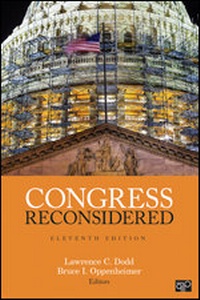
Congress Reconsidered
11th Edition
Published on 2. March 2017
Book
Paperback/Softback
536 pages
978-1-5063-2878-2 (ISBN)
Description
For almost four decades, the editors of Congress Reconsidered, Lawrence C. Dodd and Bruce I. Oppenheimer have delivered the best contemporary work from leading congressional scholars in a form that is both challenging and accessible. The tradition continues in this Eleventh Edition as contributing authors focus on the many ways Congress has changed over time and examine the conditions that foster these developments. Simply put, this bestselling volume remains on the cutting edge of scholarship, identifying patterns of change in Congress and placing those patterns in context.
Reviews / Votes
"For seasoned congressional scholars and beginners alike, Congress Reconsidered once again offers essential insights that place the contemporary Congress in political context. This book effectively situates Congress at the nexus of virtually every major topic in American politics, from elections to campaign finance, inter-branch politics, partisanship, representation, and public policy-making. It is, in short, an indispensable resource for making sense of American politics in an era of political upheaval." -- Walter Wilson "Congress Reconsidered is always relevant, as the authors shift the focus of each edition to include chapters that cover the latest emphases of scholarly research on the institution. This text has no equal when it comes to a set of articles that inform students about Congress, research on the topic, and challenges confronted by the legislative branch." -- Charles S. Bullock "Congress Reconsidered is the best text of its kind. Every article and chapter in the book helps convey to students that Congress is more than just the group of people they see on TV. Students are often amazed at the breadth of scholarship on Congress and, through this book, come to understand how it is constrained and influenced by other institutions." -- Rob Mellen Jr. "This edited volume is chock-full of thoughtful, empirically-minded essays by respected congressional scholars. It would be difficult to construct a text that is more effective than Dodd and Oppenheimer's in offering such accessible but serious treatments of contemporary issues in the U.S. Congress." -- Barry BurdenMore details
Edition
11th Revised edition
Language
English
Place of publication
Washington
United States
Publishing group
SAGE Publications Inc
Target group
College/higher education
Edition type
Revised edition
Dimensions
Height: 229 mm
Width: 152 mm
Weight
639 gr
ISBN-13
978-1-5063-2878-2 (9781506328782)
Copyright in bibliographic data and cover images is held by Nielsen Book Services Limited or by the publishers or by their respective licensors: all rights reserved.
Schweitzer Classification
Other editions
Previous edition
Lawrence C. Dodd | Bruce I. Oppenheimer
Congress Reconsidered
Book
02/2013
10th Edition
CQ Press
€84.38
Article exhausted; check for reprint
Persons
Lawrence C. Dodd holds the Manning J. Dauer Eminent Scholar Chair in Political Science at the University of Florida. His books include Coalitions in Parliamentary Government (1976), Congress and the Administrative State (coauthored with Richard Schott, 1979), The Dynamics of American Politics (coedited with Cal Jillson, 1994), Learning Democracy (coauthored with Leslie E. Anderson, 2005), and Thinking About Congress (2012). His articles have appeared in the American Political Science Review, Journal of Politics, Polity, Journal of Democracy, and elsewhere. Dodd has served as a congressional fellow, Hoover national fellow, and Woodrow Wilson Center fellow; president of the Southern and Southwestern Political Science Associations; and chair of the APSA's Legislative Studies Section.
Bruce I. Oppenheimer is professor of political science at Vanderbilt University and director of the Center for the Study of Democratic Institutions. He has been a Brookings fellow in Governmental Studies (1970-1971) and an APSA congressional fellow (1974-1975). He is author of Oil and the Congressional Process: The Limits of Symbolic Politics (1974). His book Sizing Up the Senate: The Unequal Consequences of Equal Representation (1999), cowritten with Frances Lee, was awarded the Lyndon Baines Johnson Foundation's D. B. Hardeman Prize for the best book on Congress. He is also the editor of U.S. Senate Exceptionalism (2002) and the author of numerous articles. His recent research focuses on Congress and energy policy and on variation in competition in open-seat House primaries.
Bruce I. Oppenheimer is professor of political science at Vanderbilt University and director of the Center for the Study of Democratic Institutions. He has been a Brookings fellow in Governmental Studies (1970-1971) and an APSA congressional fellow (1974-1975). He is author of Oil and the Congressional Process: The Limits of Symbolic Politics (1974). His book Sizing Up the Senate: The Unequal Consequences of Equal Representation (1999), cowritten with Frances Lee, was awarded the Lyndon Baines Johnson Foundation's D. B. Hardeman Prize for the best book on Congress. He is also the editor of U.S. Senate Exceptionalism (2002) and the author of numerous articles. His recent research focuses on Congress and energy policy and on variation in competition in open-seat House primaries.
Content
Part I: Patterns and Dynamics of Congressional Change
Chapter 1: The New World of U.S. Senators - Barbara Sinclair
Chapter 2: Lending and Reclaiming Power: Majority Leadership in the House Since the 1950s - John H. Aldrich and David W. Rohde
Part II: Elections and Constituencies
Chapter 3: Voters, Candidates and Issues in Congressional Elections - Robert S. Erikson and Gerald C. Wright
Chapter 4: Partisanship, Money, and Competition: Elections and the Transformation of Congress since the 1970s - Gary C. Jacobson
Chapter 5: Constituency Representation in Congress: In General and in Periods of Higher and Lower Partisan Polarization - Soren Jordan, Kim Quaile Hill, and Patricia A. Hurley
Chapter 6: Black-Latino Relations in Congress: Examining Institutional Context and Inter-Minority Group Relations - Rodney Hero and Robert H. Preuhs
Part III: Parties and Committees
Chapter 7: The Dynamics of Party Government in Congress - Steven S. Smith and Gerald Gamm
Chapter 8: Legislating in Polarized Times - Sarah Binder
Chapter 9: Legislative Effectiveness and Problem Solving in the U.S. House of Representatives - Craig Volden and Alan E. Wiseman
Chapter 10: Filibusters and Majority Rule in the Modern Senate - Gregory Koger
Part IV: Congress, the President, and Public Policy
Chapter 11: Is Advice and Consent Broken? The Contentious Politics of Selecting Federal Judges and Justices - Sarah Binder and Forrest Maltzman
Chapter 12: ANWR and CAFE: Frustrating Energy Production and Conservation Initiatives in Congress over Three Decades - Bruce I. Oppenheimer
Chapter 13: The Endurance of Non-Partisanship in House Appropriations - Peter C. Hanson
Chapter 14: Congress, Public Opinion, and the Political Costs of Waging War - Douglas Kriner
Chapter 15: The Balance of Power Between the Congress and the President: Issues and Dilemmas - Joseph Cooper
Part V: Congress and Political Change
Chapter 16: Moderate Polarization and Policy Productivity in Congress: From Harding to Obama - Lawrence C. Dodd and Scot Schraufnagel
Chapter 17: An Examination of Congressional Efforts to Repeal the Affordable Care Act - Jordan Ragusa
Chapter 18: Congress in the Age of Trump: The 2016 National Elections and Their Aftermath - Bruce I. Oppenheimer and Lawrence C. Dodd
Chapter 1: The New World of U.S. Senators - Barbara Sinclair
Chapter 2: Lending and Reclaiming Power: Majority Leadership in the House Since the 1950s - John H. Aldrich and David W. Rohde
Part II: Elections and Constituencies
Chapter 3: Voters, Candidates and Issues in Congressional Elections - Robert S. Erikson and Gerald C. Wright
Chapter 4: Partisanship, Money, and Competition: Elections and the Transformation of Congress since the 1970s - Gary C. Jacobson
Chapter 5: Constituency Representation in Congress: In General and in Periods of Higher and Lower Partisan Polarization - Soren Jordan, Kim Quaile Hill, and Patricia A. Hurley
Chapter 6: Black-Latino Relations in Congress: Examining Institutional Context and Inter-Minority Group Relations - Rodney Hero and Robert H. Preuhs
Part III: Parties and Committees
Chapter 7: The Dynamics of Party Government in Congress - Steven S. Smith and Gerald Gamm
Chapter 8: Legislating in Polarized Times - Sarah Binder
Chapter 9: Legislative Effectiveness and Problem Solving in the U.S. House of Representatives - Craig Volden and Alan E. Wiseman
Chapter 10: Filibusters and Majority Rule in the Modern Senate - Gregory Koger
Part IV: Congress, the President, and Public Policy
Chapter 11: Is Advice and Consent Broken? The Contentious Politics of Selecting Federal Judges and Justices - Sarah Binder and Forrest Maltzman
Chapter 12: ANWR and CAFE: Frustrating Energy Production and Conservation Initiatives in Congress over Three Decades - Bruce I. Oppenheimer
Chapter 13: The Endurance of Non-Partisanship in House Appropriations - Peter C. Hanson
Chapter 14: Congress, Public Opinion, and the Political Costs of Waging War - Douglas Kriner
Chapter 15: The Balance of Power Between the Congress and the President: Issues and Dilemmas - Joseph Cooper
Part V: Congress and Political Change
Chapter 16: Moderate Polarization and Policy Productivity in Congress: From Harding to Obama - Lawrence C. Dodd and Scot Schraufnagel
Chapter 17: An Examination of Congressional Efforts to Repeal the Affordable Care Act - Jordan Ragusa
Chapter 18: Congress in the Age of Trump: The 2016 National Elections and Their Aftermath - Bruce I. Oppenheimer and Lawrence C. Dodd