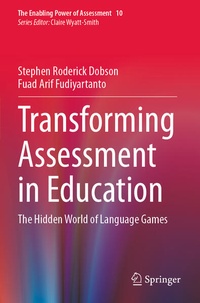
This book transforms our current understanding of assessment practice in different educational settings and cultures. Drawing upon the resources of language games and critical realism the authors argue for an innovative engagement with the philosophical, theoretical and practical foundations of assessment. What is the connection between learning, motivation and assessment? Is assessment for learning a motorway or a blind alley for improved learning outcomes? How can creativity be assessed through the eyes of the connoisseur? How can assessment cultures be understood as forms of life and language games? Do new forms of society transform our assessment practices? A critical appreciation of the work of Royce Sadler is offered for assessment specialists.
Series
Edition
Language
Place of publication
Publishing group
Springer International Publishing
Target group
Professional and scholarly
Illustrations
16 s/w Abbildungen
XXXIX, 196 p. 16 illus.
Dimensions
Height: 235 mm
Width: 155 mm
Thickness: 13 mm
Weight
ISBN-13
978-3-031-26993-6 (9783031269936)
DOI
10.1007/978-3-031-26991-2
Schweitzer Classification
Professor Stephen Dobson has worked across multiple educational eco-systems. His research in assessment bridges insights from Cultural Studies, Sociology, Philosophy, the Arts and Policy making. He has previously published on the viva in higher education, youth culture, urban studies and refugee work or
refugeeness
as he terms it.
Fuad Arif Fudiyartanto
is Senior Lecturer at the State Islamic University (UIN) Sunan Kalijaga Yogyakarta, Indonesia. His interdisciplinary research covers assessment and linguistics, with a particular focus on sociology of assessment, higher education assessment (of English studies), and translation studies. He is currently Head of the Language Centre of the university (2021-2024).
Introduction.- 1. What is critical realism and how to understand assessment?.- 2. New forms of society: new forms of assessment?.- 3.Assessment for learning - motorway or dead end for improved learning outcomes?.- 4. Challenging the culture of formative assessment.- 5. Negotiating belief and habitus on assessment within institution.- 6. Developing assessment capital for excellence.- 7. Motivation, learning and assessment.- 8. Assessment and connoisseurship.- Conclusion.