

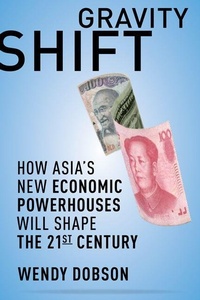
Gravity Shift
How Asia's New Economic Powerhouses Will Shape the 21st Century
Published on 31. July 2010
Book
Paperback/Softback
224 pages
978-1-4426-1165-8 (ISBN)
Description
The rapid growth, diversity and strategic importance of the emerging Chinese and Indian economies have fired the world's imagination with both hopes and fears for the future. Wendy Dobson's perceptive analysis of changing institutions, demographics, and politics paints a thoughtful and surprising picture of India and China as economic powerhouses in the year 2030. Examining past events and current trends, Gravity Shift offers bold predictions of the changes we can expect in key economic and political institutions in China and India, changes that will inform and shape tomorrow's business decisions.
Dobson's work anticipates that by 2030, China's economy will be larger than those of the United States, India, and Japan, though its population will be ageing and its growth slowing. India will also come into its own, making major strides in modernizing its vast rural population, vanquishing illiteracy, and emerging as an innovative manufacturing powerhouse. A China-India free trade agreement could well become the foundation of a cooperative Asian economic community. As the world re-evaluates business practices in the wake of the global economic crisis, Gravity Shift provides a clear vision of how India and China will reshape the Asian region, to inform and transform global economic institutions.
Dobson's work anticipates that by 2030, China's economy will be larger than those of the United States, India, and Japan, though its population will be ageing and its growth slowing. India will also come into its own, making major strides in modernizing its vast rural population, vanquishing illiteracy, and emerging as an innovative manufacturing powerhouse. A China-India free trade agreement could well become the foundation of a cooperative Asian economic community. As the world re-evaluates business practices in the wake of the global economic crisis, Gravity Shift provides a clear vision of how India and China will reshape the Asian region, to inform and transform global economic institutions.
Reviews / Votes
'A well-written analysis ... a refreshing read as to where the world is headed without the usual ideological, paranoiac or pessimistic filters that many western analysts rely on when looking at Asia's development.' -- Diane Francis, National PostMore details
Language
English
Place of publication
Toronto
Canada
Target group
College/higher education
Professional and scholarly
Product notice
Paperback (trade)
Illustrations
5 figures; 5 tables
Dimensions
Height: 228 mm
Width: 151 mm
Thickness: 20 mm
Weight
383 gr
ISBN-13
978-1-4426-1165-8 (9781442611658)
Copyright in bibliographic data and cover images is held by Nielsen Book Services Limited or by the publishers or by their respective licensors: all rights reserved.
Schweitzer Classification
Other editions
Additional editions
E-Book
12/2009
1st Edition
University of Toronto Press
€44.95
Available for download
Person
Wendy Dobson, one of Canada's leading international economists, provides two unique vantage points based on her own experiences in the two countries and in the international system. One is top-down, informed by her role as Canada's Associate Deputy Minister of Finance responsible for international financial diplomacy in the G-7 in the late 1980s and more recently as a professor at the University of Toronto. The other perspective is bottom-up, drawing on her life and work in India in the 1960s, in a job that took her into politicians' offices and sent her into the villages, and her many visits to China starting in 1978, the year that its transformation began to emerge.
Since 1993 she has led research and teaching at the Rotman Institute for International Business at the University of Toronto's Rotman School of Management. She has published twenty books and many articles on Asia and the international economy. Between 1995 and 2002 she was the managing editor of the Hong Kong Bank of Canada's Papers on Asia, published by University of Toronto Press. One of her books, Multinationals and East Asian Integration, won the Ohira Prize in 1998 for the best English-language book on Asia, and several of her other publications have been translated into Chinese.
Since 1993 she has led research and teaching at the Rotman Institute for International Business at the University of Toronto's Rotman School of Management. She has published twenty books and many articles on Asia and the international economy. Between 1995 and 2002 she was the managing editor of the Hong Kong Bank of Canada's Papers on Asia, published by University of Toronto Press. One of her books, Multinationals and East Asian Integration, won the Ohira Prize in 1998 for the best English-language book on Asia, and several of her other publications have been translated into Chinese.
Content
Preface
1 Why Are They Growing So Fast?
2 Developing Human Capital
3 Finance: Sharper Scissors Required
4 From Latecomers to Technology Titans?
5 Sprints, Spurts, and Stumbling Blocks
6 As Gravity Shifts
7 The New Asian Powerhouses and the World Economy in 2030
Notes
Bibliography
Acknowledgments
Index
1 Why Are They Growing So Fast?
2 Developing Human Capital
3 Finance: Sharper Scissors Required
4 From Latecomers to Technology Titans?
5 Sprints, Spurts, and Stumbling Blocks
6 As Gravity Shifts
7 The New Asian Powerhouses and the World Economy in 2030
Notes
Bibliography
Acknowledgments
Index