

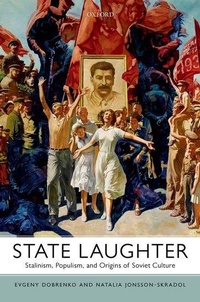
State Laughter
Stalinism, Populism, and Origins of Soviet Culture
Published on 3. February 2022
Book
Hardback
436 pages
978-0-19-884041-1 (ISBN)
Description
Stalin's reign of terror was not all doom and gloom, much of it was (meant to be) funny! From comedy films to satirical theatre, from caricature to court speeches, and from Stalin's own writings to bawdy folk songs, humour pervaded the popular culture of the USSR. Until now, conventional wisdom has held that humour was a hallmark of the subversive, but in State Laughter Dobrenko and Jonsson-Skradol do away with that notion. Instead, tracing the development of official humour, satire, and comedy from the revolution through to the 1950s, they explore how and why laughter was a core component of the survival of the Soviet regime. Grounded in Soviet intellectual and cultural history, State Laughter offers the first comprehensive analysis of state-sponsored popular culture in Stalin's Soviet Union.
Reviews / Votes
Broadly interdisciplinary and replete with nuanced insights into Stalin-era comedic practices, discourses, and genres, Dobrenko and Jonsson-Skradol's gripping volume offers new perspectives on humor under totalitarianism. This empirically-rich, theoretically-informed, and carefully documented study is bound to appeal to a wide range of scholars and students of Soviet history, literature, and culture. * Olga Mesropova, Russian Review * This book opens up new ways of examining Soviet culture by moving away from reductive narratives in which Soviet jokes always belonged to dissidents' efforts to resist Stalinist totalitarianism. The emphasis on state-sanctioned laughter in Stalinist culture contributes not only to cultural studies of laughter in general but also benefits the understanding of Soviet culture and Soviet subjectivity in general. Most importantly, the methodology developed in this book could further inspire scholars studying cultures and politics of other communist states to explore the formation and transformation of the comic in official narratives. * Yejun Zou, Europe-Asia Studies * This new volume is the first to offer a comprehensive exploration of how Stalin's regime understood, attempted to control, and ultimately wielded humour as a (usually blunt-force) tool to engineer utopia. The authors (Dobrenko,Skradol) place their study in direct opposition to the two principal claims that long permeated both emigre accounts and the historiography. * Jonathan Waterlow, Modern Language Review * State Laughter should be considered a must-read for anyone interested in Soviet mass culture under Stalin. * David Brandenberger, Ab Imperio * This rich volume is certain to be of interest to students and scholars of Stalinist culture and its chronological successors, as well as more broadly to those with an interest in satire and other varieties of the comic in authoritarian states. * Seth Graham, Slavonic and East European Review *More details
Language
English
Place of publication
Oxford
United Kingdom
Target group
Professional and scholarly
Product notice
sewn/stitched
Cloth over boards
Illustrations
16 black and white figures/illustrations
Dimensions
Height: 226 mm
Width: 157 mm
Thickness: 33 mm
Weight
816 gr
ISBN-13
978-0-19-884041-1 (9780198840411)
Copyright in bibliographic data and cover images is held by Nielsen Book Services Limited or by the publishers or by their respective licensors: all rights reserved.
Schweitzer Classification
Other editions
Additional editions
Evgeny Dobrenko | Natalia Jonsson-Skradol
State Laughter
Stalinism, Populism, and Origins of Soviet Culture
E-Book
01/2022
1st Edition
OUP eBook
€62.99
Available for download
Evgeny Dobrenko | Natalia Jonsson-Skradol
State Laughter
Stalinism, Populism, and Origins of Soviet Culture
E-Book
12/2021
1st Edition
OUP eBook
€62.99
Available for download
Persons
Evgeny Dobrenko is Professor of Russian Studies at Ca' Foscari University. He has previously held posts across the, then, Soviet Union, the USA, and the UK, including, among others, the Moscow and Odessa State Universities, Stanford, Amherst, and the University of California. Over his career he has authored, edited and co-edited some 20 books and more than 250 articles and essays on Soviet and post-Soviet literature and culture, Stalinism, Socialist Realism, Soviet national literatures, Russian and Soviet film, critical theory, and Soviet cultural history.
Natalia Jonsson-Skradol has published over 20 articles on functions and uses of language in oppressive regimes. Her work has appeared in Slavic Review, Utopian Studies, Slavonic and East European Review, German Quarterly and in other academic publications. She has lived and worked in Israel, Germany, Austria, and the UK.
Natalia Jonsson-Skradol has published over 20 articles on functions and uses of language in oppressive regimes. Her work has appeared in Slavic Review, Utopian Studies, Slavonic and East European Review, German Quarterly and in other academic publications. She has lived and worked in Israel, Germany, Austria, and the UK.
Author
Professor of Russian Studies and Co-Director of the Prokhorov Centre for the Study of Central and Eastern European Intellectual and Cultural HistoryProfessor of Russian Studies and Co-Director of the Prokhorov Centre for the Study of Central and Eastern European Intellectual and Cultural History, University of Sheffiled
Research FellowResearch Fellow, The Prokhorov Centre for the Study of Central and Eastern European Intellectual and Cultural History, University of Sheffield
Content
- Introduction
- 1: The Stalinist World of Laughter: The Fate of the Comic in a Tragic Age
- 2: A Killer Wit: Laughter in Stalinist Official Discourse
- 3: The Funny War: Laughing at the Front in WWII
- 4: "One Might Think It Is a Ward in a Madhouse": Late Stalinism, the Early Cold War, and Caricature
- 5: The Gogols and the Shchedrins: Lessons in "Positive Satire"
- 6: The Soviet Bestiary: Genealogy of the Stalinist Fable
- 7: The Merry Adventures of Stalin's Peasants: Kolkhoz Commedia dell'arte
- 8: "A Total Racket": Vaudeville for the New People
- 9: Metalaughter: Populism and the Stalinist Musical Comedy