

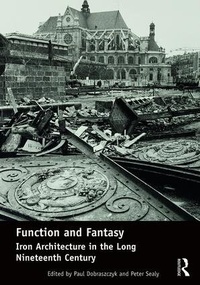
Function and Fantasy: Iron Architecture in the Long Nineteenth Century
1st Edition
Published on 12. July 2016
Book
Hardback
310 pages
978-1-4724-3000-7 (ISBN)
Description
The introduction of iron - and later steel - construction and decoration transformed architecture in the nineteenth century. While the structural employment of iron has been a frequent subject of study, this book re-directs scholarly scrutiny on its place in the aesthetics of architecture in the long nineteenth century. Together, its eleven unique and original chapters chart - for the first time - the global reach of iron's architectural reception, from the first debates on how iron could be incorporated into architecture's traditional aesthetics to the modernist cleaving of its structural and ornamental roles.
The book is divided into three sections. Formations considers the rising tension between the desire to translate traditional architectural motifs into iron and the nascent feeling that iron buildings were themselves creating an entirely new field of aesthetic expression. Exchanges charts the commercial and cultural interactions that took place between British iron foundries and clients in far-flung locations such as Argentina, Jamaica, Nigeria and Australia. Expressing colonial control as well as local agency, iron buildings struck a balance between pre-fabricated functionalism and a desire to convey beauty, value and often exoticism through ornament. Transformations looks at the place of the aesthetics of iron architecture in the late nineteenth and early twentieth centuries, a period in which iron ornament sought to harmonize wide social ambitions while offering the tantalizing possibility that iron architecture as a whole could transform the fundamental meanings of ornament.
Taken together, these chapters call for a re-evaluation of modernism's supposedly rationalist interest in nineteenth-century iron structures, one that has potentially radical implications for the recent ornamental turn in contemporary architecture.
The book is divided into three sections. Formations considers the rising tension between the desire to translate traditional architectural motifs into iron and the nascent feeling that iron buildings were themselves creating an entirely new field of aesthetic expression. Exchanges charts the commercial and cultural interactions that took place between British iron foundries and clients in far-flung locations such as Argentina, Jamaica, Nigeria and Australia. Expressing colonial control as well as local agency, iron buildings struck a balance between pre-fabricated functionalism and a desire to convey beauty, value and often exoticism through ornament. Transformations looks at the place of the aesthetics of iron architecture in the late nineteenth and early twentieth centuries, a period in which iron ornament sought to harmonize wide social ambitions while offering the tantalizing possibility that iron architecture as a whole could transform the fundamental meanings of ornament.
Taken together, these chapters call for a re-evaluation of modernism's supposedly rationalist interest in nineteenth-century iron structures, one that has potentially radical implications for the recent ornamental turn in contemporary architecture.
More details
Language
English
Place of publication
London
United Kingdom
Publishing group
Taylor & Francis Ltd
Target group
College/higher education
Dimensions
Height: 246 mm
Width: 174 mm
Weight
730 gr
ISBN-13
978-1-4724-3000-7 (9781472430007)
Copyright in bibliographic data and cover images is held by Nielsen Book Services Limited or by the publishers or by their respective licensors: all rights reserved.
Schweitzer Classification
Other editions
Additional editions
Paul Dobraszczyk | Peter Sealy
Function and Fantasy: Iron Architecture in the Long Nineteenth Century
Book
02/2018
1st Edition
Routledge
€81.89
Shipment within 10-20 days
Paul Dobraszczyk | Peter Sealy
Function and Fantasy: Iron Architecture in the Long Nineteenth Century
E-Book
07/2016
Routledge
€69.99
Available for download
Paul Dobraszczyk | Peter Sealy
Function and Fantasy: Iron Architecture in the Long Nineteenth Century
E-Book
07/2016
Routledge
€69.99
Available for download
Persons
Paul Dobraszczyk is a lecturer in Art History at the University of Manchester and his research covers a wide variety of subjects, including ornament and iron, visual representations of London's Victorian sewers, and the relationship between real and imagined urban ruins. He has published widely on these subjects, including Iron, Ornament and Architecture in Victorian Britain (Ashgate, 2014), London's Sewers (Shire, 2014) and Into the Belly of the Beast: Exploring London's Victorian Sewers (Spire, 2009). His latest book, The Dead City: Urban Ruins and the Spectacle of Decay will be published by IB Tauris in 2017.
Peter Sealy is a PhD candidate at Harvard University, where he is a Frank Knox Fellow. His dissertation charts the productive utility of photography's claim to factuality as it explored increasingly spatial qualities in late nineteenth-century architectural publications. An exposei of this argument will appear in Blackwell's Companion to Nineteenth-Century Architecture. He co-authored (with Martin Bressani) an article on the photographs in Charles Garnier's Le Nouvel Opeira, published in Art and the Early Photographic Album (CASVA, 2011). He holds architecture degrees from McGill University and the Harvard GSD; previously, he worked at the Canadian Centre for Architecture in Montreial on exhibitions including Actions (2008) and Journeys (2010).
Peter Sealy is a PhD candidate at Harvard University, where he is a Frank Knox Fellow. His dissertation charts the productive utility of photography's claim to factuality as it explored increasingly spatial qualities in late nineteenth-century architectural publications. An exposei of this argument will appear in Blackwell's Companion to Nineteenth-Century Architecture. He co-authored (with Martin Bressani) an article on the photographs in Charles Garnier's Le Nouvel Opeira, published in Art and the Early Photographic Album (CASVA, 2011). He holds architecture degrees from McGill University and the Harvard GSD; previously, he worked at the Canadian Centre for Architecture in Montreial on exhibitions including Actions (2008) and Journeys (2010).
Content
Introduction: Architecture Unbound (Paul Dobraszczyk and Peter Sealy), Part I: Formations, 1. London's Crystal Palace and its Decorative Iron Construction (John W. Stamper), 2. Paleostructure: Biological, Spiritual and Architectural Evolution at the Oxford Museum (Nathaniel Walker), 3. Mimesis Recast: Artistic Production in the Aftermath of Neoclassicism (Axel Sowa), 4. Richard Lucae and the Aesthetics of Space in the Age of Iron (Jasper Cepl), Part II: Exchanges, 5. From Rational to Structurally Ornamental: Exported English Iron Architecture of the Mid-Nineteenth Century (Jonathan Clarke), 6. Scottish Cast Iron in Argentina: Its Role in the British Informal Imperial System (Lucia Juarez), 7. Utility and Beauty: Iron Architecture in Jamaica, 1800-1908 (Elizabeth Pigou-Dennis), 8. Corrugated Iron: Forming New Perceptions in the Australian Landscape (Anne Warr), Part III: Transformations, 9. Meta-Ornament: Iron and the Railway Station in Britain (Paul Dobraszczyk), 10. Dreams in Iron: The Wish Image in Emile Zola's Novels (Peter Sealy), 11. Casting Aspersions: Debating Iron Ornament in New York's East River Bridges (Charles Rosenblum)