

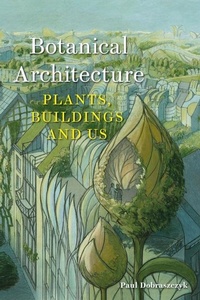
Botanical Architecture
Plants, Buildings and Us
Published on 21. October 2024
Book
Hardback
280 pages
978-1-78914-927-2 (ISBN)
Description
When we look at trees, we see a form of natural architecture, and yet we have seemingly always exploited trees to make new buildings of our own. While a tree creates its own structure, we generally destroy other things to build, with increasingly disastrous consequences.
Looking closely at how elements of plants - seeds, roots, trunks, branches, leaves, flowers and canopies - relate to buildings, this book asks what might be required to design with plants and become more attuned to vegetal life in our structures. It also proposes that we build as much for plants as for ourselves, understanding that our lives are always totally dependent on theirs. Botanical Architecture offers a provocative and original take on the relationship between ecology and architecture.
Looking closely at how elements of plants - seeds, roots, trunks, branches, leaves, flowers and canopies - relate to buildings, this book asks what might be required to design with plants and become more attuned to vegetal life in our structures. It also proposes that we build as much for plants as for ourselves, understanding that our lives are always totally dependent on theirs. Botanical Architecture offers a provocative and original take on the relationship between ecology and architecture.
Reviews / Votes
An impressive, compendious book with a great deal to offer the architecture lover and the plant lover alike, including much that will surprise. * Literary Review * Botanical Architecture offers an encyclopedic array of material on the relationship between nature and buildings. Dobraszczyk (Bartlett School of Architecture, UK) contextualizes his discussion of architecture by drawing together research in the sciences, social sciences, and engineering, as well as literature, philosophy, film, art installations, and video games. His examples span the globe and the ancient world to the present. Recommended. * Choice * Plants are architects! This is what, with admirable lucidity, Paul Dobraszczyk claims in his new book. Focusing by turns on seeds, roots, trunks, branches, leaves, flowers, canopies, and vegetal communities that include all living beings, Botanical Architecture is a tour d'imagination of thinking with plants. * Michael Marder, author of Time is a Plant and (with Edward S. Casey) Plants in Place * In this fascinating and wide-ranging book Paul Dobraszczyk takes us on a journey through the intersecting realms of botany and architecture. Botanical architecture is set to be a pivotal contribution to what we might term the 'vegetal turn' that is now spreading across multiple disciplinary fields ranging from art history to materials science. * Matthew Gandy, Professor of Geography, University of Cambridge * With Botanical Architecture, Paul Dobraszczyk shows that many architects have been learning not from Las Vegas but from vegetation-and that the lessons of plantlife are endless. From ancient forest homes to medieval floral ornament, from modern green roofs to oxygen gardens in space, Dobraszczyk's book is a deep-rooted and exciting compendium. * Geoff Manaugh, New York Times-bestselling author of A Burglar's Guide to the City and BLDGBLOG *More details
Language
English
Place of publication
London
United Kingdom
Target group
College/higher education
Illustrations
109 illustrations, 36 in colour
Dimensions
Height: 240 mm
Width: 165 mm
Thickness: 25 mm
Weight
826 gr
ISBN-13
978-1-78914-927-2 (9781789149272)
Copyright in bibliographic data and cover images is held by Nielsen Book Services Limited or by the publishers or by their respective licensors: all rights reserved.
Schweitzer Classification
Person
Paul Dobraszczyk is an architectural writer and a lecturer at the Bartlett School of Architecture, London. His books include Future Cities (2019) and Animal Architecture (2023), both published by Reaktion Books, as well as Architecture and Anarchism (2021).
Content
Introduction: Vegetal Architecture
1 Seeds
2 Roots
3 Trunks
4 Branches
5 Leaves
6 Flowers
7 Canopies
References
Further Reading
Acknowledgements
Photo Acknowledgements
Index
1 Seeds
2 Roots
3 Trunks
4 Branches
5 Leaves
6 Flowers
7 Canopies
References
Further Reading
Acknowledgements
Photo Acknowledgements
Index