

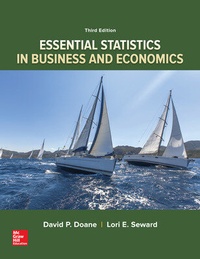
Essential Statistics in Business and Economics
3rd Edition
Published on 29. March 2019
Book
Paperback/Softback
690 pages
978-1-260-54764-1 (ISBN)
Description
The Third Edition of Essential Statistics in Business and Economics was written to meet four distinct objectives.
Objective 1: Communicate the Meaning of Variation in a Business Context Variation exists everywhere in the world around us and successful businesses know how to measure variation. This text shows how businesses know how to tell when variation should be responded to and when it should be left alone.
Objective 2: Use Realistic Business Applications The text offers examples, case studies, and problems from current research or real applications whenever possible. Hypothetical data are used when it seems the best way to illustrate a concept.
Objective 3: Incorporate Current Statistical Practices and Offer Practical Advice With the increased reliance on computers and data analytics, statistics practitioners have changed the way they use statistical tools. The text shows the current practices and explains why they are used the way they are, and tells you when each technique should not be used.
Objective 4: Provide More In-Depth Explanation of the Why and Let the Software Take Care of the How Today's technology makes it easier to summarize and communicate with data than ever before. The text demonstrates easily mastered techniques with commonly available software. The authors emphasize the idea of risks in decision making and that risks should be quantified and considered in business decisions.
Objective 1: Communicate the Meaning of Variation in a Business Context Variation exists everywhere in the world around us and successful businesses know how to measure variation. This text shows how businesses know how to tell when variation should be responded to and when it should be left alone.
Objective 2: Use Realistic Business Applications The text offers examples, case studies, and problems from current research or real applications whenever possible. Hypothetical data are used when it seems the best way to illustrate a concept.
Objective 3: Incorporate Current Statistical Practices and Offer Practical Advice With the increased reliance on computers and data analytics, statistics practitioners have changed the way they use statistical tools. The text shows the current practices and explains why they are used the way they are, and tells you when each technique should not be used.
Objective 4: Provide More In-Depth Explanation of the Why and Let the Software Take Care of the How Today's technology makes it easier to summarize and communicate with data than ever before. The text demonstrates easily mastered techniques with commonly available software. The authors emphasize the idea of risks in decision making and that risks should be quantified and considered in business decisions.
More details
Edition
3rd edition
Language
English
Place of publication
OH
United States
Target group
College/higher education
US School Grade: From College Freshman to College Graduate Student
Illustrations
5 Illustrations
Dimensions
Height: 277 mm
Width: 213 mm
Thickness: 22 mm
Weight
1204 gr
ISBN-13
978-1-260-54764-1 (9781260547641)
Copyright in bibliographic data and cover images is held by Nielsen Book Services Limited or by the publishers or by their respective licensors: all rights reserved.
Schweitzer Classification
Persons
David P. Doane is Professor of Quantitative Methods in Oakland University's Department of Decision and Information Sciences. He earned his Bachelor of Arts degree in mathematics and economics at the University of Kansas and his PhD from Purdue University's Krannert Graduate School.
Lori E. Seward is an Instructor in the Decisions Sciences Department in the College of Business at The University of Colorado at Denver and Health Sciences Center. She earned her Bachelor of Science and Master of Science degrees in Industrial Engineering at Virginia Tech. After several years working as a reliability and quality engineer in the paper and automotive industries, she earned her PhD from Virginia Tech.
Lori E. Seward is an Instructor in the Decisions Sciences Department in the College of Business at The University of Colorado at Denver and Health Sciences Center. She earned her Bachelor of Science and Master of Science degrees in Industrial Engineering at Virginia Tech. After several years working as a reliability and quality engineer in the paper and automotive industries, she earned her PhD from Virginia Tech.
Content
Table of Contents
CHAPTER ONE: Overview of Statistics
CHAPTER TWO: Data Collection
CHAPTER THREE: Describing Data Visually
CHAPTER FOUR: Descriptive Statistics
CHAPTER FIVE: Probability
CHAPTER SIX: Discrete Probability Distributions
CHAPTER SEVEN: Continuous Probability Distributions
CHAPTER EIGHT: Sampling Distributions and Estimation
CHAPTER NINE: One-Sample Hypothesis Tests
CHAPTER TEN: Two-Sample Hypothesis Tests
CHAPTER ELEVEN: Analysis of Variance
CHAPTER TWELVE: Simple Regression
CHAPTER THIRTEEN: Multiple Regression
CHAPTER FOURTEEN: Chi-Square Tests
APPENDICES
A Binomial Probabilities
B Poisson Probabilities
C-1 Standard Normal Areas
C-2 Cumulative Standard Normal Distribution
D Student's t Critical Values
E Chi-Square Critical Values
F Critical Values of F.10
G Solutions to Odd-Numbered Exercises
H Answers to Exam Review Questions
I Writing and Presenting Reports
J Excel Statistical Functions
CHAPTER ONE: Overview of Statistics
CHAPTER TWO: Data Collection
CHAPTER THREE: Describing Data Visually
CHAPTER FOUR: Descriptive Statistics
CHAPTER FIVE: Probability
CHAPTER SIX: Discrete Probability Distributions
CHAPTER SEVEN: Continuous Probability Distributions
CHAPTER EIGHT: Sampling Distributions and Estimation
CHAPTER NINE: One-Sample Hypothesis Tests
CHAPTER TEN: Two-Sample Hypothesis Tests
CHAPTER ELEVEN: Analysis of Variance
CHAPTER TWELVE: Simple Regression
CHAPTER THIRTEEN: Multiple Regression
CHAPTER FOURTEEN: Chi-Square Tests
APPENDICES
A Binomial Probabilities
B Poisson Probabilities
C-1 Standard Normal Areas
C-2 Cumulative Standard Normal Distribution
D Student's t Critical Values
E Chi-Square Critical Values
F Critical Values of F.10
G Solutions to Odd-Numbered Exercises
H Answers to Exam Review Questions
I Writing and Presenting Reports
J Excel Statistical Functions