

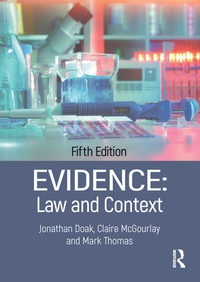
Evidence: Law and Context
5th Edition
Published on 21. February 2018
Book
Paperback/Softback
470 pages
978-1-138-05499-8 (ISBN)
Description
Evidence: Law and Context explains the key concepts of evidence law in England and Wales clearly and concisely, set against the backdrop of the broader political and theoretical contexts. The book focuses on the essential topics commonly found on Evidence courses covering both criminal evidence and civil evidence. It takes a contextual approach discussing how wider policy debates and societal trends have impacted upon the recent evolution of the law in order to provide students with an explanation as to how and why the law has developed.
The fifth edition has been revised to include: coverage of R v Hunter 2015 and its impact on good character evidence; developments in procedures relating to young and vulnerable witnesses; and more in-depth coverage of key cases.
Learning points summarise the major principles and rules covered and practical examples are used throughout the text to give better understanding as to how the technical rules are applied in practice. Self-test questions are included in the book, helping students to test their understanding and prepare for assessment.
Well written, clear and with a logical structure throughout, it contains all the information necessary for any undergraduate evidence law module.
The fifth edition has been revised to include: coverage of R v Hunter 2015 and its impact on good character evidence; developments in procedures relating to young and vulnerable witnesses; and more in-depth coverage of key cases.
Learning points summarise the major principles and rules covered and practical examples are used throughout the text to give better understanding as to how the technical rules are applied in practice. Self-test questions are included in the book, helping students to test their understanding and prepare for assessment.
Well written, clear and with a logical structure throughout, it contains all the information necessary for any undergraduate evidence law module.
More details
Edition
5th edition
Language
English
Place of publication
London
United Kingdom
Publishing group
Taylor & Francis Ltd
Target group
Professional and scholarly
Illustrations
9 s/w Tabellen
9 Tables, black and white
Dimensions
Height: 246 mm
Width: 174 mm
Weight
839 gr
ISBN-13
978-1-138-05499-8 (9781138054998)
Copyright in bibliographic data and cover images is held by Nielsen Book Services Limited or by the publishers or by their respective licensors: all rights reserved.
Schweitzer Classification
Other editions
New editions
Book
05/2024
6th Edition
Routledge
€59.40
Shipment within 10-20 days
Additional editions
Jonathan Doak | Claire Mcgourlay | Mark Thomas
Evidence: Law and Context
Book
02/2018
5th Edition
Routledge
€223.21
Article exhausted; check for reprint
Previous edition
Jonathan Doak | Claire Mcgourlay | Mark Thomas
Evidence in Context
Book
06/2015
4th Edition
Taylor & Francis
€65.87
Article exhausted; check for reprint
Persons
Jonathan Doak is Professor of Criminal Justice and Associate Dean for Research at Nottingham Law School, Nottingham Trent University. He is currently Editor-in-Chief of the International Journal of Evidence and Proof and is a member of the Editorial Board of the Journal of Criminal Law. Jonathan completed his LLB and doctoral studies at Queen's University Belfast, and has previously taught at Durham University, the University of Sheffield and the University of Ulster.
Claire McGourlay is Professor of Legal Education at the University of Manchester. She is the Director of Teaching and Learning and is also a National and Principal Fellow of the Higher Education Academy. She teaches criminal evidence and runs the Miscarriage of Justice Review Centre at Manchester. Claire completed her doctoral studies at the University of Sheffield, where she previously taught.
Mark Thomas is a non-practising barrister and lecturer in law at Nottingham Law School, Nottingham Trent University. Mark has taught the law of evidence for a number of years at both undergraduate and postgraduate level and has particular research interest in the rights of defendants within the criminal process and the non-disclosure of evidence on the grounds of public interest.
Claire McGourlay is Professor of Legal Education at the University of Manchester. She is the Director of Teaching and Learning and is also a National and Principal Fellow of the Higher Education Academy. She teaches criminal evidence and runs the Miscarriage of Justice Review Centre at Manchester. Claire completed her doctoral studies at the University of Sheffield, where she previously taught.
Mark Thomas is a non-practising barrister and lecturer in law at Nottingham Law School, Nottingham Trent University. Mark has taught the law of evidence for a number of years at both undergraduate and postgraduate level and has particular research interest in the rights of defendants within the criminal process and the non-disclosure of evidence on the grounds of public interest.
Content
1. Introduction: Basic Concepts
2. The Adversarial Trial
3. The Burden and Standard of Proof
4. Witnesses I: Competency, Compellability and Oath Taking
5. Witnesses II: Vulnerable Witnesses
6. Witnesses III: Examination and Cross-examination
7. The Privilege against Self-incrimination and the Right to Silence
8. Confession Evidence
9. Improperly Obtained Evidence
10. Suspect Evidence: Corroboration and Identification
11. Character Evidence
12. Hearsay Evidence
13. Opinion Evidence
14. Public Interest Immunity
2. The Adversarial Trial
3. The Burden and Standard of Proof
4. Witnesses I: Competency, Compellability and Oath Taking
5. Witnesses II: Vulnerable Witnesses
6. Witnesses III: Examination and Cross-examination
7. The Privilege against Self-incrimination and the Right to Silence
8. Confession Evidence
9. Improperly Obtained Evidence
10. Suspect Evidence: Corroboration and Identification
11. Character Evidence
12. Hearsay Evidence
13. Opinion Evidence
14. Public Interest Immunity