

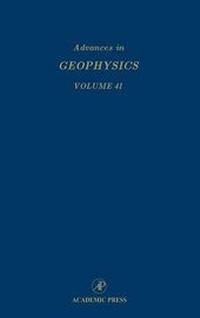
Advances in Geophysics: Volume 41
Published on 9. July 1999
Book
Hardback
239 pages
978-0-12-018841-3 (ISBN)
Description
This series provides a venue for longer reviews of current advances in geophysics. Written at a level accessible to graduate students, the articles serve to broaden knowledge of various fields and may be useful in courses and seminars.
Reviews / Votes
"This series has provided workers in many fields with invaluable reference material and critism." --SCIENCE PROGRESS"Should be on the bookshelf of every geophysicst." --PHYSICS TODAY
"The entire series should be in the library of every group working in geophysics." --AMERICAN SCIENTIST
More details
Series
Language
English
Place of publication
San Diego
United States
Publishing group
Elsevier Science Publishing Co Inc
Target group
Professional and scholarly
Libraries as well as academics and professionals in all areas of geosciences, including geophysicists, geologists, hydrologists, climate modelers, oceanographers, petroleum explorationists, and others.
Dimensions
Height: 229 mm
Width: 152 mm
Weight
530 gr
ISBN-13
978-0-12-018841-3 (9780120188413)
Copyright in bibliographic data and cover images is held by Nielsen Book Services Limited or by the publishers or by their respective licensors: all rights reserved.
Schweitzer Classification
Other editions
Additional editions
Persons
Renata Dmowska works in the School of Engineering and Applied Sciences at Harvard University in Cambridge, MA, USA. Barry Saltzman, 1932-2001, was professor of geology and geophysics at Yale University and a pioneer in the theory of weather and climate, in which he made several profound and lasting contributions to knowledge of the atmosphere and climate. Saltzman developed a series of models and theories of how ice sheets, atmospheric winds, ocean currents, carbon dioxide concentration, and other factors work together, causing the climate to oscillate in a 100,000-year cycle. For this and other scientific contributions, he received the 1998 Carl Gustaf Rossby Research Medal, the highest award from the American Meteorological Society. Saltzman was a fellow of the American Meteorological Society and the American Association for the Advancement of Science and an honorary member of the Academy of Science of Lisbon. His work in 1962 on thermal convection led to the discovery of chaos theory and the famous "Saltzman-Lorenz attractor."
Content
Oscillatory Spatiotemporal Signal Detection in Climate Studies: A Multiple-Taper Spectral Domain Approach
Authors: M.E. Mann and J. Park
Numerical Models of Crustal Deformation in Seismic Zones
Author: S. C. Cohen
Authors: M.E. Mann and J. Park
Numerical Models of Crustal Deformation in Seismic Zones
Author: S. C. Cohen