

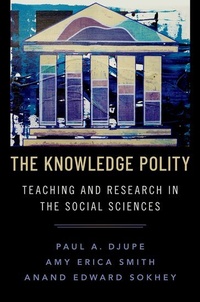
The Knowledge Polity
Teaching and Research in the Social Sciences
Published on 14. June 2022
Book
Hardback
316 pages
978-0-19-761191-3 (ISBN)
Description
Drawing on surveys of diverse social science faculty, three acclaimed scholars develop a rich and sometimes surprising portrait of who produces research, teaches students, and contributes to the business of higher education - and how, when, and why.
In The Knowledge Polity, Paul A. Djupe, Amy Erica Smith, and Anand Edward Sokhey envision academics as members of a polity where the primary output is knowledge and citizenship comes with rights and responsibilities. Leveraging the 2017 Professional Activity in the Social Sciences (PASS) Study, they develop a theoretically and empirically rich account of who produces knowledge, and how. The data enable an unparalleled understanding of the nature and sources of inequalities by gender and racial or ethnic identification in the disciplines of sociology and political science in the US. To explain those inequalities, the authors consider academics as embedded in institutional and social contexts-including their home lives-and carefully consider their personalities and changing compositions of the academic workforce. A comprehensive and wide-ranging analysis, this book documents patterns that have long been shrouded in anecdote and enables scholars from across the social and behavioral sciences to make empirically-grounded decisions about their individual and collective futures.
In The Knowledge Polity, Paul A. Djupe, Amy Erica Smith, and Anand Edward Sokhey envision academics as members of a polity where the primary output is knowledge and citizenship comes with rights and responsibilities. Leveraging the 2017 Professional Activity in the Social Sciences (PASS) Study, they develop a theoretically and empirically rich account of who produces knowledge, and how. The data enable an unparalleled understanding of the nature and sources of inequalities by gender and racial or ethnic identification in the disciplines of sociology and political science in the US. To explain those inequalities, the authors consider academics as embedded in institutional and social contexts-including their home lives-and carefully consider their personalities and changing compositions of the academic workforce. A comprehensive and wide-ranging analysis, this book documents patterns that have long been shrouded in anecdote and enables scholars from across the social and behavioral sciences to make empirically-grounded decisions about their individual and collective futures.
More details
Language
English
Place of publication
New York
United States
Target group
College/higher education
Illustrations
75 b/w figures
Dimensions
Height: 241 mm
Width: 159 mm
Thickness: 22 mm
Weight
576 gr
ISBN-13
978-0-19-761191-3 (9780197611913)
Copyright in bibliographic data and cover images is held by Nielsen Book Services Limited or by the publishers or by their respective licensors: all rights reserved.
Schweitzer Classification
Other editions
Additional editions
Paul A. Djupe | Anand Edward Sokhey | Amy Erica Smith
The Knowledge Polity
Teaching and Research in the Social Sciences
Book
06/2022
Oxford University Press Inc
€32.50
Shipment within 15-20 days
Paul A. Djupe | Anand Edward Sokhey | Amy Erica Smith
The Knowledge Polity
Teaching and Research in the Social Sciences
E-Book
03/2022
OUP eBook
€17.49
Available for download
Paul A. Djupe | Anand Edward Sokhey | Amy Erica Smith
The Knowledge Polity
Teaching and Research in the Social Sciences
E-Book
03/2022
OUP eBook
€17.49
Available for download
Persons
Paul A. Djupe is an associate professor of political science at Denison University, affiliated scholar with PRRI, and series editor of Religious Engagement in Democratic Politics (Temple University Press). His is the author of The Evangelical Crackup? The Future of the Evangelical-Republican Coalition (2018).
Amy Erica Smith is an associate professor of political science as well as a Liberal Arts and Sciences Dean's Professor at Iowa State University. In the 2020-22 academic years, she is an Andrew Carnegie Fellow. She is the author of Religion and Brazilian Democracy: Mobilizing the People of God (2019).
Anand Edward Sokhey is an associate professor of political science and a faculty fellow at the Institute for Behavioral Science at the University of Colorado at Boulder. He is the coauthor of Politics on Display: Yard Signs and the Politicization of Social Spaces (Oxford, 2019).
Amy Erica Smith is an associate professor of political science as well as a Liberal Arts and Sciences Dean's Professor at Iowa State University. In the 2020-22 academic years, she is an Andrew Carnegie Fellow. She is the author of Religion and Brazilian Democracy: Mobilizing the People of God (2019).
Anand Edward Sokhey is an associate professor of political science and a faculty fellow at the Institute for Behavioral Science at the University of Colorado at Boulder. He is the coauthor of Politics on Display: Yard Signs and the Politicization of Social Spaces (Oxford, 2019).
Author
Associate Professor of Political ScienceAssociate Professor of Political Science, Denison University
Associate Professor of Political ScienceAssociate Professor of Political Science, University of Colorado Boulder
Liberal Arts and Sciences Dean's Professor and Associate Professor of Political ScienceLiberal Arts and Sciences Dean's Professor and Associate Professor of Political Science, Iowa State University
Content
Acknowledgments
Preface
Introduction: From the Pipeline to the Polity
Chapter 1 The Who, When, What, and Where of Submissions and Publications
Chapter 2 The Who, When, What, and Where of Teaching
Chapter 3 The Institutional Context: Universities, Departments, and Families
Chapter 4 Advice Networks and Coauthorship
Chapter 5 Disposed to Publish or Teach? Exploring the Role of Personality
Chapter 6 The Publication Pipeline
Chapter 7 The Tweeting Polity: Mediated Public Engagement and Academic Research
Chapter 8 It Takes a Polity to Raise a Publication: Peer Reviewing and Academic Citizenship
Conclusion
Appendix A
Appendix B
References
Preface
Introduction: From the Pipeline to the Polity
Chapter 1 The Who, When, What, and Where of Submissions and Publications
Chapter 2 The Who, When, What, and Where of Teaching
Chapter 3 The Institutional Context: Universities, Departments, and Families
Chapter 4 Advice Networks and Coauthorship
Chapter 5 Disposed to Publish or Teach? Exploring the Role of Personality
Chapter 6 The Publication Pipeline
Chapter 7 The Tweeting Polity: Mediated Public Engagement and Academic Research
Chapter 8 It Takes a Polity to Raise a Publication: Peer Reviewing and Academic Citizenship
Conclusion
Appendix A
Appendix B
References