


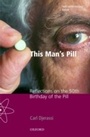
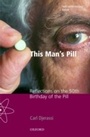
This Man's Pill
Reflections on the 50th Birthday of the Pill
Published on 24. April 2003
Book
Paperback/Softback
322 pages
978-0-19-860695-6 (ISBN)
Description
October 15, 1951 marks the birthday of one of the key episodes in 20th century social history: the first synthesis of a steroid oral contraceptive in a small laboratory in Mexico City - an event that triggered the development of the Pill. Carl Djerassi has been honoured worldwide for that accomplishment, which ultimately changed the life of women and the nature of human reproduction in ways that were not foreseeable. On the 50th anniversary of this pivotal event, Djerassi weaves a compelling personal narrative full of self-reflection and occasional humour on the impact this invention has had on the world at large and on him personally. He credits the Pill with radically altering his academic career at Stanford University to become one of the few American chemists writing novels and plays. This Man's Pill presents a forcefully revisionist account of the early history of the Pill, debunking many of the journalistic and romantic accounts of its scientific origin. Djerassi does not shrink from exploring why we have no Pill for men or why Japan only approved the Pill in 1999 (together with Viagra). Emphasizing that development of the Pill occurred during the post-War period of technological euphoria, he believes that it could not be repeated in today's climate. Would the sexual revolution of the 1960s or the impending separation of sex ("in bed") and fertilization ("under the microscope") still have happened? This Man's Pill answers such questions while providing a uniquely authoritative account of a discovery that changed the world.
Reviews / Votes
Review from other book by this author Carl Djerassi's scientific authorship of one of the most socially significant innovations of our time is well known. In this book, he examines the implications and social reception of the Pill with a combination of humanistic concern and careful socio-scientific analysis that is as rare as it is valuable. * Kenneth J Arrow, Nobel laureate in Economics, 1972 * fascinating . . . entertaining * Redaktion Angewandte Chemie, 2002 * It is attractively written, appealing to non-scientists as well as to chemists * Chemistry in Britain, January 2002 * his essays are well worth reading * Nature 20/12/2001 * To a degree almost totally foreign to scientists, Carl Djerassi has put himself and his science under the microscope. In the process, he ranges far afield from the social implications of this monumental synthesis of the birth control "Pill" to his most recent excursions into the expression of science in literature, with poetry, fiction and the drama as his media. Join this voyeuristic feast. * Joshua Lederberg, Nobel laureate in Physiology or Medicine, 1958 *More details
Language
English
Place of publication
Oxford
United Kingdom
Illustrations
2 figures
Dimensions
Height: 198 mm
Width: 129 mm
Thickness: 17 mm
Weight
344 gr
ISBN-13
978-0-19-860695-6 (9780198606956)
Copyright in bibliographic data and cover images is held by Nielsen Book Services Limited or by the publishers or by their respective licensors: all rights reserved.
Schweitzer Classification
Other editions
Additional editions
E-Book
04/2003
1st Edition
OUP eBook
€20.99
Available for download
E-Book
04/2003
1st Edition
OUP eBook
€20.99
Available for download
Person
Carl Djerassi, professor of chemistry at Stanford University, is one of the few American scientists to have been awarded both the National Medal of Science (for the first synthesis of a steroid oral contraceptive - "the Pill") and the National Medal of Technology (for promoting new approaches to insect control). A member of the US National Academy of Sciences and the American Academy of Arts and Sciences as well as many foreign academies, Djerassi has received 18 honorary doctorates together with numerous other honours, such as the first Wolf Prize in Chemistry, the first Award for the Industrial Application of Science from the National Academy of Sciences, and the American Chemical Society's highest award, the Priestley Medal. For the past decade, he has turned to fiction writing, mostly in the genre of "science-in-fiction," whereby he illustrates, in the guise of realistic fiction, the human side of scientists and the personal conflicts faced by scientists in their quest for scie
Content
1. An exaltation of thirty: Murasaki and company ; 2. Genealogy and birth of the pill ; 3. Bitter pills ; 4. The view from Tokyo ; 5. Sex and Immortality ; 6. From the pill to the PC ; 7. Science-in-fiction is not science fiction. Is it autobiography? ; 8. Behind the scrim of fiction ; 9. The softer chemist ; 10. The pill and Paul Klee ; 11. Science on stage ; 12. What if?