

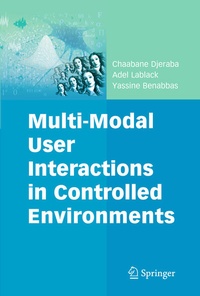
Multi-Modal User Interactions in Controlled Environments
Published on 29. July 2010
Book
Hardback
XVI, 216 pages
978-1-4419-0315-0 (ISBN)
Description
Multi-Modal User Interactions in Controlled Environments investigates the capture and analysis of user's multimodal behavior (mainly eye gaze, eye fixation, eye blink and body movements) within a real controlled environment (controlled-supermarket, personal environment) in order to adapt the response of the computer/environment to the user. Such data is captured using non-intrusive sensors (for example, cameras in the stands of a supermarket) installed in the environment. This multi-modal video based behavioral data will be analyzed to infer user intentions while assisting users in their day-to-day tasks by adapting the system's response to their requirements seamlessly. This book also focuses on the presentation of information to the user.
Multi-Modal User Interactions in Controlled Environments is designed for professionals in industry, including professionals in the domains of security and interactive web television. This book is also suitable for graduate-level students in computer science and electrical engineering.
More details
Series
Edition
2010 ed.
Language
English
Place of publication
New York
United States
Target group
Professional and scholarly
Professional/practitioner
Product notice
Laminated cover
Illustrations
20 s/w Abbildungen
XVI, 216 p. 20 illus.
Dimensions
Height: 242 mm
Width: 164 mm
Thickness: 24 mm
Weight
498 gr
ISBN-13
978-1-4419-0315-0 (9781441903150)
DOI
10.1007/978-1-4419-0316-7
Schweitzer Classification
Other editions
Additional editions
Chaabane Djeraba | Adel Lablack | Yassine Benabbas
Multi-Modal User Interactions in Controlled Environments
Book
09/2012
Springer
€139.09
Shipment within 15-20 days
Chaabane Djeraba | Adel Lablack | Yassine Benabbas
Multi-Modal User Interactions in Controlled Environments
E-Book
06/2010
1st Edition
Springer
€96.29
Available for download
Content
Abnormal Event Detection.- Flow Estimation.- Estimation of Visual Gaze.- Visual Field Projection and Region of Interest Analysis.- Conclusion.