


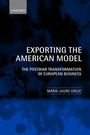
Exporting the American Model
The Post-War Transformation of European Business
Published on 2. July 1998
Book
Hardback
324 pages
978-0-19-829317-0 (ISBN)
Description
Marie-Laure Djelic explores the convergent and divergent trends in the evolution of business systems and organization in Western Europe in the post-war period. She examines in particular the influence of a large-scale, cross-national transfer of the American corporate model, including the Marshall Plan and the involvement of American business in European reconstruction. She focuses on France, West Germany, and Italy, looking in turn at the physical, ownership, organizational, and governance structure of each after 1945. Her core argument is that the model had varying degrees of success in each of those three countries and, in some areas, encountered significant resistance.
The book underscores the socially constructed and historically contingent nature of structural arrangements shaping conditions of industrial production in capitalist countries today. National systems of industrial production are not given and necessary; they are made and shaped through time by actors with particular interests, often in direct confrontation with other groups. This shaping is taking place within particular institutional contexts, in peculiar political and geopolitical conditions. Foreign actors, in geopolitical power positions, can, it is argued, play a particularly significant role in such processes.
The book underscores the socially constructed and historically contingent nature of structural arrangements shaping conditions of industrial production in capitalist countries today. National systems of industrial production are not given and necessary; they are made and shaped through time by actors with particular interests, often in direct confrontation with other groups. This shaping is taking place within particular institutional contexts, in peculiar political and geopolitical conditions. Foreign actors, in geopolitical power positions, can, it is argued, play a particularly significant role in such processes.
Reviews / Votes
investigates a very interesting research topic ... Another strength of the book ... is her recognition that there are national peculiarities. In addition, the book has a good structure and is well written. * Ragnhild Kvalshaugen, Organization Studies, 0.5. 21/4. 2000. * in many ways this book poses more questions than it answers, and whets the reader's appetite for the story of transfer in later decades. Surely this is a mark of a good book. * David Morgan, Management Learning, 31.3. * this volume is a welcome addition to the literature on national transformation. * David Morgan, Management Learning, 31.3. * a thoughtful, well-crafted and detailed comparative analysis ... a timely study of European 'modernisation'. * David Morgan, Management Learning, 31.3. * 'Professor Djelic's book fills a huge gap in our understanding of comparative business systems by demonstrating how post-Second World War politics shaped the rules governing business in Europe. The historical institutional analysis, which focuses on American influences and European resistance, helps make sense of the differences evident today.' * Neil Fligstein, Professor, Department of Sociology, University of California: Berkeley * For the institutionalist theoretician, interested in exactly how the process worked, the author offers a carefully argued model, with, thankfully, not too much jargon. For the general reader, the book is a fascinating survey of key aspects of economic history...it should be required reading for IMF and World Bank missions, themselves a key part of the political process. * John Calverley. The Business Economist. Vol 29. * A wideranging and thoughtful study. Undoubtedly provides both students and researchers with an excellent starting point for debating the impact of Americanization of European business. Djelic's wide-ranging approach provides coherent and detailed analysis. * Carlo Morelli, Economic History Scoiety * Truly a blockbuster book, Exporting the American Model reveals why and how the American model of corporate capitalism spread across parts of Europe after WWII, and why and how it was resisted. Djelic's powerful and wideranging analysis will be essential reading for comparative sociologists, institutional political scientists, and students of business. * Theda Skocpol, Professor of Government and Sociology, Harvard University * This is the best book on the evolution of the European corporate landscape during the Marshall Plan era. . . . The author's theoretical sophistication and skilful use of documentary sources assure this book a place next to the recent historical analyses of European industry by Alfred D. Chandler and Frank Dobbin. * Mauro F. Guillen, The Wharton School, University of Pennsylvania *More details
Language
English
Place of publication
Oxford
United Kingdom
Target group
Professional and scholarly
Illustrations
10 black and white figures
Dimensions
Height: 240 mm
Width: 161 mm
Thickness: 22 mm
Weight
658 gr
ISBN-13
978-0-19-829317-0 (9780198293170)
Copyright in bibliographic data and cover images is held by Nielsen Book Services Limited or by the publishers or by their respective licensors: all rights reserved.
Schweitzer Classification
Other editions
Additional editions
Book
07/2001
Oxford University Press
€71.80
Shipment within 15-20 days
Person
Content
Introduction ; PART I. CROSS-NATIONAL TRANSFERSTRUCTURAL TYPES ; 1. The American Structural Revolution ; 2. Stability of European Industries ; PART II. CROSS-NATIONAL TRANSFERCONDITIONS, CHANNELS, AND ACTORS ; 3. Crisis Inside, Dependence Outside ; 4. Actors and Institutional Channels ; PART III. CROSS-NATIONAL TRANSFERMECHANISMS ; 5. Voluntary Imitation ; 6. From Coercion to Imitation ; 7. From Control to Conversion ; PART IV NATIONAL LIMITS TO THE CROSS-NATIONAL TRANSFER PROCESS ; 8. The Resistance of European Business ; 9. Between All-Out War and Active Participation ; Concluding Remarks