

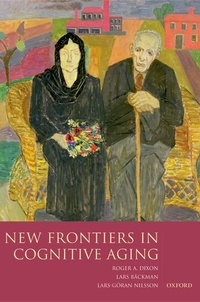
New Frontiers in Cognitive Aging
Published on 8. April 2004
Book
Hardback
372 pages
978-0-19-852569-1 (ISBN)
Description
With an ever increasing population of aging people in the western world, it is more crucial than ever that we try to understand how and why cognitive competence breaks down with advancing age; why do some people follow normal patterns of cognitive change, while others follow a path of progressive decline, with neurodegenerative diseases such as Alzheimer's. What can be done to prevent cognitive decline - or to avoid neurodegenerative diseases? The answers, if they come, will not emerge from research within one discipline, but from work being done across a range of scientific and medical specialities.
This volume brings together leading experts from a range of fields studying cognitive aging, including neuroscience, pharmacology, health, genetics, sensory biology, and epidemiology. Unlike other books in this area, this book is more about 'new frontiers' than past research and accomplishments. Recently cognitive aging research has taken several new directions, linking with, and benefiting from, rapid technological and theoretical advances in these neighbouring disciplines. This book provides unique interdisciplinary coverage of the topic. With each chapter including commentaries from specialists in related fields, the book provides an integrative study of the topic. For those within the fields of psychology, cognitive neuroscience, and geriatrics, this volume will make an important contribution in furthering our understanding of a problem that affects us all.
This volume brings together leading experts from a range of fields studying cognitive aging, including neuroscience, pharmacology, health, genetics, sensory biology, and epidemiology. Unlike other books in this area, this book is more about 'new frontiers' than past research and accomplishments. Recently cognitive aging research has taken several new directions, linking with, and benefiting from, rapid technological and theoretical advances in these neighbouring disciplines. This book provides unique interdisciplinary coverage of the topic. With each chapter including commentaries from specialists in related fields, the book provides an integrative study of the topic. For those within the fields of psychology, cognitive neuroscience, and geriatrics, this volume will make an important contribution in furthering our understanding of a problem that affects us all.
Reviews / Votes
Most of the individual chapters are easy to understand even for the non-specialist in cognitive neuroscience . . . as a non-cognitive neuroscientist, I found it extremely interesting . . . for some who wish to appraise themselves of the state of the art and future areas of exploration this would be fruitful reading. * The Lancet Neurology, Vol 3 *More details
Language
English
Place of publication
Oxford
United Kingdom
Target group
Professional and scholarly
Illustrations
numeous figures
Dimensions
Height: 242 mm
Width: 162 mm
Thickness: 25 mm
Weight
790 gr
ISBN-13
978-0-19-852569-1 (9780198525691)
Copyright in bibliographic data and cover images is held by Nielsen Book Services Limited or by the publishers or by their respective licensors: all rights reserved.
Schweitzer Classification
Persons
Dixon, Roger (Department of Psychology, University of Alberta, Edmonton, Canada) / Backman, Lars (Karolinska Institute, Stockholm, Sweden) / Nilsson, Lars-Goran (Stockholm University, Stockholm, Sweden)
Content
PART I - FRONTIERS IN COGNITIVE AGING ; PART II - NEW THEORETICAL ORIENTATIONS IN COGNITIVE AGING ; PART III - NEW DIRECTIONS IN THE COGNITIVE NEUROSCIENCE OF AGING ; PART IV - FRONTIERS OF BIOLOGICAL AND HEALTH EFFECTS OF COGNITIVE AGING ; PART V - FINAL FRONTIERS? NEW RESEARCH DIRECTIONS, PERSPECTIVES AND IMPERATIVES