

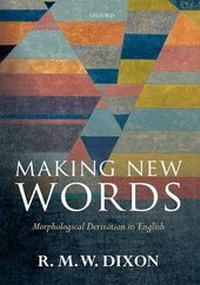
Making New Words
Morphological Derivation in English
Published on 21. August 2014
Book
Paperback/Softback
470 pages
978-0-19-871237-4 (ISBN)
Description
Making New Words provides a detailed study of the 200 or so prefixes and suffixes which create new words in today's English. Alongside a systematic discussion of these forms, Professor Dixon explores and explains the hundreds of conundrums that seem to be exceptions to general rules. Why, for instance, do we say un-distinguished (with prefix un-) but in-distinguishable (with in-); why un-ceasing but in-cesssant? Why, alongside gold-en, do we say silver-y (not silver-en)? Why is it wood-en (not wood-ic) but metall-ic (not metall-en)?
After short preliminary chapters, which set the scene and outline the criteria employed, there are accounts of the derivation of negative words, of other derivations which do not change word class, on making new verbs, new adjectives, new nouns, and new adverbs. The final chapter deals with combinations of suffixes, of prefixes, and of the two together. Within each chapter, derivational affixes are arranged in semantic groups, the members of which are contrasted with respect to meaning and function; for example, child-less and child-free. For each affix there is an account of its genetic origin (from Old English, Greek, Latin, French, and so on), its phonological form and implications for stress placement, the roots it can be attached to (and why), and how its range of meanings has developed over the centuries. The book is written in the author's accustomed style - clear and well-organised, with easy-to-understand explanations. The exposition is illustrated by examples, ranging from Shakespeare, W. S. Gilbert, and modern novels to what was heard on the radio. It will be an invaluable text and sourcebook for scholars and students of the English language and of general linguistics, from undergraduate level upwards. The many fascinating facts presented here, in such a lucid and accessible manner, will also appeal to the general reader interested in picking to pieces the English language to see how it works.
After short preliminary chapters, which set the scene and outline the criteria employed, there are accounts of the derivation of negative words, of other derivations which do not change word class, on making new verbs, new adjectives, new nouns, and new adverbs. The final chapter deals with combinations of suffixes, of prefixes, and of the two together. Within each chapter, derivational affixes are arranged in semantic groups, the members of which are contrasted with respect to meaning and function; for example, child-less and child-free. For each affix there is an account of its genetic origin (from Old English, Greek, Latin, French, and so on), its phonological form and implications for stress placement, the roots it can be attached to (and why), and how its range of meanings has developed over the centuries. The book is written in the author's accustomed style - clear and well-organised, with easy-to-understand explanations. The exposition is illustrated by examples, ranging from Shakespeare, W. S. Gilbert, and modern novels to what was heard on the radio. It will be an invaluable text and sourcebook for scholars and students of the English language and of general linguistics, from undergraduate level upwards. The many fascinating facts presented here, in such a lucid and accessible manner, will also appeal to the general reader interested in picking to pieces the English language to see how it works.
Reviews / Votes
Every teacher and student of English linguistics should possess this excellent book ... a truly monumental work. * Pavol Stekauer, Language *More details
Language
English
Place of publication
Oxford
United Kingdom
Target group
College/higher education
Professional and scholarly
Dimensions
Height: 247 mm
Width: 183 mm
Thickness: 28 mm
Weight
816 gr
ISBN-13
978-0-19-871237-4 (9780198712374)
Copyright in bibliographic data and cover images is held by Nielsen Book Services Limited or by the publishers or by their respective licensors: all rights reserved.
Schweitzer Classification
Other editions
Additional editions
E-Book
08/2014
1st Edition
OUP eBook
€31.99
Available for download
Book
08/2014
Oxford University Press
€170.23
Shipment within 15-20 days
Person
R. M. W. Dixon is Adjunct Professor and Deputy Director of the Language and Culture Research Centre at James Cook University. He has published grammars of a number of Australian languages (including Dyirbal and Yidin), in addition to A Grammar of Boumaa Fijian (University of Chicago Press, 1988), The Jarawara Language of Southern Amazonia (OUP, 2004; paperback 2011) and A Semantic Approach to English Grammar (Oxford University Press, 2005). He is also the author of the three volume work Basic Linguistic Theory (OUP, 2010-12) and his book Edible Gender will be published by OUP in 2015.
Content
1. Preliminaries ; 2. How to make new words ; 3. Criteria - affixes, semi-affixes, and compounds ; 4. What we describe ; 5. Un-expected, mis-judged, dis-organized counter-revolution: Making negative words ; 6. Ultra-patriotic, extra-special, pre-election pseudo-promise: Keeping the same word class ; 7. Be-feather, smart-en, em-power, beauti-fy, moral-ize: Making new verbs ; 8. Moon-like, death-ly, angr-y, mysteri-ous, memor-able: Making new adjectives ; 9. Eager-ness, bidd-ing, pay-ment, owner-ship, satisf-action: Making new nouns ; 10. Carefully, sideways, homewards, crab-fashion: Making new adverbs ; 11. Un-relent-less-ly de-west-ern-iz-ing non-mean-ing-ful infra-structures: Combining affixes ; 12. Envoi: the way of words ; Appendix 1: List of adjective and verb semantic types, with sample members ; Appendix 2: Alphabetical directory of adjective and verbs in the list of semantic types ; Glossary ; References