

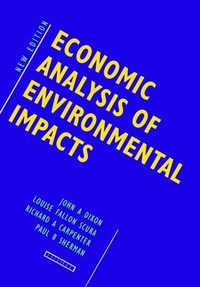
Economic Analysis of Environmental Impacts
2nd Edition
Published on 2. October 2017
Book
Hardback
224 pages
978-1-138-47166-5 (ISBN)
Description
This revised and updated guide to the environmental economics of development projects demonstrates how the environmental impacts of projects can be translated into monetary values. The theoretical bases are examined, and the techniques themselves given detailed exposition, supported by extensive case studies illustrating a wide range of applications. The text should become a useful complement to all standard forms of project analysis.
More details
Edition
2nd edition
Language
English
Place of publication
London
United Kingdom
Publishing group
Taylor & Francis Ltd
Target group
College/higher education
Dimensions
Height: 245 mm
Width: 170 mm
Weight
570 gr
ISBN-13
978-1-138-47166-5 (9781138471665)
Copyright in bibliographic data and cover images is held by Nielsen Book Services Limited or by the publishers or by their respective licensors: all rights reserved.
Schweitzer Classification
Other editions
Additional editions
John Dixon | Louise Scura | Richard Carpenter
Economic Analysis of Environmental Impacts
E-Book
11/2013
2nd Edition
Routledge
€78.99
Available for download
John Dixon | Louise Scura | Richard Carpenter
Economic Analysis of Environmental Impacts
E-Book
11/2013
2nd Edition
Routledge
€79.49
Available for download
John Dixon | Louise Scura | Richard Carpenter
Economic Analysis of Environmental Impacts
Book
11/1994
2nd Edition
Earthscan Ltd
€94.38
Shipment within 3-4 weeks
Persons
John A. Dixon, Principal Environmental Economist with the World Bank Environment Department, is widely published on the topics of applied economic analysis of environmental impacts and natural resources management. Formerly with the Environment and Policy Institute of the East-West Centre, Honolulu, he holds a Ph.D. in economics and has extensive field experience in Asia and Latin America.
Louise Fallon Scura, Natural Resources Management Specialist with the World Bank Environment Department, specializes in economic analysis of natural resource and environmental impacts, natural resource management and coastal zone management, and has significant practical experience in Asia, Africa and the Americas. She has a Ph.D. in agricultural and resource economics, a B.S. in environmental sciences and aquaculture, and worked as a biologist before switching to economics.
Richard A. Carpenter, formerly a research Associate at the Environment and Policy Institute of the East-West Center, Honolulu, is an independent consultant based in Virginia. He has a master's degree in chemistry and specializes in environmental assessment.
Paul B. Sherman, formerly with the East-West Center Environment and Policy Institute and the State of Hawaii Department of Business, Economic Development and Tourism, obtained a Ph. D. in economics and a master's degree in environmental management. His work focused on applied economic valuation, and economics of protected areas and drylands management.
Louise Fallon Scura, Natural Resources Management Specialist with the World Bank Environment Department, specializes in economic analysis of natural resource and environmental impacts, natural resource management and coastal zone management, and has significant practical experience in Asia, Africa and the Americas. She has a Ph.D. in agricultural and resource economics, a B.S. in environmental sciences and aquaculture, and worked as a biologist before switching to economics.
Richard A. Carpenter, formerly a research Associate at the Environment and Policy Institute of the East-West Center, Honolulu, is an independent consultant based in Virginia. He has a master's degree in chemistry and specializes in environmental assessment.
Paul B. Sherman, formerly with the East-West Center Environment and Policy Institute and the State of Hawaii Department of Business, Economic Development and Tourism, obtained a Ph. D. in economics and a master's degree in environmental management. His work focused on applied economic valuation, and economics of protected areas and drylands management.
Content
Part I, From Theory to Practice: Development, Environment and the Role of Economic Analysis * Assessing Impacts and Setting Priorities * Economic Measurement of Environmental Impacts - Theoretical Basis and Practical Applications * Generally Applicable Techniques of Valuing Environmental Impacts * Selectively Applicable Techniques of Valuing Impacts * Potentially Applicable Techniques of Valuing Environmental Impacts * The Limits to Economic Measurement of Environmental Impacts * Part II, Case Studies: Nepal Hill Forest Development Project * Mangrove Valuation in Bintuni Bay, Irian Jaya, Indonesia * Estimating the Health Impact of Air Pollution: Methodology and Application to Jakarta * Benefits and Costs of Soil Conservation in the Loess Plateau of China * Tongonan Geothermal Power Plant, Leyte, Philippines * The Benefits and Costs of Establishing a National Park in Madagascar * An Economic and Ecological Analysis of the Bonaire Marine Park * Willingness to Pay for Improved Water Supplies in Onitsha, Nigeria * Setting Priorities in Central and Eastern Europe * References * Index