

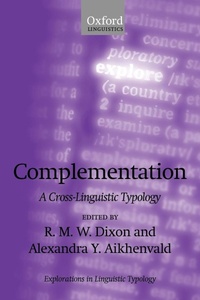
Complementation
A Cross-Linguistic Typology
Published on 28. August 2008
Book
Paperback/Softback
306 pages
978-0-19-955666-3 (ISBN)
Description
This book explores the variety of types of complementation found across the languages of the world and their grammatical properties and meanings. It shows how languages differ in the grammatical properties of complement clauses and in the types of verbs which take them, and explores the complement strategies deployed by languages which lack a complement clause construction. The book includes detailed studies of particular languages, including Akkadian, Israeli, Jarawara, and Pennsylvania German. These are framed by R. M. W. Dixon's introduction, which sets out the range of issues, and his conclusion, which draws together the evidence and the arguments.
More details
Series
Language
English
Place of publication
Oxford
United Kingdom
Target group
College/higher education
Professional and scholarly
Dimensions
Height: 234 mm
Width: 156 mm
Thickness: 17 mm
Weight
468 gr
ISBN-13
978-0-19-955666-3 (9780199556663)
Copyright in bibliographic data and cover images is held by Nielsen Book Services Limited or by the publishers or by their respective licensors: all rights reserved.
Schweitzer Classification
Other editions
Additional editions
Book
06/2006
Oxford University Press
€81.60
Shipment within 15-20 days
Persons
R.M.W. Dixon is Professor and Director of the Research Centre for Linguistic Typology at La Trobe University. He has published grammars of a number of Australian languages (including Dyirbal and Yidin), in addition to A Grammar of Boumaa Fijian (1988), The Jarawara Language of Southern Amazonia (2004) and A Semantic Approach to English Grammar (2005). His works on typological theory include Where have All the Adjectives Gone? and Other Essays (1982) and Ergativity (1994). His essay The Rise and Fall of Languages (1997) expounded a punctuated equilibrium model for language development which is the basis for his detailed case study Australian Languages: their Nature and Development (2002). He is currently working on an extensive study of the basic linguistic theory.
Alexandra Y. Aikhenvald is Professor and Associate Director of the Research Centre for Linguistic Typology at La Trobe University. She has worked on descriptive and historical aspects of Berber languages and published, in Russian, a grammar of Modern Hebrew (1990). She is a major authority on typological and areal features of South American languages, particularly of the Arawak family: Bare (1995, based on work with the last speaker, who has since died), Warekena (1998), and Tariana (2003). Her monographs include Classifiers: a Typology of Noun Categorization Devices (2000, 2003), Language Contact in Amazonia (2002) and Evidentiality (2004), all published by OUP. She is currently working on a reference grammar of Manambu, from the Sepik area of New Guinea.
Alexandra Y. Aikhenvald is Professor and Associate Director of the Research Centre for Linguistic Typology at La Trobe University. She has worked on descriptive and historical aspects of Berber languages and published, in Russian, a grammar of Modern Hebrew (1990). She is a major authority on typological and areal features of South American languages, particularly of the Arawak family: Bare (1995, based on work with the last speaker, who has since died), Warekena (1998), and Tariana (2003). Her monographs include Classifiers: a Typology of Noun Categorization Devices (2000, 2003), Language Contact in Amazonia (2002) and Evidentiality (2004), all published by OUP. She is currently working on a reference grammar of Manambu, from the Sepik area of New Guinea.
Content
1. Complement Clauses and Complementation Strategies in Typological Perspective ; 2. Complement Clause Types in Pennsylania German ; 3. Complement Clause Types in Israeli ; 4. Complement Clause Type and Complementation Strategy in Jarawara ; 5. Complement Clause Types and Complementation Strategy in White Hmong ; 6. Complement Clause Types and Complementation Strategy in Dolakha Newar ; 7. Complement Clause Types and Complementation Strategies in Akkadian ; 8. Complement Clause Types and Complementation Strategies in Tariana ; 9. Complement Clause Type and Complementation Strategies in Goemai ; 10. Complement Clause Type and Complementation Strategies in Matses ; 11. Complement Clause Type and Complementation Strategy in Kambera ; 12. Complementation Strategies in Dyirbal ; Author Index ; Language and Language Family Index ; Subject Index