

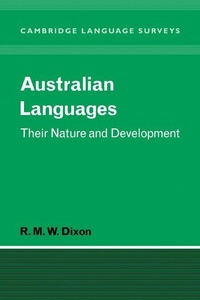
Australian Languages
Their Nature and Development
Published on 5. November 2007
Book
Paperback/Softback
780 pages
978-0-521-04604-6 (ISBN)
Description
Aboriginal people have been in Australia for at least 40,000 years, speaking about 250 languages. Through examination of published and unpublished materials on each of the individual languages, Professor Dixon surveys the ways in which the languages vary typologically and presents a profile of this long-established linguistic area. The areal distribution of most features is illustrated with more than 30 maps, showing that the languages tend to move in cyclic fashion with respect to many of the parameters. There is also an index of languages and language groups. Professor Dixon, a pioneering scholar in the field, brings an interesting perspective to this diverse and complex material.
More details
Series
Language
English
Place of publication
Cambridge
United Kingdom
Target group
Professional and scholarly
Product notice
Paperback (trade)
Illustrations
38 Tables, unspecified; 33 Maps; 3 Line drawings, unspecified
Dimensions
Height: 229 mm
Width: 152 mm
Thickness: 41 mm
Weight
1108 gr
ISBN-13
978-0-521-04604-6 (9780521046046)
Copyright in bibliographic data and cover images is held by Nielsen Book Services Limited or by the publishers or by their respective licensors: all rights reserved.
Schweitzer Classification
Other editions
Additional editions
E-Book
01/2005
1st Edition
Cambridge University Press
€93.49
Available for download
Person
R. M. W. Dixon is Director of the Research Centre for Linguistic Typology at La Trobe University, Victoria.
Content
List of maps; List of abbreviations and conventions; Preface; Acknowledgements; Conventions followed; List of languages and language groups; 1. The language situation in Australia; 2. Modelling the language situation; 3. Overview; 4. Vocabulary; 5. Case and other nominal suffixes; 6. Verbs; 7. Pronouns; 8. Bound pronouns; 9. Prefixing and fusion; 10. Generic nouns, classifiers, genders and noun classes; 11. Ergative/accusative morphological and syntactic profiles; 12. Phonology; 13. Genetic subgroups and small linguistic areas; 14. Summary and conclusion; References; Index of languages, dialects and language groups; Subject index.