

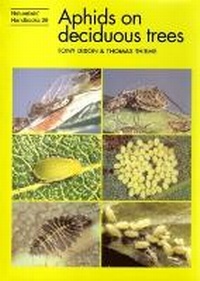
Aphids on deciduous trees
1st Edition
Published on 12. July 2007
Book
Paperback/Softback
138 pages
978-0-85546-314-4 (ISBN)
Description
Aphids are tempting subjects for investigation because they are often abundant, easily found, and unlikely to run away, and because of intriguing facts about their biology such as polyphenism, parthenogenesis, gall formation, and the production of a soldier morph. However, until now identification has presented a severe challenge to the beginner, because there are so many rather similar species, many of which have several different forms. The authors make this much-needed Naturalists' Handbook accessible by confining themselves to aphids living on broad-leaved trees. This has reduced the problems of identification to manageable proportions and should encourage more field studies of this important and ubiquitous group of insects.
This is a digital reprint (without updates) of ISBN 9780855463144 (2007).
This is a digital reprint (without updates) of ISBN 9780855463144 (2007).
More details
Series
Language
English
Place of publication
Slough
United Kingdom
Target group
Professional and scholarly
US School Grade: Third Grade
Illustrations
16 farbige Bildtafeln, s/w Abbildungen, 35 Schaubilder
Illustrations, black and white; 35 Figures; 16 Plates, color
Dimensions
Height: 210 mm
Width: 148 mm
Weight
270 gr
ISBN-13
978-0-85546-314-4 (9780855463144)
Copyright in bibliographic data and cover images is held by Nielsen Book Services Limited or by the publishers or by their respective licensors: all rights reserved.
Schweitzer Classification
Other editions
New editions
Tony Dixon | Thomas Thieme
Aphids on deciduous trees
Book
11/2020
Pelagic Publishing
€48.90
Shipment within 10-15 days
Content
Introduction;
Aphids: Distribution; Evolution; Size; Food; Symbionts; Host specificity; Reproduction; Life cycle; Dispersal;
Trees as habitat: Seasonality; Trees' commitment to defence;
Natural enemies: Natural enemies of aphids; Structure of aphidophagous mechanisms;
Abundance: Role of natural enemies; Role of host abundance; Role of intraspecific competition;
Sex: Mechanism; Sex ratio;
Distribution and global warming: Regional distribution; Global warming and distribution; Global warming and aphid abundance;
Identification: Introduction to the keys; Terms; Preparing aphids for identification; The keys; Descriptions of genera and species;
Techniques and approaches to original work: Collecting and observing aphids in the field; Rearing aphids in the laboratory; Experiments;
Useful addresses; References and further reading.
Aphids: Distribution; Evolution; Size; Food; Symbionts; Host specificity; Reproduction; Life cycle; Dispersal;
Trees as habitat: Seasonality; Trees' commitment to defence;
Natural enemies: Natural enemies of aphids; Structure of aphidophagous mechanisms;
Abundance: Role of natural enemies; Role of host abundance; Role of intraspecific competition;
Sex: Mechanism; Sex ratio;
Distribution and global warming: Regional distribution; Global warming and distribution; Global warming and aphid abundance;
Identification: Introduction to the keys; Terms; Preparing aphids for identification; The keys; Descriptions of genera and species;
Techniques and approaches to original work: Collecting and observing aphids in the field; Rearing aphids in the laboratory; Experiments;
Useful addresses; References and further reading.