

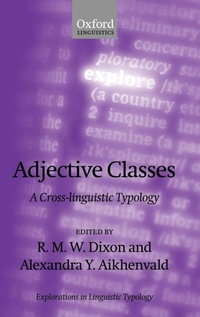
Adjective Classes
A Cross-Linguistic Typology
Published on 16. September 2004
Book
Hardback
392 pages
978-0-19-927093-4 (ISBN)
Description
This book shows that every language has an adjective class and examines how these vary in size and character. The opening chapter considers current generalizations about the nature and classification of adjectives and sets out the cross-linguistic parameters of their variation. Thirteen chapters then explore adjective classes in languages from North, Central and South America, Europe, Africa, Asia, and the Pacific. Studies of well-known languages such as Russian, Japanese, Korean and Lao are juxtaposed with the languages of small hunter-gatherer and slash-and-burn agriculturalist groups. All are based on fine-grained field research. The nature and typology of adjective classes are then reconsidered in the conclusion.
This pioneering work shows, among other things, that the grammatical properties of the adjective class may be similar to nouns or verbs or both or neither; that some languages have two kinds of adjectives, one hard to distinguish from nouns and the other from verbs; that the adjective class can sometimes be large and open, and in other cases small and closed.
The book will interest scholars and advanced students of language typology and of the syntax and semantics of adjectives.
Each book in this series focuses on an aspect of language that is of current theoretical interest and for which there has not previously or recently been any full-scale cross-linguistic study. The series is for typologists, fieldworkers, and theory developers at graduate level and above. The books will be suited for use as the basis for advanced seminars and courses. The subjects of next three volumes will be serial verb constructions, complementation, and grammars in contact.
This pioneering work shows, among other things, that the grammatical properties of the adjective class may be similar to nouns or verbs or both or neither; that some languages have two kinds of adjectives, one hard to distinguish from nouns and the other from verbs; that the adjective class can sometimes be large and open, and in other cases small and closed.
The book will interest scholars and advanced students of language typology and of the syntax and semantics of adjectives.
Each book in this series focuses on an aspect of language that is of current theoretical interest and for which there has not previously or recently been any full-scale cross-linguistic study. The series is for typologists, fieldworkers, and theory developers at graduate level and above. The books will be suited for use as the basis for advanced seminars and courses. The subjects of next three volumes will be serial verb constructions, complementation, and grammars in contact.
Reviews / Votes
A very useful and usable resource * Andrew Spencer, Language, vol. 84, no.2, 2008 * The articles are of consistently high quality and the range of language types represented, like the calibre of the researchers themselves, is impressive ... Dixon and Aikhenveld are to be congratulated on bringing together...a first-rate cast of linguists working on such a diverse set of the world's languages ... a remarkable volume ... This volume and the papers in it represent a major advance in parts of speech typology and will surely frame the debate in the nature of adjectives, and lexical classes, and their role in grammatical and typological theory for years to come. * David Beck, Functions of Language * ...makes a major contribution to the general study of parts of speech across languages... The editors of this book have provided a much-needed analytical framework for typologizing the key distinctions in how the adjective manifests itself as a part of speech. * Edward J Vajda, Western Washington University *More details
Series
Language
English
Place of publication
Oxford
United Kingdom
Target group
Professional and scholarly
Illustrations
numerous tables
Dimensions
Height: 240 mm
Width: 161 mm
Thickness: 26 mm
Weight
757 gr
ISBN-13
978-0-19-927093-4 (9780199270934)
Copyright in bibliographic data and cover images is held by Nielsen Book Services Limited or by the publishers or by their respective licensors: all rights reserved.
Schweitzer Classification
Other editions
Additional editions
Book
05/2006
Oxford University Press
€87.10
Shipment within 15-20 days
Persons
R. M. W. Dixon is Professor and Director of the Research Centre for Linguistic Typology at La Trobe University. He has published grammars of a number of Australian languages (including Dyirbal and Yidin), in addition to A Grammar of Boumaa Fijian (University of Chicago Press 1988), A New Approach to English Grammar, on Semantic Principles (Oxford University Press 1991, revised edition in preparation), and The Jarawara language of southern Amazonia (Oxford UP 2004). His books on typological theory include Where have all the Adjectives Gone? and other Essays in Semantics and Syntax (1982) and Ergativity (1994). His essay The Rise and Fall of Languages (1997) expounded a punctuated equilibrium model for language development which is the basis for his detailed case study Australian Languages: their Nature and Development (2002). He is currently working on an extensive study of basic linguistic theory.
Alexandra Y. Aikhenvald is Professor and Associate Director of the Research Centre for Linguistic Typology at La Trobe University. She has worked on descriptive and historical aspects of Berber languages and has published in Russian a grammar of Modern Hebrew (1990). She is a major authority on languages of the Arawak family of northern Amazonia, and has written grammars of Bare (1995, based on work with the last speaker who has since died) and Warekena (1998), plus A Grammar of Tariana, from Northwest Amazonia (Cambridge University Press 2003). Her books include Classifiers: a Typology of Noun Categorization devices (OUP 2000, paperback reissue 2003), Language Contact in Amazonia (OUP 2002), and Evidentiality (OUP 2004). She is currently working on grammatical description of Manambu, from the Sepik region of New Guinea.
Alexandra Y. Aikhenvald is Professor and Associate Director of the Research Centre for Linguistic Typology at La Trobe University. She has worked on descriptive and historical aspects of Berber languages and has published in Russian a grammar of Modern Hebrew (1990). She is a major authority on languages of the Arawak family of northern Amazonia, and has written grammars of Bare (1995, based on work with the last speaker who has since died) and Warekena (1998), plus A Grammar of Tariana, from Northwest Amazonia (Cambridge University Press 2003). Her books include Classifiers: a Typology of Noun Categorization devices (OUP 2000, paperback reissue 2003), Language Contact in Amazonia (OUP 2002), and Evidentiality (OUP 2004). She is currently working on grammatical description of Manambu, from the Sepik region of New Guinea.
Content
1. Adjective Classes in Typological Perspective ; 2. Inflected and Uninflected Adjective in Japanese ; 3. The Two Adjective Classes in Manange ; 4. The Adjective Class in Tariana ; 5. Adjectives in Mam ; 6. Adjectives in Papantla Totonac ; 7. The Small Adjective Class in Jarawara ; 8. The Russian Adjective: A pervasive yet elusive category ; 9. The Adjective Class in Korean ; 10. Is there an Adjective Class in Wolof? ; 11. Adjectives in North-east Ambae ; 12. Adjectives in Semelai ; 13. Adjectives in Qiang ; 14. Adjectives in Lao ; 15. Adjectives: What can we conclude?