


Acceptance and Commitment Therapy for Behavior Analysts
A Practice Guide from Theory to Treatment
1st Edition
Published on 16. March 2023
Book
Hardback
300 pages
978-1-032-16809-8 (ISBN)
Description
This book provides a thorough discussion of acceptance and commitment therapy or training (ACT) and a guide for its use by behavior analysts. The book emphasizes how the intentional development of six core behavioral processes - values, committed action, acceptance, defusion, self-as-context, and present moment awareness - help establish the psychological flexibility needed to acquire and maintain adaptive behaviors that compete with maladaptive behavior patterns in verbally able clients.
Split into three parts, the book discusses the history and controversy surrounding the rise of acceptance and commitment strategies in behavior analysis and shows how the processes underlying ACT are linked to foundational behavioral scientific principles as amplified by stimulus equivalence and relational learning principles such as those addressed by relational frame theory. In a careful step-by-step way, it describes the best practices for administering the acceptance and commitment procedures at the level of the individual client, organizational systems, and with families. Attention is also given to the ethical and scope-of-practice considerations for behavior analysts, along with recommendations for conducting on-going research on this new frontier for behavior analytic treatment across a myriad of populations and behaviors. Written by leading experts in the field, the book argues that practice must proceed from the basic tenants of behavior analysis, and that now is the opportune moment to bring ACT methods to behavior analysts to maximize the scope and depth of behavioral treatments for all people.
Acceptance and Commitment Therapy for Behavior Analysts will be an essential read for students of behavior analysis and behavior therapy, as well as for individuals on graduate training programs that prepare behavior analysts and professionals that are likely to use ACT in their clinical practice and research.
Split into three parts, the book discusses the history and controversy surrounding the rise of acceptance and commitment strategies in behavior analysis and shows how the processes underlying ACT are linked to foundational behavioral scientific principles as amplified by stimulus equivalence and relational learning principles such as those addressed by relational frame theory. In a careful step-by-step way, it describes the best practices for administering the acceptance and commitment procedures at the level of the individual client, organizational systems, and with families. Attention is also given to the ethical and scope-of-practice considerations for behavior analysts, along with recommendations for conducting on-going research on this new frontier for behavior analytic treatment across a myriad of populations and behaviors. Written by leading experts in the field, the book argues that practice must proceed from the basic tenants of behavior analysis, and that now is the opportune moment to bring ACT methods to behavior analysts to maximize the scope and depth of behavioral treatments for all people.
Acceptance and Commitment Therapy for Behavior Analysts will be an essential read for students of behavior analysis and behavior therapy, as well as for individuals on graduate training programs that prepare behavior analysts and professionals that are likely to use ACT in their clinical practice and research.
More details
Series
Language
English
Place of publication
London
United Kingdom
Publishing group
Taylor & Francis Ltd
Target group
College/higher education
Professional and scholarly
Postgraduate and Professional
Illustrations
21 s/w Zeichnungen, 29 s/w Abbildungen, 8 s/w Photographien bzw. Rasterbilder
21 Line drawings, black and white; 8 Halftones, black and white; 29 Illustrations, black and white
Dimensions
Height: 260 mm
Width: 183 mm
Thickness: 21 mm
Weight
777 gr
ISBN-13
978-1-032-16809-8 (9781032168098)
Copyright in bibliographic data and cover images is held by Nielsen Book Services Limited or by the publishers or by their respective licensors: all rights reserved.
Schweitzer Classification
Other editions
Additional editions
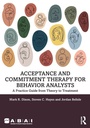
Mark R. Dixon | Steven C. Hayes | Jordan Belisle
Acceptance and Commitment Therapy for Behavior Analysts
A Practice Guide from Theory to Treatment
Book
03/2023
1st Edition
Routledge
€72.00
Shipment within 10-20 days
Mark R. Dixon | Steven C. Hayes | Jordan Belisle
Acceptance and Commitment Therapy for Behavior Analysts
A Practice Guide from Theory to Treatment
E-Book
03/2023
1st Edition
Routledge
€67.49
Available for download
Mark R. Dixon | Steven C. Hayes | Jordan Belisle
Acceptance and Commitment Therapy for Behavior Analysts
A Practice Guide from Theory to Treatment
E-Book
03/2023
1st Edition
Routledge
€67.49
Available for download
Persons
Mark R. Dixon is a clinical professor in the Department of Disability and Human Development at the University of Illinois Chicago, USA.
Steven C. Hayes is Nevada Foundation Professor in the Behavior Analysis program at the Department of Psychology at University of Nevada, USA.
Jordan Belisle is an associate professor in the Psychology Department at Missouri State University, USA.
Steven C. Hayes is Nevada Foundation Professor in the Behavior Analysis program at the Department of Psychology at University of Nevada, USA.
Jordan Belisle is an associate professor in the Psychology Department at Missouri State University, USA.
Content
Part 1: History and Theory Underlying ACT
1. Behavior Analysis and the Functional Approach to Intervention
2. A Brief History of the Science Underlying ACT
3. Psychological Flexibility and the ACT-Based Approach
4. Models of Psychological Flexibility
Part 2: Approaching Act Processes Functionally and Analytically
5. Present Moment
6. Acceptance
7. Defusion
8. Values
9. Committed Action
10. Self-as-Context
Part 3: Promoting Psychological Flexibility with Clients and in our Field
11. The ACT Assessment Process
12. The ACT Treatment Process
13. Research
14. Ethical Decision-Making
1. Behavior Analysis and the Functional Approach to Intervention
2. A Brief History of the Science Underlying ACT
3. Psychological Flexibility and the ACT-Based Approach
4. Models of Psychological Flexibility
Part 2: Approaching Act Processes Functionally and Analytically
5. Present Moment
6. Acceptance
7. Defusion
8. Values
9. Committed Action
10. Self-as-Context
Part 3: Promoting Psychological Flexibility with Clients and in our Field
11. The ACT Assessment Process
12. The ACT Treatment Process
13. Research
14. Ethical Decision-Making