

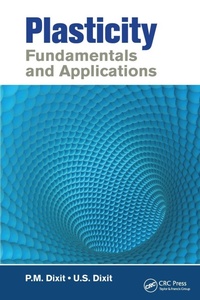
Plasticity
Fundamentals and Applications
1st Edition
Published on 23. August 2018
Book
Paperback/Softback
602 pages
978-1-138-07496-5 (ISBN)
Description
Explores the Principles of Plasticity
Most undergraduate programs lack an undergraduate plasticity theory course, and many graduate programs in design and manufacturing lack a course on plasticity-leaving a number of engineering students without adequate information on the subject. Emphasizing stresses generated in the material and its effect, Plasticity: Fundamentals and Applications effectively addresses this need. This book fills a void by introducing the basic fundamentals of solid mechanics of deformable bodies. It provides a thorough understanding of plasticity theory, introduces the concepts of plasticity, and discusses relevant applications.
Studies the Effects of Forces and Motions on Solids
The authors make a point of highlighting the importance of plastic deformation, and also discuss the concepts of elasticity (for a clear understanding of plasticity, the elasticity theory must also be understood). In addition, they present information on updated Lagrangian and Eulerian formulations for the modeling of metal forming and machining.
Topics covered include:
Stress
Strain
Constitutive relations
Fracture
Anisotropy
Contact problems
Plasticity: Fundamentals and Applications
enables students to understand the basic fundamentals of plasticity theory, effectively use commercial finite-element (FE) software, and eventually develop their own code. It also provides suitable reference material for mechanical/civil/aerospace engineers, material processing engineers, applied mechanics researchers, mathematicians, and other industry professionals.
Most undergraduate programs lack an undergraduate plasticity theory course, and many graduate programs in design and manufacturing lack a course on plasticity-leaving a number of engineering students without adequate information on the subject. Emphasizing stresses generated in the material and its effect, Plasticity: Fundamentals and Applications effectively addresses this need. This book fills a void by introducing the basic fundamentals of solid mechanics of deformable bodies. It provides a thorough understanding of plasticity theory, introduces the concepts of plasticity, and discusses relevant applications.
Studies the Effects of Forces and Motions on Solids
The authors make a point of highlighting the importance of plastic deformation, and also discuss the concepts of elasticity (for a clear understanding of plasticity, the elasticity theory must also be understood). In addition, they present information on updated Lagrangian and Eulerian formulations for the modeling of metal forming and machining.
Topics covered include:
Stress
Strain
Constitutive relations
Fracture
Anisotropy
Contact problems
Plasticity: Fundamentals and Applications
enables students to understand the basic fundamentals of plasticity theory, effectively use commercial finite-element (FE) software, and eventually develop their own code. It also provides suitable reference material for mechanical/civil/aerospace engineers, material processing engineers, applied mechanics researchers, mathematicians, and other industry professionals.
Reviews / Votes
"This book has been written in a way that a plasticity course can be offered to graduate students without previous solid mechanics background. The concept of Cartesian vectors and tensors in index notation is discussed in chapter 2 to prepare students for understanding the topics presented in subsequent chapters. ... This book emphasizes the application of plasticity in solving engineering problems. Eulerian and updated Lagrangian formulations, calculus of variations and extreme principles are discussed in chapters 6 and 7 to prepare students for numerical calculation."-Han-Chin Wu, University of Iowa, Iowa City, USA
"The book is successful in presenting a modern treatment of plasticity theories without sacrificing details both at the conceptual and the applied level. The breadth of applications covered is unique and includes a wide range of
disciplines ranging from contact mechanics to fracture. In this the book will find no parallels in the modern literature on plasticity."
-Prof. Anurag Gupta, Indian Institute of Technology Kanpur
"Comprehensive coverage from mathematic tools to constitutive formulations, from application examples to computational aspects."
-Tongxi Yu, Hong Kong University of Science and Technology (HKUST)
More details
Language
English
Place of publication
London
United Kingdom
Publishing group
Taylor & Francis Ltd
Target group
College/higher education
Mechanical/civil/aerospace engineers, material processing engineers, applied mechanics researchers, mathematicians, industries.
Product notice
Paperback (trade)
Unsewn / adhesive bound
Illustrations
115 s/w Abbildungen, 7 s/w Tabellen
7 Tables, black and white; 115 Illustrations, black and white
Dimensions
Height: 234 mm
Width: 156 mm
Thickness: 31 mm
Weight
830 gr
ISBN-13
978-1-138-07496-5 (9781138074965)
Copyright in bibliographic data and cover images is held by Nielsen Book Services Limited or by the publishers or by their respective licensors: all rights reserved.
Schweitzer Classification
Other editions
Additional editions
Book
10/2014
1st Edition
CRC Press
€245.12
Article exhausted; check for reprint
E-Book
10/2014
1st Edition
CRC Press
€76.49
Available for download
E-Book
10/2014
1st Edition
CRC Press
€76.49
Available for download
Persons
Dr. P.M. Dixit
obtained a bachelor's degree in aeronautical engineering from the Indian Institute of Technology (IIT) Kharagpur in 1974 and a PhD in mechanics in 1979 from the University of Minnesota, Minneapolis, USA. He joined the Department of Mechanical Engineering at the IIT Kanpur in 1984, where he is currently a professor. For the past 25 years, he has been working in the area of computational plasticity with applications for metal-forming processes and ductile fracture in impact problems using finite element method as a computational tool. He has published approximately 50 journal papers, 25 conference papers, and two books.
Dr. U.S. Dixit
obtained a bachelor's degree in mechanical engineering from the University of Roorkee (now Indian Institute of Technology Roorkee) in 1987, an MTech in mechanical engineering from Indian Institute of Technology (IIT) Kanpur in 1993, and a PhD in mechanical engineering from IIT Kanpur in 1998. A professor for the department of mechanical engineering, Indian Institute of Technology Guwahati, Dr. Dixit has published numerous papers and three books. He has also edited a book on metal forming, guest-edited a number of special journal issues, and is an associate editor for the Journal of Institution of Engineers Series C.
obtained a bachelor's degree in aeronautical engineering from the Indian Institute of Technology (IIT) Kharagpur in 1974 and a PhD in mechanics in 1979 from the University of Minnesota, Minneapolis, USA. He joined the Department of Mechanical Engineering at the IIT Kanpur in 1984, where he is currently a professor. For the past 25 years, he has been working in the area of computational plasticity with applications for metal-forming processes and ductile fracture in impact problems using finite element method as a computational tool. He has published approximately 50 journal papers, 25 conference papers, and two books.
Dr. U.S. Dixit
obtained a bachelor's degree in mechanical engineering from the University of Roorkee (now Indian Institute of Technology Roorkee) in 1987, an MTech in mechanical engineering from Indian Institute of Technology (IIT) Kanpur in 1993, and a PhD in mechanical engineering from IIT Kanpur in 1998. A professor for the department of mechanical engineering, Indian Institute of Technology Guwahati, Dr. Dixit has published numerous papers and three books. He has also edited a book on metal forming, guest-edited a number of special journal issues, and is an associate editor for the Journal of Institution of Engineers Series C.
Content
Solid Mechanics and Its Applications. Review of Algebra and Calculus of Vectors and Tensors. Stress. Measures of Deformation and Rate of Deformation. Incremental and Rate Type of Elastic-Plastic Constitutive Relations for Isotropic Materials, Objective Incremental Stress and Stress Rate Measures. Eulerian and Updated Lagrangian Formulations. Calculus of Variations and Extremum Principles. Two-Dimensional and Axisymmetric Elasto-Plastic Problems. Contact Mechanics. Dynamic Elasto-Plastic Problems. Continuum Damage Mechanics and Ductile Fracture. Plastic Anisotropy. References. Index.