

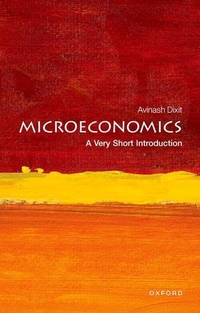
Microeconomics
A Very Short Introduction
Published on 24. April 2014
Book
Paperback/Softback
160 pages
978-0-19-968937-8 (ISBN)
Description
Microeconomics - individuals' choices of where to live and work, how much to save, what to buy, and firms' decisions about location, hiring, firing, and investment - involves issues that concern us on a daily basis. But when people think about economics, they tend to place importance on the bigger picture - macroeconomics - including issues such as unemployment, inflation, and the competitiveness of nations.
In this Very Short Introduction, Avinash Dixit argues that the microeconomy has a large impact on the economic world, arguably as much as the issues of macroeconomics.
Dixit steers a clear path through the huge number of issues related to microeconomics, explaining what happens when things go well, as well as showing how they fail, why that happens, and what can be done about it. Using real-life examples from around the world, using the minimum of mathematics and including simple graphs, he provides insights into economics from psychology and sociology to explain economic behaviour and rational choice. An ideal introduction for anyone interested in business and economics.
ABOUT THE SERIES: The Very Short Introductions series from Oxford University Press contains hundreds of titles in almost every subject area. These pocket-sized books are the perfect way to get ahead in a new subject quickly. Our expert authors combine facts, analysis, perspective, new ideas, and enthusiasm to make interesting and challenging topics highly readable.
In this Very Short Introduction, Avinash Dixit argues that the microeconomy has a large impact on the economic world, arguably as much as the issues of macroeconomics.
Dixit steers a clear path through the huge number of issues related to microeconomics, explaining what happens when things go well, as well as showing how they fail, why that happens, and what can be done about it. Using real-life examples from around the world, using the minimum of mathematics and including simple graphs, he provides insights into economics from psychology and sociology to explain economic behaviour and rational choice. An ideal introduction for anyone interested in business and economics.
ABOUT THE SERIES: The Very Short Introductions series from Oxford University Press contains hundreds of titles in almost every subject area. These pocket-sized books are the perfect way to get ahead in a new subject quickly. Our expert authors combine facts, analysis, perspective, new ideas, and enthusiasm to make interesting and challenging topics highly readable.
Reviews / Votes
One of The Financial Times Best Books of 2014 Dixit demonstrates in this accessible book that economists do at least know a great deal more than nothing about microeconomics * Lorien Kite, Book of the Year 2014, Financial Times * [A]ccessible and straight-talking * Rutland Mercury *More details
Series
Language
English
Place of publication
Oxford
United Kingdom
Target group
College/higher education
Illustrations
17 black and white illustrations
Dimensions
Height: 172 mm
Width: 113 mm
Thickness: 12 mm
Weight
127 gr
ISBN-13
978-0-19-968937-8 (9780199689378)
Copyright in bibliographic data and cover images is held by Nielsen Book Services Limited or by the publishers or by their respective licensors: all rights reserved.
Schweitzer Classification
Other editions
Additional editions
E-Book
04/2014
OUP eBook
€9.49
Available for download
E-Book
04/2014
OUP eBook
€9.49
Available for download
Person
Avinash Dixit is John J. F. Sherrerd '52 University Professor of Economics Emeritus at Princeton University. He is also a Distinguished Adjunct Professor of Economics at Lingnan University, Hong Kong, and a Senior Research Fellow at Nuffield College, Oxford. His research interests have included microeconomic theory, game theory, international trade, industrial organization, growth and development theories, public economics, political economy, and the new institutional economics.
Content
FURTHER READING