

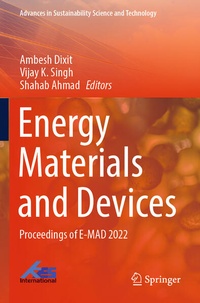
Energy Materials and Devices
Proceedings of E-MAD 2022
Published on 2. April 2025
Book
Paperback/Softback
XVI, 362 pages
978-981-99-9011-5 (ISBN)
Description
This book is a collection of peer-reviewed best-selected research papers presented at the National Conference on Energy Materials and Devices (E-MAD 2022), organized by the Indian Institute of Technology Jodhpur, India, during 16-18 December 2022. The book focusses on the current state-of-the-art research and development in the field of lithium and beyond lithium-ion batteries as electrochemical energy storage devices for sustainable development to meet the energy storage needs. This includes the materials' design using computational approaches together with experimental advances targeting the next-generation energy storage materials and devices such as photo rechargeable batteries. In addition, the proceedings also focus simultaneously on green hydrogen energy generation, storage, and integration in fuel cells. It includes the catalytically active nanoengineered materials for hydrogen generation, functionalized hydrides and their composites for enhanced hydrogen storage together withtheir possible integration in fuel cells for their direct energy generation applications.
More details
Series
Language
English
Place of publication
Singapore
Singapore
Target group
Professional and scholarly
Illustrations
19 s/w Abbildungen, 159 farbige Abbildungen
XVI, 362 p. 178 illus., 159 illus. in color.
Dimensions
Height: 235 mm
Width: 155 mm
Thickness: 20 mm
Weight
644 gr
ISBN-13
978-981-99-9011-5 (9789819990115)
DOI
10.1007/978-981-99-9009-2
Schweitzer Classification
Other editions
Additional editions
Book
02/2024
Springer
€267.49
Shipment within 3-4 weeks
Persons
Dr. Ambesh Dixit (M.S. and Ph.D. from Wayne State University, MI, USA, and Masters and Bachelor from the University of Allahabad, Allahabad, India) is professor at the Indian Institute of Technology Jodhpur. He has wide experience in computational and experimental materials and device physics with a special emphasis on the design and development of materials for different applications. He is leading Advanced Materials and Device (A-MAD) Laboratory, and his current research efforts are in developing functional nanomaterials and related products for energy generation and storage including lithium and beyond lithium-ion energy storage materials and devices, H2 generation, and storage. He is an expert in multifunctional materials and was the first one to demonstrate that iron vanadate (FeVO4) is a multiferroic system to the scientific community. He has published more than 100 research articles, and two Indian patents are in progress.
Dr. Shahab Ahmad isworking as a associate professor at the Department of Physics, Indian Institute of Technology (IIT) Jodhpur. Dr. Shahab has received Ph.D. in Physics from IIT-Delhi, India, in 2014. During Ph.D., he has been visiting researcher at NanoPhotonics Centre, Cavendish Laboratory, University of Cambridge, UK. He has worked as a post-doctoral fellow at NanoManufacturing Centre, Department of Engineering, University of Cambridge, UK, from 2014-2017. Dr. Shahab has worked as an assistant professor at IIT Jodhpur and Centre for Nanoscience and Nanotechnology, Jamia Millia Islamia (Central University), New Delhi, India for two years. So far, he has authored more than 40 research articles in internationally reputed journals including Advanced Materials, Nano Letters, Advanced Energy Materials, Nature, ACS Nano, JACS, etc. Dr. Vijay Kumar Singh received his Master from Indian Institute of Technology Kanpur India, Bachelor and Ph.D. from Banaras Hindu University, Varanasi India. Thenhe moved to Jeonbuk National University, Jeonju, South Korea, for Postdoctoral Research. He is currently working as an inspire faculty in the Department of Physics Indian Institute of Technology Jodhpur, India. He has wide expertise in the atomically controlled synthesis and applications of carbon and transition metal chalcogenides-based quantum materials. He has developed high-speed 2D FET, 2D-0D heterostructure-based UV photodetector, and biosensor for cancer detection. His current research efforts are in developing the quantum materials-based next-generation electronic, optical, and biosensing devices. He is also working on generation, storage, and applications of green hydrogen. He has published more than 20 research articles in the journals of international repute.
Dr. Shahab Ahmad isworking as a associate professor at the Department of Physics, Indian Institute of Technology (IIT) Jodhpur. Dr. Shahab has received Ph.D. in Physics from IIT-Delhi, India, in 2014. During Ph.D., he has been visiting researcher at NanoPhotonics Centre, Cavendish Laboratory, University of Cambridge, UK. He has worked as a post-doctoral fellow at NanoManufacturing Centre, Department of Engineering, University of Cambridge, UK, from 2014-2017. Dr. Shahab has worked as an assistant professor at IIT Jodhpur and Centre for Nanoscience and Nanotechnology, Jamia Millia Islamia (Central University), New Delhi, India for two years. So far, he has authored more than 40 research articles in internationally reputed journals including Advanced Materials, Nano Letters, Advanced Energy Materials, Nature, ACS Nano, JACS, etc. Dr. Vijay Kumar Singh received his Master from Indian Institute of Technology Kanpur India, Bachelor and Ph.D. from Banaras Hindu University, Varanasi India. Thenhe moved to Jeonbuk National University, Jeonju, South Korea, for Postdoctoral Research. He is currently working as an inspire faculty in the Department of Physics Indian Institute of Technology Jodhpur, India. He has wide expertise in the atomically controlled synthesis and applications of carbon and transition metal chalcogenides-based quantum materials. He has developed high-speed 2D FET, 2D-0D heterostructure-based UV photodetector, and biosensor for cancer detection. His current research efforts are in developing the quantum materials-based next-generation electronic, optical, and biosensing devices. He is also working on generation, storage, and applications of green hydrogen. He has published more than 20 research articles in the journals of international repute.
Content
Na-rich layered cathode materials for high energy sodium-ion batteries: A computational study.- In-Situ X-ray diffraction studies of battery electrode materials for microscopic understanding the phase stability and performance correlation.- In-Situ Raman Characterization of Electrode Materials for Rechargeable Li/Na ion batteries Mo2C: A potential anode material for lithium and sodium ion battery.- Diffusion and ion-ion correlations in EC-LiTFSI electrolytes.- Photo-Enhanced Li-Ion Batteries based on Conversion Type Hematite Phase Iron Oxide Nanostructures.- Experimental study on dead-lithium formation in lithium-ion battery.- Cost-effective Aluminum-Air Battery with enhanced performance using V2O5 catalyst together with NH4VO3 Additive in an alkaline medium.- Low-cost Aqueous Rechargeable Iron-ion battery in Ambient conditions using C3N4-based cathode.- High-performance aqueous asymmetric supercapacitor based on hybrid electrodes.- Exfoliated graphite as a potential host for ZnONanorods- based Symmetric Flexible Supercapacitor.- SrTiO3/CNT/PANI Ternary Composite for Supercapacitor Applications.- Enhance the Electrochemical parameters of Supercapacitor Using ZnO based Electrode Material.- Characterization and analysis of (1-x) Ba0.96Sr0.04Zr0.1Ti0.9O3- xNaNbO3: A study onStructural, Dielectric and Energy Storage Behaviour.- Recent Progress and Challenges in Hydrogen Storage Medium and Transportation for Boosting Hydrogen Economy.- A Comparative Review of Hydrogen Production by Membrane Water Electrolysis (MWE) Technologies.- Concentrated Solar Thermal-based Hydrogen Generation: Some Recent Findings and a Proposal for Experiment Setup.