

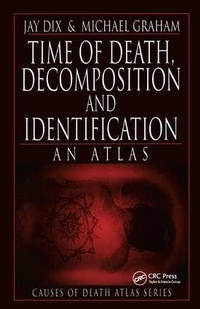
Time of Death, Decomposition and Identification
An Atlas
1st Edition
Published on 26. July 2017
Book
Hardback
120 pages
978-1-138-42701-3 (ISBN)
Description
A postmortem X-ray of a male homicide victim reveals a bullet lodged next to his spine. That he was shot is clear. How recently? is what death investigators must determine. The answer: the absence of scar tissue surrounding the bullet proves the victim had been recently shot.
And while the average person may find tattoos to be creative and aesthetic, to the trained death investigator, they can actually be the key to aiding in the eventual identification of a body.
They say the dead can't speak. But in the fascinating field of forensic pathology, the deceased can tell an elaborate story, especially when death investigators know what clues to look for.
The first volume in the new Forensic Pathology Atlases: Causes of Death Series, this book takes an in-depth look at the determination of the time of death, postmortem changes, and identification. In TIME OF DEATH, DECOMPOSITION AND IDENTIFICATION, you'll learn through the extensive use of photographs and discussion how estimating the time of death can rarely be accomplished with scientific accuracy. You'll learn about the numerous changes the body undergoes after death, and how positive and probable identifications are made.
For death investigators, law enforcement officers, attorneys, and anyone else involved in forensic death cases, TIME OF DEATH, DECOMPOSITION AND IDENTIFICATION is a "must have" resource.
And while the average person may find tattoos to be creative and aesthetic, to the trained death investigator, they can actually be the key to aiding in the eventual identification of a body.
They say the dead can't speak. But in the fascinating field of forensic pathology, the deceased can tell an elaborate story, especially when death investigators know what clues to look for.
The first volume in the new Forensic Pathology Atlases: Causes of Death Series, this book takes an in-depth look at the determination of the time of death, postmortem changes, and identification. In TIME OF DEATH, DECOMPOSITION AND IDENTIFICATION, you'll learn through the extensive use of photographs and discussion how estimating the time of death can rarely be accomplished with scientific accuracy. You'll learn about the numerous changes the body undergoes after death, and how positive and probable identifications are made.
For death investigators, law enforcement officers, attorneys, and anyone else involved in forensic death cases, TIME OF DEATH, DECOMPOSITION AND IDENTIFICATION is a "must have" resource.
Reviews / Votes
"The volumes are appropriate reading for death investigators, law enforcement officers and attorneys...Physicians-in-training would benefit in such specialties as Pathology, Emergency Medicine and Surgery...I anticipate that the remaining volumes in this series will prove equally useful."--Laurence R. Simpson, Jr., M.D.-Forensic Pathologist, Michigan State University
Promo Copy
More details
Series
Language
English
Place of publication
London
United Kingdom
Publishing group
Taylor & Francis Ltd
Target group
Professional and scholarly
Academic, Professional, and Professional Practice & Development
Dimensions
Height: 229 mm
Width: 152 mm
Weight
453 gr
ISBN-13
978-1-138-42701-3 (9781138427013)
Copyright in bibliographic data and cover images is held by Nielsen Book Services Limited or by the publishers or by their respective licensors: all rights reserved.
Schweitzer Classification
Other editions
Additional editions
Book
12/1999
1st Edition
CRC Press
€132.30
Shipment within 15-20 days
Persons
Jay Dix
Content
Preface TIME OF DEATH (POSTMORTEM INTERVAL) AND DECOMPOSITION Time of Death Introduction Rigor Mortis Livor Mortis Body Cooling (Algor Mortis) Scene Investigation Chemical Analyses Gastric, Microscopic Analyses Decomposition Adipocere Mummification Anthropophagia IDENTIFICATION Positive Identification Visual Identification Fingerprints Dental Radiographs (X-rays) DNA Fingerprinting Presumptive Identification Physical Features Clothing and Other Personal Property Circumstances Surrounding Death Skeletal Remains REFERENCES Case Examples Case 1 - Differential Decomposition Discussion Case 2 - Time of Death Case 3 - Gastric