


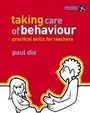
The Essential Guide to Taking Care of Behaviour
Practical Skills for Teachers
2nd Edition
Published on 27. May 2010
Book
Mixed media product
232 pages
978-1-4082-2554-7 (ISBN)
Description
This practical, skills-based book provides a wealth of behaviour management strategies that can be used in any classroom. Taking Care of Behaviour will help you to develop your existing skills, build your confidence and create realistic action plans for effective behaviour management. Paul Dix's unique, positive approach will help you manage even the most challenging behaviour with care and control.
Reviews / Votes
"I am not surprised that the author won a training award in 2009, as this book is a very good starting point for helping many adults to become more confident in improving their behaviour management techniques when working with children of all ages."- SEN Magazine
More details
Series
Edition
2nd edition
Language
English
Place of publication
Harlow
United Kingdom
Publishing group
Pearson Education Limited
Target group
Professional and scholarly
Illustrations
Illustrations
Dimensions
Height: 236 mm
Width: 156 mm
Thickness: 14 mm
Weight
370 gr
ISBN-13
978-1-4082-2554-7 (9781408225547)
Schweitzer Classification
Other editions
Previous edition
Book
01/2007
Pearson Longman
€44.80
Article exhausted; check for reprint
Content
Part 1 Managing behaviour in the classroom
Chapter 1 Things to think about before you start
Chapter 2 Managing your own behaviour: modelling social and emotional literacy
Chapter 3 Establishing and sustaining consistency and certainty
Chapter 4 Learning rituals, rules and routines
Chapter 5 Language, performance and positive manipulation
Chapter 6 Motivating students: meaningful praise and reward
Chapter 7 Reconciliation v retribution: the art of applying effective sanctions
Part 2 Advanced behaviour-management strategies
Chapter 8 Managing confrontation with flair: the ?win, win?
Chapter 9 Pivotal moments in hooking hard to reach students
Chapter 10 Building mutual trust with individuals and groups
Chapter 11 Students with extreme behaviour and behaviour-changing conditions
Part 3 Collaborating with other adults
Chapter 12 Seeking support: why, when and how
Chapter 13 Teaching partnerships: collaborative approaches with the LSA and other adults
Chapter 14 Nurturing the support of parents, mentors and the wider community
Part 4 Specific Situations
Chapter 15 Supply teachers, cover supervisors and cover lessons
Chapter 16 Managing behaviour around the site
Chapter 1 Things to think about before you start
Chapter 2 Managing your own behaviour: modelling social and emotional literacy
Chapter 3 Establishing and sustaining consistency and certainty
Chapter 4 Learning rituals, rules and routines
Chapter 5 Language, performance and positive manipulation
Chapter 6 Motivating students: meaningful praise and reward
Chapter 7 Reconciliation v retribution: the art of applying effective sanctions
Part 2 Advanced behaviour-management strategies
Chapter 8 Managing confrontation with flair: the ?win, win?
Chapter 9 Pivotal moments in hooking hard to reach students
Chapter 10 Building mutual trust with individuals and groups
Chapter 11 Students with extreme behaviour and behaviour-changing conditions
Part 3 Collaborating with other adults
Chapter 12 Seeking support: why, when and how
Chapter 13 Teaching partnerships: collaborative approaches with the LSA and other adults
Chapter 14 Nurturing the support of parents, mentors and the wider community
Part 4 Specific Situations
Chapter 15 Supply teachers, cover supervisors and cover lessons
Chapter 16 Managing behaviour around the site