

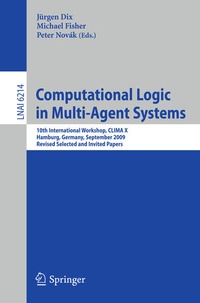
Computational Logic in Multi-Agent Systems
10th International Workshop, CLIMA-X 2009, Hamburg, Germany, September 9-10, 2009, Revised Selected and Invited Papers
1st Edition
Published on 29. October 2010
Book
Paperback/Softback
IX, 197 pages
978-3-642-16866-6 (ISBN)
Description
These are the proceedings of the 10th International Workshop on Compu- tional Logic in Multi-Agent Systems (CLIMA-X), held September 9-10, 2009 in Hamburg, co-located with MATES. The purpose of the CLIMA workshops is to provide a forum for discussing techniques, based on computational logic, for representing, in a formal way, programming and reasoning about agents and multi-agent systems. Multi-agentsystemsarecommunitiesofproblem-solvingentitiesthatcanp- ceive and act upon their environment in order to achieve both their individual goals and their joint goals. The work on such systems integrates many techno- giesandconceptsfromarti?cialintelligenceandotherareasofcomputingaswell as other disciplines. Over recent years, the agent paradigm gained popularity, due to its applicability to a full spectrum of domains, such as search engines, recommendation systems, educational support, e-procurement, simulation and routing,electroniccommerceandtrade,etc.Computationallogicprovidesawe- de?ned, general, and rigorousframeworkfor studying the syntax, semantics and procedures for the various tasks in individual agents, as well as the interaction between, and integration among, agents in multi-agent systems.
It also provides tools, techniques and standards for implementations and environments, for li- ing speci?cations to implementations, and for the veri?cation of properties of individual agents, multi-agent systems and their implementations. These proceedings feature nine regularpapers (from a total of 18 papers s- mitted), as wellas one paper basedonthe invited talk givenby TranCao Son. IntheinvitedpaperbyTranCaoSon,EnricoPontelli,andNgoc-HieuNguyen, "Planning for Multi-Agents Using ASP-Prolog," the action language B is - tended to the multi-agent case. The used technology is based on answer set programming. The contribution by Nils Bulling and Berndt Farwer on "Expressing Prop-
It also provides tools, techniques and standards for implementations and environments, for li- ing speci?cations to implementations, and for the veri?cation of properties of individual agents, multi-agent systems and their implementations. These proceedings feature nine regularpapers (from a total of 18 papers s- mitted), as wellas one paper basedonthe invited talk givenby TranCao Son. IntheinvitedpaperbyTranCaoSon,EnricoPontelli,andNgoc-HieuNguyen, "Planning for Multi-Agents Using ASP-Prolog," the action language B is - tended to the multi-agent case. The used technology is based on answer set programming. The contribution by Nils Bulling and Berndt Farwer on "Expressing Prop-
More details
Series
Edition
1st Edition.
Language
English
Place of publication
Berlin
Germany
Publishing group
Springer Berlin
Target group
Professional and scholarly
Research
Illustrations
40 s/w Abbildungen
IX, 197 p. 40 illus.
Dimensions
Height: 0 mm
Width: 0 mm
Weight
323 gr
ISBN-13
978-3-642-16866-6 (9783642168666)
DOI
10.1007/978-3-642-16867-3
Schweitzer Classification
Other editions
Additional editions
Jürgen Dix | Michael Fisher | Peter Novák
Computational Logic in Multi-Agent Systems
10th International Workshop, CLIMA-X 2009, Hamburg, Germany, September 9-10, 2009, Revised Selected and Invited Papers
E-Book
10/2010
Springer
€53.49
Available for download
Content
Planning for Multiagent Using ASP-Prolog.- Expressing Properties of Resource-Bounded Systems: The Logics RTL * and RTL.- Reasoning about Multi-agent Domains Using Action Language : A Preliminary Study.- Model Checking Normative Agent Organisations.- Operational Semantics for BDI Modules in Multi-agent Programming.- InstQL: A Query Language for Virtual Institutions Using Answer Set Programming.- Interacting Answer Sets.- Argumentation-Based Preference Modelling with Incomplete Information.- A Characterization of Mixed-Strategy Nash Equilibria in PCTL Augmented with a Cost Quantifier.- On the Implementation of Speculative Constraint Processing.