

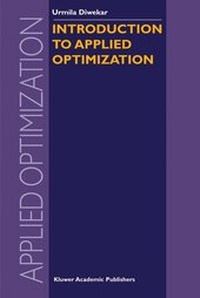
Introduction to Applied Optimization
Published on 30. June 2003
Book
Hardback
XV, 335 pages
978-1-4020-7456-1 (ISBN)
Description
This text presents a multi-disciplined view of optimization, providing students and researchers with a thorough examination of algorithms, methods, and tools from diverse areas of optimization without introducing excessive theoretical detail. This second edition includes additional topics, including global optimization and a real-world case study using important concepts from each chapter.
Introduction to Applied Optimization is intended for advanced undergraduate and graduate students and will benefit scientists from diverse areas, including engineers.
More details
Series
Language
English
Place of publication
NY
United States
Target group
College/higher education
Professional and scholarly
Illustrations
60 s/w Abbildungen
index
Dimensions
Height: 23.5 cm
Width: 15.5 cm
Thickness: 22 mm
Weight
772 gr
ISBN-13
978-1-4020-7456-1 (9781402074561)
DOI
10.1007/978-1-4757-3745-5
Schweitzer Classification
Other editions
New editions
Urmila Diwekar
Introduction to Applied Optimization
Book
08/2008
2nd Edition
Springer
€86.50
Shipment within 5-7 days
Additional editions
Urmila Diwekar
Introduction to Applied Optimization
E-Book
03/2013
Springer
€85.59
Available for download
Content
Foreword. Acknowledgements. 1: Introduction. 1.1. Problem Formulation: A Cautionary Note. 1.2. Degrees of Freedom Analysis. 1.3. Objective Function, Constraints, and Feasible Region. 1.4. Numerical Optimization. 1.5. Types of Optimization Problems. 1.6. Summary. 2: Linear Programming. 2.1. The Simplex Method. 2.2. Infeasible Solution. 2.3. Unbounded Solution. 2.4. Multiple Solutions. 2.5. Sensitivity Analysis. 2.6. Other Methods. 2.7. Hazardous Waste Blending Problem as an LP. 2.8. Summary. 3: Nonlinear Programming. 3.1. Convex and Concave Functions. 3.2. Unconstrained NLP. 3.3. Necessary and Sufficient Conditions, and Constrained NLP. 3.4. Sensitivity Analysis. 3.5. Numerical Methods. 3.6. Hazardous Waste Blending: An NLP. 3.7. Summary. 4: Discrete Optimization. 4.1. Tree and Network Representation. 4.2. Branch and Bound for IP. 4.3. Numerical Methods for IP, MILP, and MINLP. 4.4. Probabilistic Methods. 4.5. Hazardous Waste Blending: A Combinatorial Problem. 4.6. Summary.5: Optimization Under Uncertainty. 5.1. Types of Problems and Generalized Representation. 5.2. Chance Constrained Programming Method. 5.3. L-shaped Decomposition Method. 5.4. Uncertainty Analysis and Sampling. 5.5. Stochastic Annealing: An Efficient Algorithm for Combinatorial Optimization under Uncertainty. 5.6. Hazardous Waste Blending under Uncertainty. 5.7. Summary. 6: Multi-objective Optimization. 6.1. Nondominated Set. 6.2. Solution Methods. 6.3. Hazardous Waste Blending and Value of Research: An MOP. 6.4. Summary. 7: Optimal control And Dynamic Optimization. 7.1. Calculus of Variations. 7.2. Maximum Principle. 7.3. Dynamic Programming. 7.4. Stochastic Dynamic Programming. 7.5. Reversal of Blending: Optimizing a Separation Process. 7.6. Summary. Appendix A. Appendix B. Index.