

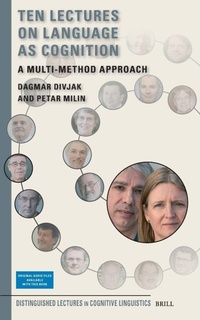
Ten Lectures on Language as Cognition
A Multi-Method Approach
Published on 26. July 2023
Book
Hardback
292 pages
978-90-04-50650-3 (ISBN)
Description
Merging insights from cognitive linguistic theories of language and learning theories originating within psychology, Divjak and Milin present a new paradigm that has computational modelling at its core. They showcase the power of this interdisciplinary approach for linguistic theory, methodology and description. Through a series of detailed case studies that model usage of the English article system, the Polish aspectual system, English tense/aspect contrasts and the Serbian case system they show how computational models anchored in learning can provide a simple and comprehensive account of how intricate phenomena that have long defied a unified treatment could be learned from exposure to usage alone. As such, their models form the basis for a first rigorous test of a core assumption of usage-based linguistics: that of the emergence of structure from use.
More details
Series
Language
English
Place of publication
Leiden
Netherlands
Target group
Professional and scholarly
Product notice
sewn/stitched
Cloth over boards
Dimensions
Height: 239 mm
Width: 160 mm
Thickness: 20 mm
Weight
576 gr
ISBN-13
978-90-04-50650-3 (9789004506503)
Copyright in bibliographic data and cover images is held by Nielsen Book Services Limited or by the publishers or by their respective licensors: all rights reserved.
Schweitzer Classification
Persons
Dagmar Divjak obtained her Ph.D. in 2004 from KU Leuven (Belgium). She is a Professor of Cognitive Linguistics and Language Cognition at the University of Birmingham, UK. Among other things, she is the author of Frequency in Language (2019, CUP), Editor-in-Chief of the journal Cognitive Linguistics (2018-) and Co-Editor of the Handbook of Cognitive Linguistics (Mouton De Gruyter, 2015/2019).
Petar Milin obtained his Ph.D. in 2004 from the University of Belgrade (Serbia). He is a Professor of the Psychology of Language and Language learning at the University of Birmingham, UK. He is Co-Editor-in-Chief of the third edition of Elsevier's Encyclopaedia of Language and Linguistics, and Consulting Editor for Methodology and Registered Reports of the journal Cognitive Linguistics (2018-).
Petar Milin obtained his Ph.D. in 2004 from the University of Belgrade (Serbia). He is a Professor of the Psychology of Language and Language learning at the University of Birmingham, UK. He is Co-Editor-in-Chief of the third edition of Elsevier's Encyclopaedia of Language and Linguistics, and Consulting Editor for Methodology and Registered Reports of the journal Cognitive Linguistics (2018-).
Content
Contents
Preface by the Series Editor
Preface by the Authors
About the Authors
Note on Supplementary Material
1 Usage-Based Linguistics
2 Memory and Attention
3 Construal
4 Learning
5 Allomorphy
6 How to Teach Machines to Learn
7 Inflectional Paradigms and Classes
8 The Unbearable Lightness of English Articles
9 Modelling Aspect: Do We Really Have a Choice?
10 Is the Past Perfect and the Present Continuous: Questioning the Cognitive Reality of Tense Label
References
About the Series Editor
Websites for Cognitive Linguistics and CIFCL Speakers
Preface by the Series Editor
Preface by the Authors
About the Authors
Note on Supplementary Material
1 Usage-Based Linguistics
2 Memory and Attention
3 Construal
4 Learning
5 Allomorphy
6 How to Teach Machines to Learn
7 Inflectional Paradigms and Classes
8 The Unbearable Lightness of English Articles
9 Modelling Aspect: Do We Really Have a Choice?
10 Is the Past Perfect and the Present Continuous: Questioning the Cognitive Reality of Tense Label
References
About the Series Editor
Websites for Cognitive Linguistics and CIFCL Speakers