

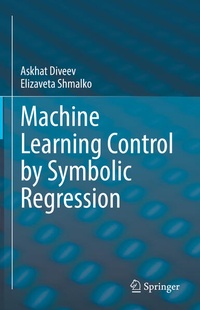
Machine Learning Control by Symbolic Regression
Published on 24. October 2021
Book
Hardback
IX, 155 pages
978-3-030-83212-4 (ISBN)
Description
This book provides comprehensive coverage on a new direction in computational mathematics research: automatic search for formulas. Formulas must be sought in all areas of science and life: these are the laws of the universe, the macro and micro world, fundamental physics, engineering, weather and natural disasters forecasting; the search for new laws in economics, politics, sociology. Accumulating many years of experience in the development and application of numerical methods of symbolic regression to solving control problems, the authors offer new possibilities not only in the field of control automation, but also in the design of completely different optimal structures in many fields.
For specialists in the field of control, Machine Learning Control by Symbolic Regression opens up a new promising direction of research and acquaints scientists with the methods of automatic construction of control systems.For specialists in the fieldof machine learning, the book opens up a new, much broader direction than neural networks: methods of symbolic regression. This book makes it easy to master this new area in machine learning and apply this approach everywhere neural networks are used. For mathematicians, the book opens up a new approach to the construction of numerical methods for obtaining analytical solutions to unsolvable problems; for example, numerical analytical solutions of algebraic equations, differential equations, non-trivial integrals, etc. For specialists in the field of artificial intelligence, the book offers a machine way to solve problems, framed in the form of analytical relationships.
For specialists in the field of control, Machine Learning Control by Symbolic Regression opens up a new promising direction of research and acquaints scientists with the methods of automatic construction of control systems.For specialists in the fieldof machine learning, the book opens up a new, much broader direction than neural networks: methods of symbolic regression. This book makes it easy to master this new area in machine learning and apply this approach everywhere neural networks are used. For mathematicians, the book opens up a new approach to the construction of numerical methods for obtaining analytical solutions to unsolvable problems; for example, numerical analytical solutions of algebraic equations, differential equations, non-trivial integrals, etc. For specialists in the field of artificial intelligence, the book offers a machine way to solve problems, framed in the form of analytical relationships.
More details
Edition
2021 ed.
Language
English
Place of publication
Cham
Switzerland
Publishing group
Springer International Publishing
Target group
Professional and scholarly
Illustrations
19 farbige Abbildungen, 36 s/w Abbildungen
IX, 155 p. 55 illus., 19 illus. in color.
Dimensions
Height: 241 mm
Width: 160 mm
Thickness: 15 mm
Weight
424 gr
ISBN-13
978-3-030-83212-4 (9783030832124)
DOI
10.1007/978-3-030-83213-1
Schweitzer Classification
Other editions
Additional editions
Askhat Diveev | Elizaveta Shmalko
Machine Learning Control by Symbolic Regression
Book
10/2022
Springer
€139.09
Shipment within 7-9 days
Askhat Diveev | Elizaveta Shmalko
Machine Learning Control by Symbolic Regression
E-Book
10/2021
1st Edition
Springer
€128.39
Available for download
Persons
Prof., Dr. Diveev
is a renowned specialist in the field of control and a leading researcher in Russia in evolutionary computation and symbolic regression. He received the Ph.D. degree in technical science from Bauman Moscow State Technical University, in 1989, and Doctor of Sciences in 2001 in Dorodnitsyn Computing Center of the Russian Academy of Sciences, in 2009 he became a professor. Presently, he works as a Director of Robotic Center of Federal Research Center "Computer Science and Control" of the Russian Academy of Sciences. He is also a Professor at the RUDN University, Engineering Department. He is the author of five books, more than 300 articles. Prof. Diveev is a member of the editorial board of the RUDN journal of Engineering Researches and journal of Instrument Engineering of the Bauman Moscow State Technical University, a general chair of the INTELS Symposium.
Dr. Shmalko is a former student and follower of Prof. Diveev, received the B.S. and M.S. degrees in Computer Science and Cybernetics from RUDN University, Engineering Dept. and the Ph.D. degree from Dorodnicyn Computing Center of the Russian Academy of Sciences, Moscow, Russia, in 2009. From 2007 to 2010, she was with IBM East Europe/Asia. Since 2010, she is a Senior researcher with the Computing Center of the Federal Research Center "Computer Science and Control" of the Russian Academy of Sciences.
The authors' current research interests are computational methods in control, symbolic regression and evolutionary computation with applications to model identification, optimization and control system synthesis. The authors conduct theoretical research and implement applied tasks on the basis of the Robotics Center of the Federal Research Center "Computer Science and Control" of the Russian Academy of Sciences.
Dr. Shmalko is a former student and follower of Prof. Diveev, received the B.S. and M.S. degrees in Computer Science and Cybernetics from RUDN University, Engineering Dept. and the Ph.D. degree from Dorodnicyn Computing Center of the Russian Academy of Sciences, Moscow, Russia, in 2009. From 2007 to 2010, she was with IBM East Europe/Asia. Since 2010, she is a Senior researcher with the Computing Center of the Federal Research Center "Computer Science and Control" of the Russian Academy of Sciences.
The authors' current research interests are computational methods in control, symbolic regression and evolutionary computation with applications to model identification, optimization and control system synthesis. The authors conduct theoretical research and implement applied tasks on the basis of the Robotics Center of the Federal Research Center "Computer Science and Control" of the Russian Academy of Sciences.
Content
1.Introduction.- 2.Mathematical Statements of MLC Problems.- 3.Numerical Solution of Machine Learning Control Problems.- 4.Symbolic Regression Methods.- 5.Examples of MLC Problem Solutions.