

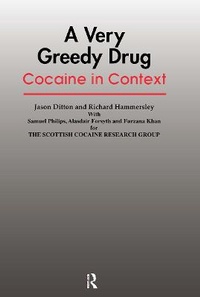
A Very Greedy Drug
Cocaine in Context
1st Edition
Published on 11. September 1996
Book
Hardback
160 pages
978-3-7186-5903-6 (ISBN)
Description
First Published in 1997. This book sketches the recent history of the panic over cocaine in Britain, before reporting in-depth research on more than a hundred users in Scotland. This group contained all types of users, from casual users to heavy users who had cut down without problems, to people with multiple drug problems. The book considers why some people can give up cocaine and others become addicted. It compares British users with those elsewhere in the world, showing that the effects are similar everywhere -- cocaine does not addict most of its users. The picture of drug use obtained from addicts in clinics is a distorted one. Cocaine use in Britain has caused much concern but its extent has been unknown. Users are still quite affluent, but when cocaine hits street level -- as it is predicted to do in the late 1990s -- problems are likely to increase.
More details
Language
English
Place of publication
Chur
Switzerland
Target group
College/higher education
Professional and scholarly
Dimensions
Height: 246 mm
Width: 171 mm
Weight
454 gr
ISBN-13
978-3-7186-5903-6 (9783718659036)
Copyright in bibliographic data and cover images is held by Nielsen Book Services Limited or by the publishers or by their respective licensors: all rights reserved.
Schweitzer Classification
Other editions
Additional editions
E-Book
12/2021
1st Edition
Routledge
€45.99
Available for download
E-Book
12/2021
1st Edition
Routledge
€45.99
Available for download
Persons
Jason Ditton Scottish Centre for Criminology, Glasgow, UK. Richard Hammersley Department of Behavioural Sciences, University of Glasgow, UK, with Samuel Philips, Alasdair Forsyth and Furzana Khan for THE SCOTTISH COCAINE RESEARCH GROUP*
Content
"The Cocaine Crisis" of 1989, Cocaine Users in Reality, Cocaine Careers, Cocaine Use in a Local Context, "Different Cokes for Different Folks", Conclusion