

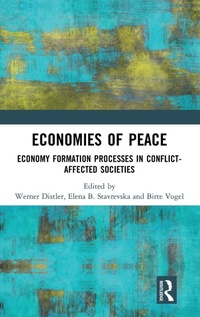
Economies of Peace
Economy Formation Processes in Conflict-Affected Societies
1st Edition
Published on 16. April 2019
Book
Hardback
172 pages
978-0-367-20939-1 (ISBN)
Description
Looking beyond and beneath the macro level, this book examines the processes and outcomes of the interaction of economic reforms and socio-economic peacebuilding programmes with, and international interventions in, people's lived realities in conflict-affected societies.
The contributions argue that disregarding socio-economic aspects of peace and how they relate to the everyday leaves a vacuum in the understanding of the formation of post-conflict economies. To address this gap, the book outlines and deploys the concept of 'post-conflict economy formation'. This is a multifaceted phenomenon, including both formal and informal processes that occur in the post-conflict period and contribute to the introduction, adjustment, or abolition of economic practices, institutions, and rules that inform the transformation of the socio-economic fabric of the society. The contributions engage with existing statebuilding and peacebuilding debates, while bringing in critical political economy perspectives. Specifically, they analyse processes of post-conflict economy formation and the navigation between livelihood needs; local translations of the liberal hegemonic order; and different, sparse manifestations of welfare states. The book concludes that a sustainable peace requires the formation of peace economies: economies that work towards reducing structural inequalities and grievances of the (pre-)conflict period, as well as addressing the livelihood concerns of citizens.
This book was originally published as a special issue of Civil Wars.
The contributions argue that disregarding socio-economic aspects of peace and how they relate to the everyday leaves a vacuum in the understanding of the formation of post-conflict economies. To address this gap, the book outlines and deploys the concept of 'post-conflict economy formation'. This is a multifaceted phenomenon, including both formal and informal processes that occur in the post-conflict period and contribute to the introduction, adjustment, or abolition of economic practices, institutions, and rules that inform the transformation of the socio-economic fabric of the society. The contributions engage with existing statebuilding and peacebuilding debates, while bringing in critical political economy perspectives. Specifically, they analyse processes of post-conflict economy formation and the navigation between livelihood needs; local translations of the liberal hegemonic order; and different, sparse manifestations of welfare states. The book concludes that a sustainable peace requires the formation of peace economies: economies that work towards reducing structural inequalities and grievances of the (pre-)conflict period, as well as addressing the livelihood concerns of citizens.
This book was originally published as a special issue of Civil Wars.
More details
Language
English
Place of publication
London
United Kingdom
Publishing group
Taylor & Francis Ltd
Target group
College/higher education
Postgraduate and Undergraduate
Dimensions
Height: 240 mm
Width: 161 mm
Thickness: 15 mm
Weight
446 gr
ISBN-13
978-0-367-20939-1 (9780367209391)
Copyright in bibliographic data and cover images is held by Nielsen Book Services Limited or by the publishers or by their respective licensors: all rights reserved.
Schweitzer Classification
Other editions
Additional editions
Werner Distler | Elena B. Stavrevska | Birte Vogel
Economies of Peace
Economy Formation Processes in Conflict-Affected Societies
Book
12/2020
1st Edition
Routledge
€55.75
Shipment within 15-20 days
Werner Distler | Elena B. Stavrevska | Birte Vogel
Economies of Peace
Economy Formation Processes in Conflict-Affected Societies
E-Book
06/2020
1st Edition
Routledge
€59.49
Available for download
Werner Distler | Elena B. Stavrevska | Birte Vogel
Economies of Peace
Economy Formation Processes in Conflict-Affected Societies
E-Book
06/2020
1st Edition
Routledge
€59.49
Available for download
Persons
Werner Distler is a Postdoctoral Research Fellow at the Centre for Conflict Studies and the Collaborative Research Centre SFB/TRR 138 'Dynamics of Security' at the University of Marburg, Germany. His work focuses on knowledge and authority in intervention, discourses and practices of securitisation in international statebuilding, and post-conflict political economy.
Elena B. Stavrevska is currently a Visiting Research Fellow at the Kroc Institute for International Peace Studies at the University of Notre Dame, USA. She is a political scientist interested in peace processes and their intersectional and political economy discontents.
Birte Vogel is a Lecturer in Peace and Conflict Studies at the Humanitarian and Conflict Response Institute at the University of Manchester, UK. Her current research is interested in the connections between economics, peace, and conflict.
Elena B. Stavrevska is currently a Visiting Research Fellow at the Kroc Institute for International Peace Studies at the University of Notre Dame, USA. She is a political scientist interested in peace processes and their intersectional and political economy discontents.
Birte Vogel is a Lecturer in Peace and Conflict Studies at the Humanitarian and Conflict Response Institute at the University of Manchester, UK. Her current research is interested in the connections between economics, peace, and conflict.
Content
Introduction - Economies of Peace: Economy Formation Processes and Outcomes in Conflict-Affected Societies 1. Precarity in Post-Conflict Yugoslavia: What About the Workers? 2. Looking into the Past to See the Future? Lessons Learned from Self-Management for Economies in Post-Conflict Societies of the Former Yugoslavia 3. The Mother, the Wife, the Entrepreneur? Women's Agency and Microfinance in a Disappearing Post-Conflict Welfare State Context 4. Intervention Gentrification and Everyday Socio-Economic Transactions in Intervention Societies 5. Peacekeeping as Enterprise: Transaction, Consumption, and the Political Economy of Peace and Peacekeeping 6. Street Level Bureaucrats and Post-conflict Policy-making: Corruption, Correctives, and the Rise of Veterans' Pensions in Timor-Leste 7. 'And Everybody Did Whatever They Wanted to Do': Informal Practices of International Statebuilders in Kosovo