

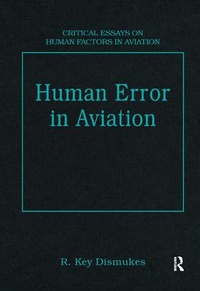
Human Error in Aviation
1st Edition
Published on 20. March 2009
Book
Hardback
608 pages
978-0-7546-2831-6 (ISBN)
Description
Most aviation accidents are attributed to human error, pilot error especially. Human error also greatly effects productivity and profitability. In his overview of this collection of papers, the editor points out that these facts are often misinterpreted as evidence of deficiency on the part of operators involved in accidents. Human factors research reveals a more accurate and useful perspective: The errors made by skilled human operators - such as pilots, controllers, and mechanics - are not root causes but symptoms of the way industry operates. The papers selected for this volume have strongly influenced modern thinking about why skilled experts make errors and how to make aviation error resilient.
Reviews / Votes
'...an extremely valuable and useful book...this excellent book will give students of human factors a good grounding in the subject..' The Aerospace ProfessionalMore details
Series
Language
English
Place of publication
London
United Kingdom
Publishing group
Taylor & Francis Ltd
Target group
College/higher education
Professional and scholarly
Dimensions
Height: 244 mm
Width: 169 mm
Weight
1280 gr
ISBN-13
978-0-7546-2831-6 (9780754628316)
Copyright in bibliographic data and cover images is held by Nielsen Book Services Limited or by the publishers or by their respective licensors: all rights reserved.
Schweitzer Classification
Other editions
Additional editions
Person
R. Key Dismukes is chief scientist for Human Factors, NASA Ames Research Center, USA. He has published applied studies in human factors and fundamental research studies in neurobiology, managed research organizations and led committees of scientists reporting on science and public issues.
Content
Contents: Introduction; Part I Conceptual Frameworks for Thinking About Human Error: The contribution of latent human failures to the breakdown of complex systems, J. Reason; Widening the search for accident causes: a theoretical framework, Daniel E. Maurino, James Reason, Neil Johnston and Rob B. Lee; Converging themes: the deep structure of accidents, R. Key Dismukes, Benjamin A. Berman and Loukia D. Loukopoulos; Human error and commercial aviation accidents: an analysis using the human factors analysis and classification system, Scott Shappell, Cristy Detwiler, Kali Holcomb, Carla Hackworth, Albert Boquet and Douglas A. Wiegmann; Illusions of explanation: a critical essay on error classification, Sidney W.A. Dekker; The paradoxes of almost totally safe transport systems, R. Amalberti. Part II Specific Aspects of Skilled Human Performance: Human workload in aviation, Barry H. Kantowitz and Patricia A. Casper; Attentional models of multitask pilot performance using advanced display technology, Christopher D. Wickens, Juliana Goh, John Helleberg, William J. Horrey and Donald A. Talleur; Pilot interaction with cockpit automation II: an experimental study of pilots' model and awareness of the flight management system, Nadine B. Sarter and David D. Woods; Pilots' monitoring strategies and performance on automated flight decks: an empirical study combining behavioral and eye-tracking data, Nadine B. Sarter, Randall J. Mumaw and Christopher D. Wickens; Toward a theory of situation awareness in dynamic systems, Mica R. Endsley; Risk perception and risk management in aviation, Judith Orasanu, Ute Fischer and Jeannie Davison; The evolution of crew resource management, Robert L. Helmreich, Ashleigh C. Merritt and John A.Wilhelm; Crews as groups: their formation and their leadership, Robert C. Ginnett; Predictors of threat and error management: identification of core nontechnical skills and implications for training systems design, Matthew J.W. Thomas; The importance of crew