

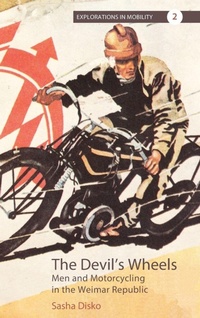
The Devil's Wheels
Men and Motorcycling in the Weimar Republic
1st Edition
Published on 1. August 2016
Book
Hardback
374 pages
978-1-78533-169-5 (ISBN)
Description
During the high days of modernization fever, among the many disorienting changes Germans experienced in the Weimar Republic was an unprecedented mingling of consumption and identity: increasingly, what one bought signaled who one was. Exemplary of this volatile dynamic was the era's burgeoning motorcycle culture. With automobiles largely a luxury of the upper classes, motorcycles complexly symbolized masculinity and freedom, embodying a widespread desire to embrace progress as well as profound anxieties over the course of social transformation. Through its richly textured account of the motorcycle as both icon and commodity, The Devil's Wheels teases out the intricacies of gender and class in the Weimar years.
Reviews / Votes
"A ?ne study of the gendering of motorcycles in the inter- war years, Sasha Disko's The Devil's Wheels offers an important interpretation of a mass-produced technology, the motorcycle, and how it came to embody masculinity as well as new forms of consumerism." * American Historical Review"All in all, Disko offers a pronounced multi-perspective analysis of the motor-cycle as 'cultural commodity' in Weimar Germany, demonstrating impressively what a modern mobility study can achieve... Disko's study is innovative and highly readable...[it] makes an important contribution to the cultural history of motorcycling and even opens up a new perspective on the cultural history of the Weimar Republic." * Journal of Transport History
"Sasha Disko's study provides a treasure trove of exciting themes for those interested in leisure time activities, gender, consumption but also interactions between the state, through the police, and the motorcyclists on the streets in Weimar Germany." * German History
"Disko offers a new and exciting interpretation that challenges our understandings of gendered consumption, modernity, and the role that motorcycles played in defining and defending masculinity, femininity, and the nation during the interwar years." * Jennifer Lynn, Montana State University
"This is a fascinating, engagingly written, and illuminating book that resonates well beyond its immediate national and historical context. Its exploration of the anxieties and opportunities surrounding identity in the Weimar Republic will be greeted enthusiastically by scholars in cultural history, mobility studies, gender studies, and a host of other interdisciplinary fields." * Cotten Seiler, Dickinson College
More details
Series
Language
English
Place of publication
Oxford
United Kingdom
Target group
College/higher education
Product notice
Library binding
Illustrations
8 Illustrations; 8 Tables, unspecified
Dimensions
Height: 235 mm
Width: 157 mm
Thickness: 25 mm
Weight
694 gr
ISBN-13
978-1-78533-169-5 (9781785331695)
DOI
10.3167/9781785331695
Copyright in bibliographic data and cover images is held by Nielsen Book Services Limited or by the publishers or by their respective licensors: all rights reserved.
Schweitzer Classification
Other editions
Additional editions
E-Book
08/2016
Berghahn Books
€111.99
Available for download
E-Book
08/2016
1st Edition
Berghahn Books
€19.49
Available for download
Person
Sasha Disko is a historian and independent scholar. She received her PhD in History from New York University, and she has been associated with the Center for Metropolitan Studies, Berlin, since 2008. Her research interests include motorization, industrialization, and leisure.
Content
List of Illustrations
Preface and Acknowledgements
Introduction: Does the man make the motorcycle or the motorcycle the man?
Abbreviations
Chapter 1. From Pioneers to Global Dominance: The First Forty Years of the German Motorcycle Industry
Chapter 2. Engineering and Advertising a Motorized Future
Chapter 3. Motorcycles and the "Everyman": Exploring the Motorcycling Milieu
Chapter 4. "Is Motorcycling Even Sport?": Strength and the National Body during the Weimar Republic
Chapter 5. Deviant Behaviors: Inclusion, Exclusion, and Community
Chapter 6. Motoring Amazons?: Women and Motorcycling During the Weimar Republic
Chapter 7. Sex and the Sidecar: Sexuality, Courtship, Marriage and Motorization
Epilogue: The Will to Motor
Appendix
Bibliography
Index
Preface and Acknowledgements
Introduction: Does the man make the motorcycle or the motorcycle the man?
Abbreviations
Chapter 1. From Pioneers to Global Dominance: The First Forty Years of the German Motorcycle Industry
Chapter 2. Engineering and Advertising a Motorized Future
Chapter 3. Motorcycles and the "Everyman": Exploring the Motorcycling Milieu
Chapter 4. "Is Motorcycling Even Sport?": Strength and the National Body during the Weimar Republic
Chapter 5. Deviant Behaviors: Inclusion, Exclusion, and Community
Chapter 6. Motoring Amazons?: Women and Motorcycling During the Weimar Republic
Chapter 7. Sex and the Sidecar: Sexuality, Courtship, Marriage and Motorization
Epilogue: The Will to Motor
Appendix
Bibliography
Index