

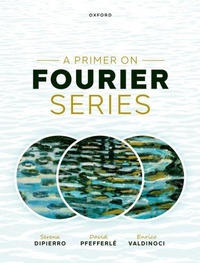
A Primer on Fourier Series
Will be published approx. on 1. October 2026
Book
Hardback
432 pages
978-0-19-791705-3 (ISBN)
Description
This textbook provides an accessible and visually intuitive introduction to Fourier series, which is one of the most powerful mathematical tools used to understand patterns, signals, and data. Equally well suited as a classroom textbook or a self-study resource, it is designed to be accessible to students encountering the subject for the first time, while also offering the rigor and breadth needed to support their scientific development in later years.
The text balances depth, clarity, and readability, integrating strong visual intuition with fully rigorous theoretical development. Concepts are introduced in a way that highlights the geometric and intuitive structures underlying Fourier analysis, while maintaining the mathematical precision expected at higher levels of study. The exposition is carefully structured to guide readers from basic principles to more advanced results without sacrificing accessibility or conceptual insight.
The book is also particularly distinctive in its coherent and unified presentation of both theory and real-world applications, weaving significant applications from engineering, physics, data analysis, and differential equations seamlessly into the theoretical narrative. The result is a text that not only teaches Fourier analysis in a rigorous and accessible way but also demonstrates its power and versatility across a wide range of scientific and technological fields.
The text balances depth, clarity, and readability, integrating strong visual intuition with fully rigorous theoretical development. Concepts are introduced in a way that highlights the geometric and intuitive structures underlying Fourier analysis, while maintaining the mathematical precision expected at higher levels of study. The exposition is carefully structured to guide readers from basic principles to more advanced results without sacrificing accessibility or conceptual insight.
The book is also particularly distinctive in its coherent and unified presentation of both theory and real-world applications, weaving significant applications from engineering, physics, data analysis, and differential equations seamlessly into the theoretical narrative. The result is a text that not only teaches Fourier analysis in a rigorous and accessible way but also demonstrates its power and versatility across a wide range of scientific and technological fields.
More details
Language
English
Place of publication
Oxford
United Kingdom
Illustrations
172 black & white and colour figures
Dimensions
Height: 246 mm
Width: 189 mm
ISBN-13
978-0-19-791705-3 (9780197917053)
Copyright in bibliographic data and cover images is held by Nielsen Book Services Limited or by the publishers or by their respective licensors: all rights reserved.
Schweitzer Classification
Other editions
Additional editions
Serena Dipierro | David Pfefferle | Enrico Valdinoci
A Primer on Fourier Series
Book
approx. 10/2026
Oxford University Press
€56.00
Not yet published
Persons
Serena Dipierro is a Professor of Mathematics, Fellow of the Australian Mathematical Society, and Australian Mathematical Society Hanna Neumann Lecturer. She has obtained prestigious awards, including the Australian Mathematical Society Medal, the Mahony-Neumann-Room Prize, the Bartolozzi Prize of the Italian Mathematical Union, the Christopher Heyde Medal of the Australian Academy of Science, the Book Prize of the Italian Mathematical Union, and the Prize of the Bulletin of the Brazilian Mathematical Society.
David Pfefferle is a Swiss-Australian mathematician and plasma physicist whose career has taken him from Lausanne to Rokkasho, from Oxfordshire to Princeton, and finally to Perth, where he is a Senior Lecturer at the University of Western Australia. His research spans plasma physics, numerical modelling, and the geometry of physical systems.
Enrico Valdinoci is a Professor of Mathematics and Australian Laureate Fellow. He is a highly cited researcher, Ladyzhenskaya Lecturer and has been awarded the James S. W. Wong Prize, the Mahony-Neumann-Room Prize, the Orazio Arena Prize, the Book Prize of the Unione Matematica Italiana, the Prize of the Bulletin of the Brazilian Mathematical Society, and the Amerio Gold Medal Prize.
David Pfefferle is a Swiss-Australian mathematician and plasma physicist whose career has taken him from Lausanne to Rokkasho, from Oxfordshire to Princeton, and finally to Perth, where he is a Senior Lecturer at the University of Western Australia. His research spans plasma physics, numerical modelling, and the geometry of physical systems.
Enrico Valdinoci is a Professor of Mathematics and Australian Laureate Fellow. He is a highly cited researcher, Ladyzhenskaya Lecturer and has been awarded the James S. W. Wong Prize, the Mahony-Neumann-Room Prize, the Orazio Arena Prize, the Book Prize of the Unione Matematica Italiana, the Prize of the Bulletin of the Brazilian Mathematical Society, and the Amerio Gold Medal Prize.
Content
- Where to start
- -
- 1: Fourier Series: Development of the Theory
- 1.1 Periodic functions
- 1.2 How to "optimally" approximate periodic functions
- 1.3 Some further observations in L²((0, 1))
- 1.4 Decay of Fourier coefficients
- 1.5 The quest for convergence
- 1.6 Pointwise convergence of Fourier Series "all in one breath"
- 1.7 Pointwise convergence of Fourier Series: a refined version
- 1.8 Uniqueness results
- 1.9 More on the decay of Fourier coefficients
- 1.10 Uniform convergence results
- 1.11 Convergence in L²((0, 1))
- 1.12 Convergence in Lp((0, 1))
- 1.13 Averaging procedures for Fourier Series
- 1.14 Persistent overshooting phenomena
- 1.15 Convergence issues
- 1.16 Functions of arbitrary periods
- 1.17 Fourier Series in any dimension
- 2: Fourier Series: Applications
- 2.1 The old-fashioned epicycle theory
- 2.2 Does anyone need a computer?
- 2.3 Predicting tides
- 2.4 Partial differential equations
- 2.5 Fourier's cellar
- 2.6 The Dirichlet problem on the two-dimensional disk
- 2.7 The Dirichlet problem on a square and the behaviour near corners
- 2.8 Calculating the exact value of a series
- 2.9 Number theory
- 2.10 Inequalities of analytic flavour
- 2.11 Inequalities of geometric flavor
- 2.12 The Weierstrass Approximation Theorem
- 2.13 The Radon Transform
- 2.14 Filters
- 2.15 Edge detection
- 2.16 Denoising
- 2.17 Who listens to the radio?
- 2.18 Overdrives, clipping, distortion, and ringing artifacts
- 2.19 Linear motions on tori
- 2.20 Weyl's Equidistribution Theorem
- 2.21 Minkowski's Theorem on convex sets
- 2.22 The Central Limit Theorem
- -
- What Comes Next?
- Appendix A - One more example confirming Theorem 1.15.1
- Solutions to selected exercises