

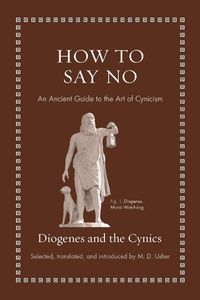
How to Say No
An Ancient Guide to the Art of Cynicism
Published on 18. October 2022
Book
Hardback
248 pages
978-0-691-22985-0 (ISBN)
Description
An entertaining and enlightening collection of ancient writings about the philosophers who advocated simple living and rejected unthinking conformity
The Cynics were ancient Greek philosophers who stood athwart the flood of society's material excess, unexamined conventions, and even norms of politeness and thundered "No!" Diogenes, the most famous Cynic, wasn't shy about literally extending his middle finger to the world, expressing mock surprise that "most people go crazy over a finger." When asked why he was called Diogenes the Dog, he replied "because I fawn on those who give, I bark at those who don't, and I bite scoundrels." How to Say No is a delightful collection of brief ancient writings about Cynicism that captures all the outrageousness, wit, and wisdom of its remarkable cast of characters-from Diogenes in the fourth century BCE to the column-stander Symeon Stylites in late antiquity.
With their "less is more" approach to life, the Cynics speak urgently to our world of climate change, economic uncertainty, and psychic malaise. Although the Cynics weren't writers, their memorable utterances and behavior were recorded by their admirers and detractors, and M. D. Usher offers fresh new translations of appealing selections from this body of writing-ranging from street sermons and repartee to biography and snapshots of Cynics in action.
Complete with introductions to the volume and each selection as well as the original Greek and Latin on facing pages, this lively book demonstrates why the Cynics still retain their power to surprise us and make us laugh-and to make us think and question how we live.
The Cynics were ancient Greek philosophers who stood athwart the flood of society's material excess, unexamined conventions, and even norms of politeness and thundered "No!" Diogenes, the most famous Cynic, wasn't shy about literally extending his middle finger to the world, expressing mock surprise that "most people go crazy over a finger." When asked why he was called Diogenes the Dog, he replied "because I fawn on those who give, I bark at those who don't, and I bite scoundrels." How to Say No is a delightful collection of brief ancient writings about Cynicism that captures all the outrageousness, wit, and wisdom of its remarkable cast of characters-from Diogenes in the fourth century BCE to the column-stander Symeon Stylites in late antiquity.
With their "less is more" approach to life, the Cynics speak urgently to our world of climate change, economic uncertainty, and psychic malaise. Although the Cynics weren't writers, their memorable utterances and behavior were recorded by their admirers and detractors, and M. D. Usher offers fresh new translations of appealing selections from this body of writing-ranging from street sermons and repartee to biography and snapshots of Cynics in action.
Complete with introductions to the volume and each selection as well as the original Greek and Latin on facing pages, this lively book demonstrates why the Cynics still retain their power to surprise us and make us laugh-and to make us think and question how we live.
Reviews / Votes
"This fascinating, well-translated selection admirably exemplifies the multi-faceted nature of the cynic way of life and is thoroughly recommended."---Peter Jones, Classics For All Reviews "The Cynics, observes Usher, 'were not scholars or writers.' Like Jesus, Socrates or Buddha, they were 'oralists whose memorable utterances and actions were transmitted to posterity by admirers (and detractors).' And it's precisely this that explains their endurance, both during and beyond their lifetime... the vivid anecdotes in which they appear have kept them not just alive, but in excellent philosophical shape."---Costica Bradatan, Times Literary SupplementMore details
Series
Language
English
Place of publication
New Jersey
United States
Product notice
Trade binding
Dimensions
Height: 179 mm
Width: 119 mm
Thickness: 25 mm
Weight
284 gr
ISBN-13
978-0-691-22985-0 (9780691229850)
Copyright in bibliographic data and cover images is held by Nielsen Book Services Limited or by the publishers or by their respective licensors: all rights reserved.
Schweitzer Classification
Other editions
Additional editions
E-Book
10/2022
1st Edition
Princeton University Press
€18.49
Available for download
Persons
M. D. Usher is the Lyman-Roberts Professor of Classical Languages and Literature and a member of the Department of Geography and Geosciences at the University of Vermont. With his wife, he also built, owns, and operates Works & Days Farm in Shoreham, Vermont. His previous books include How to Be a Farmer: An Ancient Guide to Life on the Land (Princeton), Plato's Pigs and Other Ruminations, and a number of books for children, including Diogenes.