

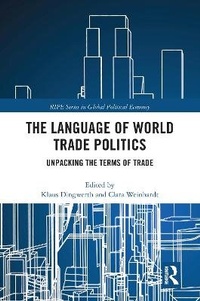
The Language of World Trade Politics
Unpacking the Terms of Trade
1st Edition
Published on 30. June 2020
Book
Paperback/Softback
204 pages
978-0-367-58661-4 (ISBN)
Description
Outcomes in major multilateral trade negotiations are conventionally explained as resulting from interests weighted by (trading) power. Offering a different overview of the concepts we use to talk about the international trade regime, this edited collection puts the ideational foundation of world trade politics centre stage, and critically examines the terms in which we make sense of world trade politics.
The concepts used to make sense of world trade politics are often employed strategically, making some aspects of reality visible and others invisible. Reflecting upon ten key concepts from 'trade' itself to 'protectionism' and 'justice', this book poses two broad questions: first, how and by whom have the meanings of different terms used to describe, challenge and defend world trade politics been constructed? Second, how have the individual terms changed over time, and with what consequences? The editors and contributors draw on a broad range of theoretical approaches, from post-structuralism or cognitivism to normative theory, shedding new light on why certain trade issues and agendas win out over others, who benefits from the current system of trade governance, and what contemporary challenges the World Trade Organization faces. In doing so, the book speaks to a growing and diverse constructivist literature in International Political Economy.
This book will be of interest to scholars, students and policy professionals working within International Relations, International Political Economy and economics.
The concepts used to make sense of world trade politics are often employed strategically, making some aspects of reality visible and others invisible. Reflecting upon ten key concepts from 'trade' itself to 'protectionism' and 'justice', this book poses two broad questions: first, how and by whom have the meanings of different terms used to describe, challenge and defend world trade politics been constructed? Second, how have the individual terms changed over time, and with what consequences? The editors and contributors draw on a broad range of theoretical approaches, from post-structuralism or cognitivism to normative theory, shedding new light on why certain trade issues and agendas win out over others, who benefits from the current system of trade governance, and what contemporary challenges the World Trade Organization faces. In doing so, the book speaks to a growing and diverse constructivist literature in International Political Economy.
This book will be of interest to scholars, students and policy professionals working within International Relations, International Political Economy and economics.
Reviews / Votes
"A key message of this excellent contribution is that our understanding of world trade (politics) is not as straightforward as we would like it to be. By exploring the changing meaning of ten 'terms of trade' in seperate chapters, the authors show how we, as practicioners and scholars, employ language and mental concepts that, while helping us make sense of trade politics, similtanerously shape and limit our appreciation of social reality."Fabian Bohneberger,World Trade Review, 2019
More details
Series
Language
English
Place of publication
London
United Kingdom
Publishing group
Taylor & Francis Ltd
Target group
College/higher education
Postgraduate
Dimensions
Height: 234 mm
Width: 156 mm
Weight
400 gr
ISBN-13
978-0-367-58661-4 (9780367586614)
Copyright in bibliographic data and cover images is held by Nielsen Book Services Limited or by the publishers or by their respective licensors: all rights reserved.
Schweitzer Classification
Other editions
Additional editions
Book
09/2018
1st Edition
Routledge
€215.41
Shipment within 10-20 days
E-Book
08/2018
1st Edition
Routledge
€61.99
Available for download
Persons
Klaus Dingwerth is Professor in Political Science with a Focus on the Political Theory of the Globalized and Digital Society at the University of St. Gallen, Switzerland and a Non-Resident Fellow at the Global Public Policy Institute (GPPi).
Clara Weinhardt is a Lecturer in International Relations at the Hertie School of Governance and a Non-Resident Fellow at the Global Public Policy Institute (GPPi).
Clara Weinhardt is a Lecturer in International Relations at the Hertie School of Governance and a Non-Resident Fellow at the Global Public Policy Institute (GPPi).
Content
1. The Language of World Trade Politics: Introduction 2. Trade 3. Protectionism 4. Foreign Direct Investment 5. Multilateralism 6. Democracy 7. Civil Society 8. Coherence 9. Development 10. Environment 11. Justice