

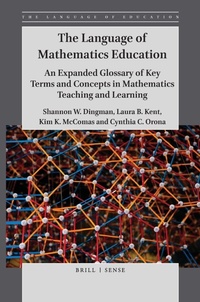
The Language of Mathematics Education
An Expanded Glossary of Key Terms and Concepts in Mathematics Teaching and Learning
Published on 22. August 2019
Book
Paperback/Softback
140 pages
978-90-04-40938-5 (ISBN)
Description
The Language of Mathematics Education: An Expanded Glossary of Key Terms and Concepts in Mathematics Teaching and Learning offers mathematics teachers, mathematics education professionals and students a valuable resource in which common terms are defined and expounded upon in short essay format. The shared vocabulary and terminology relating to mathematics teaching and learning, and used by mathematics educators is an essential component of work conducted in the field.
The authors provide an overview of more than 100 terms commonly used in mathematics teaching and learning. Each term is defined and is followed by a short overview of the concept under discussion that includes several bibliographic references the reader can use for further investigation. In addition to terms specific to the domain of mathematics education, select key terms common across all fields of education (e.g., curriculum, epistemology, metacognition) are included. The goal for this book is to serve as a resource for those entering the field as they navigate the language and terminology of mathematics education and as an asset for more established professionals who wish to gain additional insights into these ideas.
The authors provide an overview of more than 100 terms commonly used in mathematics teaching and learning. Each term is defined and is followed by a short overview of the concept under discussion that includes several bibliographic references the reader can use for further investigation. In addition to terms specific to the domain of mathematics education, select key terms common across all fields of education (e.g., curriculum, epistemology, metacognition) are included. The goal for this book is to serve as a resource for those entering the field as they navigate the language and terminology of mathematics education and as an asset for more established professionals who wish to gain additional insights into these ideas.
More details
Series
Language
English
Place of publication
Leiden
Netherlands
Target group
Professional and scholarly
Product notice
Paperback (trade)
Unsewn / adhesive bound
Dimensions
Height: 231 mm
Width: 155 mm
Thickness: 10 mm
Weight
227 gr
ISBN-13
978-90-04-40938-5 (9789004409385)
Copyright in bibliographic data and cover images is held by Nielsen Book Services Limited or by the publishers or by their respective licensors: all rights reserved.
Schweitzer Classification
Other editions
Additional editions
Shannon W. Dingman | Laura B. Kent | Kim K. McComas
The Language of Mathematics Education
An Expanded Glossary of Key Terms and Concepts in Mathematics Teaching and Learning
Book
08/2019
Brill
€145.50
Shipment within 10-20 days
Persons
Shannon W. Dingman, Ph.D. (2007), University of Missouri, is an Associate Professor of Mathematics Education in the Department of Mathematical Sciences at the University of Arkansas. His research agenda centers on the role of mathematics curriculum materials in mathematics teaching.
Laura B. Kent, Ph.D. (1996), University of Wisconsin, is an Associate Professor of Mathematics Education in the Department of Curriculum & Instruction at the University of Arkansas. Her research interests focus on student thinking and mathematics classroom based professional development.
Kim K. McComas, Ph.D. (2011), University of Arkansas, is an Assistant Clinical Professor of Mathematics Education in the Department of Curriculum & Instruction at the University of Arkansas. Her interests include a problem based approach to teaching mathematics.
Cynthia C. Orona, Ph.D. (2013), Oklahoma State University, is an Assistant Professor of Mathematics and STEM Education in the Department of Curriculum & Instruction at the University of Arkansas. Her research interests are pre-service elementary mathematics teachers and STEM curriculum.
Laura B. Kent, Ph.D. (1996), University of Wisconsin, is an Associate Professor of Mathematics Education in the Department of Curriculum & Instruction at the University of Arkansas. Her research interests focus on student thinking and mathematics classroom based professional development.
Kim K. McComas, Ph.D. (2011), University of Arkansas, is an Assistant Clinical Professor of Mathematics Education in the Department of Curriculum & Instruction at the University of Arkansas. Her interests include a problem based approach to teaching mathematics.
Cynthia C. Orona, Ph.D. (2013), Oklahoma State University, is an Assistant Professor of Mathematics and STEM Education in the Department of Curriculum & Instruction at the University of Arkansas. Her research interests are pre-service elementary mathematics teachers and STEM curriculum.
Content
Foreword
?Barbara J. Reis
Preface and Introduction
Abstract Thinking
Action Research
Active Mathematics Teaching and Learning
Additive Reasoning
Algebraic Reasoning
Algorithm
Assessment in Mathematics
?Formative Assessment
?Summative Assessment
?Progressive Assessment
Basic (Number) Facts
Beliefs/Attitudes
Cognitive Demand
Cognitive Science
Cognitively Guided Instruction (CGI)
Common Core State Standards for Mathematics (CCSSM)
Computer Algebra Systems (CAS)
Concept Image
Conceptual Knowledge
Conjecture
Constructivist Theory of Learning
Cooperative Learning
Council for the Accreditation of Educator Preparation (CAEP)
Counting
Covariational Reasoning
Curricular Reasoning
Curriculum
Curriculum Alignment
Curriculum Coherence
Curriculum Knowledge
Decentering
Deductive Reasoning
Design Research in Education
Didactic
Differentiated Instruction
Direct Modeling
Discourse
Discovery Learning
Dynamic Geometry Software (DGS)
Educational Technology
Epistemology
Equity
Error Patterns
Ethnomathematics
Fidelity of Implementation
Flipped Classroom
Functions-Based Approach to Teaching Algebra
Geometric Reasoning
High-Stakes Testing
Inductive Reasoning
Instructional Strategies and Techniques
?Direct Instruction/Lecture Method
?Inquiry Based Instruction/Active Learning
?Three-Act Tasks
?Launch-Explore-Summarize
?5 Practices
?Flipped Classroom Approach
Learning Trajectory
Lesson Study
Longitudinal Study
Manipulatives
Math Anxiety
Math Wars
Mathematical Identity
Mathematical Knowledge for Teaching (MKT)
Mathematical Literacy
Mathematical Modeling
Mathematics Skills
Meaningful Learning
Mental Discipline
Mental Math
Metacognition
Misconceptions
Model-Eliciting Activities (MEA's)
Multiple Embodiment
Multiplicative Reasoning
National Assessment of Educational Progress (NAEP)
NCTM Standards
New Math
Non-Anticipatory
Number Sense/Numeracy
Numerical Estimation
Pedagogical Content Knowledge (PCK)
Performance Based Assessments
Prior Knowledge
Problem Based Learning (PrBL)
Problem Solving Heuristics
Problem Structure
Procedural Knowledge
Productive Struggle
Professional Development (PD)
Professional Organizations in Mathematics Education
?National Council of Teachers of Mathematics (NCTM)
?National Council of Supervisors of Mathematics (NCSM)
?Association of Mathematics Teacher Educators (AMTE)
?Psychology of Mathematics Education (PME)
?American Educational Research Association (AERA)
?International Commission on Mathematical Instruction (ICMI)
?Research Council on Mathematics Learning (RCML)
?Mathematical Association of America (MAA)
?American Mathematical Society (AMS)
Program for International Student Assessment (PISA)
Project Based Learning (PBL)
Proportional Reasoning
Quantitative Literacy (QL)
Quantitative Reasoning (QR)
Radical Constructivism
Reification
Relational Thinking
Representational Fluency
Representations
Response to Intervention (RtI)
Responsive Teaching
Rigor
Rote Learning
Scaffolding
Sense-Making
Situated Learning (Cognition)
Social Constructivism
Socio-Cultural Learning Theory (SCLT)
Sociomathematical Norms
Spatial Thinking
Strands of Mathematical Proficiency
Subitizing
Task Analysis
Teacher Noticing
Technological and Pedagogical Content Knowledge (TPACK)
Trends in Mathematics and Science Study (TIMMS)
Van Hiele Levels of Geometric Thinking
Zone of Proximal Development (ZPD)
?Barbara J. Reis
Preface and Introduction
Abstract Thinking
Action Research
Active Mathematics Teaching and Learning
Additive Reasoning
Algebraic Reasoning
Algorithm
Assessment in Mathematics
?Formative Assessment
?Summative Assessment
?Progressive Assessment
Basic (Number) Facts
Beliefs/Attitudes
Cognitive Demand
Cognitive Science
Cognitively Guided Instruction (CGI)
Common Core State Standards for Mathematics (CCSSM)
Computer Algebra Systems (CAS)
Concept Image
Conceptual Knowledge
Conjecture
Constructivist Theory of Learning
Cooperative Learning
Council for the Accreditation of Educator Preparation (CAEP)
Counting
Covariational Reasoning
Curricular Reasoning
Curriculum
Curriculum Alignment
Curriculum Coherence
Curriculum Knowledge
Decentering
Deductive Reasoning
Design Research in Education
Didactic
Differentiated Instruction
Direct Modeling
Discourse
Discovery Learning
Dynamic Geometry Software (DGS)
Educational Technology
Epistemology
Equity
Error Patterns
Ethnomathematics
Fidelity of Implementation
Flipped Classroom
Functions-Based Approach to Teaching Algebra
Geometric Reasoning
High-Stakes Testing
Inductive Reasoning
Instructional Strategies and Techniques
?Direct Instruction/Lecture Method
?Inquiry Based Instruction/Active Learning
?Three-Act Tasks
?Launch-Explore-Summarize
?5 Practices
?Flipped Classroom Approach
Learning Trajectory
Lesson Study
Longitudinal Study
Manipulatives
Math Anxiety
Math Wars
Mathematical Identity
Mathematical Knowledge for Teaching (MKT)
Mathematical Literacy
Mathematical Modeling
Mathematics Skills
Meaningful Learning
Mental Discipline
Mental Math
Metacognition
Misconceptions
Model-Eliciting Activities (MEA's)
Multiple Embodiment
Multiplicative Reasoning
National Assessment of Educational Progress (NAEP)
NCTM Standards
New Math
Non-Anticipatory
Number Sense/Numeracy
Numerical Estimation
Pedagogical Content Knowledge (PCK)
Performance Based Assessments
Prior Knowledge
Problem Based Learning (PrBL)
Problem Solving Heuristics
Problem Structure
Procedural Knowledge
Productive Struggle
Professional Development (PD)
Professional Organizations in Mathematics Education
?National Council of Teachers of Mathematics (NCTM)
?National Council of Supervisors of Mathematics (NCSM)
?Association of Mathematics Teacher Educators (AMTE)
?Psychology of Mathematics Education (PME)
?American Educational Research Association (AERA)
?International Commission on Mathematical Instruction (ICMI)
?Research Council on Mathematics Learning (RCML)
?Mathematical Association of America (MAA)
?American Mathematical Society (AMS)
Program for International Student Assessment (PISA)
Project Based Learning (PBL)
Proportional Reasoning
Quantitative Literacy (QL)
Quantitative Reasoning (QR)
Radical Constructivism
Reification
Relational Thinking
Representational Fluency
Representations
Response to Intervention (RtI)
Responsive Teaching
Rigor
Rote Learning
Scaffolding
Sense-Making
Situated Learning (Cognition)
Social Constructivism
Socio-Cultural Learning Theory (SCLT)
Sociomathematical Norms
Spatial Thinking
Strands of Mathematical Proficiency
Subitizing
Task Analysis
Teacher Noticing
Technological and Pedagogical Content Knowledge (TPACK)
Trends in Mathematics and Science Study (TIMMS)
Van Hiele Levels of Geometric Thinking
Zone of Proximal Development (ZPD)