

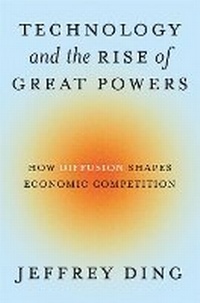
Technology and the Rise of Great Powers
How Diffusion Shapes Economic Competition
Published on 20. August 2024
Book
Hardback
280 pages
978-0-691-26033-4 (ISBN)
Description
A novel theory of how technological revolutions affect the rise and fall of great powers
When scholars and policymakers consider how technological advances affect the rise and fall of great powers, they draw on theories that center the moment of innovation-the eureka moment that sparks astonishing technological feats. In this book, Jeffrey Ding offers a different explanation of how technological revolutions affect competition among great powers. Rather than focusing on which state first introduced major innovations, he investigates why some states were more successful than others at adapting and embracing new technologies at scale. Drawing on historical case studies of past industrial revolutions as well as statistical analysis, Ding develops a theory that emphasizes institutional adaptations oriented around diffusing technological advances throughout the entire economy.
Examining Britain's rise to preeminence in the First Industrial Revolution, America and Germany's overtaking of Britain in the Second Industrial Revolution, and Japan's challenge to America's technological dominance in the Third Industrial Revolution (also known as the "information revolution"), Ding illuminates the pathway by which these technological revolutions influenced the global distribution of power and explores the generalizability of his theory beyond the given set of great powers. His findings bear directly on current concerns about how emerging technologies such as AI could influence the US-China power balance.
When scholars and policymakers consider how technological advances affect the rise and fall of great powers, they draw on theories that center the moment of innovation-the eureka moment that sparks astonishing technological feats. In this book, Jeffrey Ding offers a different explanation of how technological revolutions affect competition among great powers. Rather than focusing on which state first introduced major innovations, he investigates why some states were more successful than others at adapting and embracing new technologies at scale. Drawing on historical case studies of past industrial revolutions as well as statistical analysis, Ding develops a theory that emphasizes institutional adaptations oriented around diffusing technological advances throughout the entire economy.
Examining Britain's rise to preeminence in the First Industrial Revolution, America and Germany's overtaking of Britain in the Second Industrial Revolution, and Japan's challenge to America's technological dominance in the Third Industrial Revolution (also known as the "information revolution"), Ding illuminates the pathway by which these technological revolutions influenced the global distribution of power and explores the generalizability of his theory beyond the given set of great powers. His findings bear directly on current concerns about how emerging technologies such as AI could influence the US-China power balance.
Reviews / Votes
"A Chicago Council on Global Affairs Read of the Year" "Winner of the Lepgold Book Prize, Georgetown University" "A Choice Outstanding Academic Title of the Year" "Winner of the Science, Technology, and Art in International Relations Section Book Award, International Studies Association" "One of the best books examining . . . how technology enables national power is from Jeffrey Ding. . . . An important and interesting book." * Information Technology & Innovation Foundation * "Brilliant. . . . [Technology and the Rise of Great Powers] is one of the most important books in international relations to be published in years." * Choice * "[Technology and the Rise of Great Powers's] most significant contribution is its framework for analyzing how technology influences international power dynamics across populations. Instead of focusing on the technological capabilities and resources of companies like OpenAI and DeepSeek, Ding urges social scientists to adopt a long-term historical perspective-one that prioritizes skill in-frastructure and diffusion over innovation as the primary driver of international power."---Sebastian James Rose, H-Net Reviews "A timely examination of how technological change can bring about power transitions and points at the humble, yet essential, process of technological diffusion."---Ludovica Meacci, International Affairs "Magisterial."---Sebastien Laye, Washington Examiner "If you want to understand who might win the AI race, start by looking backward. In this deeply researched text, political science professor Jeffrey Ding does exactly that. He charts how past 'GPTs' - in this case, that's 'general purpose technologies' - have shaped the rise and fall of empires. . . . Ding's framework culminates in a stark warning for policymakers that they may not even be running the race that matters"---Catherine Thorbecke, BloombergMore details
Series
Language
English
Place of publication
New Jersey
United States
Target group
College/higher education
Professional and scholarly
Product notice
Trade binding
Illustrations
15 b/w illus. 20 tables.
Dimensions
Height: 235 mm
Width: 156 mm
ISBN-13
978-0-691-26033-4 (9780691260334)
Copyright in bibliographic data and cover images is held by Nielsen Book Services Limited or by the publishers or by their respective licensors: all rights reserved.
Schweitzer Classification
Other editions
Additional editions
E-Book
08/2024
1st Edition
Princeton University Press
€28.99
Available for download
Person
Jeffrey Ding is assistant professor of political science at George Washington University. He also holds research affiliations with the Foreign Policy Research Institute, the Elliott School of International Affairs, and the Centre for the Governance of AI.