

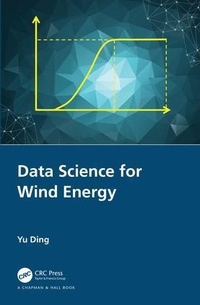
Data Science for Wind Energy
1st Edition
Published on 24. May 2019
Book
Hardback
400 pages
978-1-138-59052-6 (ISBN)
Description
Data Science for Wind Energy provides an in-depth discussion on how data science methods can improve decision making for wind energy applications, near-ground wind field analysis and forecast, turbine power curve fitting and performance analysis, turbine reliability assessment, and maintenance optimization for wind turbines and wind farms. A broad set of data science methods covered, including time series models, spatio-temporal analysis, kernel regression, decision trees, kNN, splines, Bayesian inference, and importance sampling. More importantly, the data science methods are described in the context of wind energy applications, with specific wind energy examples and case studies. Please also visit the author's book site at https://aml.engr.tamu.edu/book-dswe.
Features
Provides an integral treatment of data science methods and wind energy applications
Includes specific demonstration of particular data science methods and their use in the context of addressing wind energy needs
Presents real data, case studies and computer codes from wind energy research and industrial practice
Covers material based on the author's ten plus years of academic research and insights
Features
Provides an integral treatment of data science methods and wind energy applications
Includes specific demonstration of particular data science methods and their use in the context of addressing wind energy needs
Presents real data, case studies and computer codes from wind energy research and industrial practice
Covers material based on the author's ten plus years of academic research and insights
Reviews / Votes
"This is the first book that focuses on the data science methodologies and their applications in a growing field, wind energy. It is well-organized and well-written. It will enhance the knowledge base of data science and its applications in the wind energy field."-- Elsayed A. Elsayed, Professor, Rutgers University
More details
Language
English
Place of publication
London
United Kingdom
Publishing group
Taylor & Francis Ltd
Target group
College/higher education
Product notice
sewn/stitched
Cloth over boards
Illustrations
103 s/w Abbildungen, 58 s/w Tabellen
58 Tables, black and white; 103 Illustrations, black and white
Dimensions
Height: 234 mm
Width: 163 mm
Thickness: 28 mm
Weight
794 gr
ISBN-13
978-1-138-59052-6 (9781138590526)
Copyright in bibliographic data and cover images is held by Nielsen Book Services Limited or by the publishers or by their respective licensors: all rights reserved.
Schweitzer Classification
Other editions
Additional editions

Yu Ding
Data Science for Wind Energy
Book
12/2020
1st Edition
Chapman & Hall/CRC
€74.10
Shipment within 15-20 days
Yu Ding
Data Science for Wind Energy
E-Book
06/2019
1st Edition
Chapman & Hall/CRC
€0.00
Available for download
Yu Ding
Data Science for Wind Energy
E-Book
06/2019
1st Edition
Chapman & Hall/CRC
€0.00
Available for download
Person
Yu Ding is the Mike and Sugar Barnes Professor of Industrial and Systems Engineering and Professor of Electrical and Computer Engineering at Texas A&M University, and a Fellow of the Institute of Industrial & Systems Engineers and the American Society of Mechanical Engineers
Content
Chapter 1 ? Introduction
Part I Wind Field Analysis
Chapter 2 ? A Single Time Series Model
Chapter 3 ? Spatiotemporal
Chapter 4 ? Regimeswitching
Part II Wind Turbine Performance Analysis
Chapter 5 ? Power Curve Modeling and Analysis
Chapter 6 ? Production Efficiency Analysis
Chapter 7 ? Quantification of Turbine Upgrade
Chapter 8 ? Wake Effect Analysis
Chapter 9 ? Overview of Turbine Maintenance Optimization
Chapter 10 ? Extreme Load Analysis
Chapter 11 ? Computer Simulator Based Load Analysis
Chapter 12 ? Anomaly Detection and Fault Diagnosis
Part I Wind Field Analysis
Chapter 2 ? A Single Time Series Model
Chapter 3 ? Spatiotemporal
Chapter 4 ? Regimeswitching
Part II Wind Turbine Performance Analysis
Chapter 5 ? Power Curve Modeling and Analysis
Chapter 6 ? Production Efficiency Analysis
Chapter 7 ? Quantification of Turbine Upgrade
Chapter 8 ? Wake Effect Analysis
Chapter 9 ? Overview of Turbine Maintenance Optimization
Chapter 10 ? Extreme Load Analysis
Chapter 11 ? Computer Simulator Based Load Analysis
Chapter 12 ? Anomaly Detection and Fault Diagnosis