

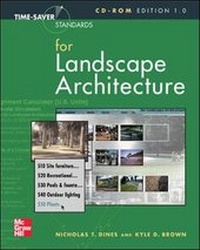
Time-Saver Standards for Landscape Architecture CD-ROM
Published on 16. March 2002
Book
978-0-07-135761-6 (ISBN)
Description
This award-winning reference now on CD-ROM has time-saver standards for landscape architecture. Recognized as a great contribution to professional literature by the American Society of Landscape Architecture, "Time-Saver Standards for Landscape Architecture on CD-ROM" offers the full content of the Second Edition of this highly regarded book in digital form. The CD-ROM includes features that link text to online data sources and also link data, calculations, and figures to other computer-based design applications such as CAD, spreadsheet, and word processing programs. The result is a truly interactive information resource.The key features to look for include: full content of book redesigned, reorganized, and fully searchable in hyperlinked format; dimensional data tables and graphics; interactive features that assist designers with critical calculations; and details in U.S. and metric measurements. As a value-added feature, the CD-ROM may be used in conjunction with "Time-Saver Standards for Landscape Construction Details", a CD of 350 exportable detail drawings.
Full access to the award-winning book in a searchable computerized format makes this reference a primary source of information for all design professionals, including landscape architects, architects, planners, engineers, and students.System requirements included: Windows Pentium 133 MHz or faster; Windows 95 OSR 2.0 or greater; 64 MB RAM; 24 MB available hard-disk space; 4x CD-ROM (8x or faster recommended); 16 bit color recommended Macintosh; Power PC Processor; Mac OS 8.6 or greater; 64 MB RAM; 24 MB available hard-disk space; 4x CD-ROM (8x or faster recommended); and 16 bit color recommended Microsoft Excel 2000 or other spreadsheet program capable of reading Excel (xls) files is required to use calculation modules contained in the CD. AutoCAD 2000 or other CAD program capable of reading AutoCAD (dwg) files is required to use CAD graphics contained in the CD.
Full access to the award-winning book in a searchable computerized format makes this reference a primary source of information for all design professionals, including landscape architects, architects, planners, engineers, and students.System requirements included: Windows Pentium 133 MHz or faster; Windows 95 OSR 2.0 or greater; 64 MB RAM; 24 MB available hard-disk space; 4x CD-ROM (8x or faster recommended); 16 bit color recommended Macintosh; Power PC Processor; Mac OS 8.6 or greater; 64 MB RAM; 24 MB available hard-disk space; 4x CD-ROM (8x or faster recommended); and 16 bit color recommended Microsoft Excel 2000 or other spreadsheet program capable of reading Excel (xls) files is required to use calculation modules contained in the CD. AutoCAD 2000 or other CAD program capable of reading AutoCAD (dwg) files is required to use CAD graphics contained in the CD.
More details
Series
Language
English
Place of publication
United States
Publishing group
McGraw-Hill Education - Europe
Target group
Professional and scholarly
Dimensions
Height: 241 mm
Width: 193 mm
Thickness: 39 mm
Weight
235 gr
ISBN-13
978-0-07-135761-6 (9780071357616)
Copyright in bibliographic data and cover images is held by Nielsen Book Services Limited or by the publishers or by their respective licensors: all rights reserved.
Schweitzer Classification
Persons
Nicholas T. Dines, FASLA, is a professor of landscape architecture and former director of the landscape architecture graduate program at the University of Massachusetts where for over 30 years, he has taught courses in site engineering, structures, design studio, design drawing, design theory, and professional practice. He is the co-editor of McGraw-Hill's Time-Saver Standards for Landscape Architecture; co-author of Time-Saver Standards for Landscape Construction Details CD, and its companion publication, Time-Saver Standards Concise Site Construction Details Manual; and author of, Landscape Perspective Drawing. He has over 32 years of professional experience, including a 10-year period of work on residential and recreational design projects in Greece. He currently is conducting research in multi-media applications to both professional and academic design and planning practices, with a special focus on site construction and sustainable design. He has a bachelor's degree from Michigan State University and a MLA degree from Harvard University. His home is in Williamsburg, Massachusetts.
Kyle D. Brown is an assistant professor of landscape architecture at California State Polytechnic University, Pomona. He is a co-producer of Time-Saver Standards for Landscape Construction Details CD; co-author of Time-Saver Standards Concise Site Construction Details Manual; and assistant editor of Time-Saver Standards for Landscape Architecture. He has a bachelors degree from the University of Minnesota, a MLA degree from the University of Massachusetts, where he is also completing a doctorate in regional planning. His home is in Claremont, California.
Kyle D. Brown is an assistant professor of landscape architecture at California State Polytechnic University, Pomona. He is a co-producer of Time-Saver Standards for Landscape Construction Details CD; co-author of Time-Saver Standards Concise Site Construction Details Manual; and assistant editor of Time-Saver Standards for Landscape Architecture. He has a bachelors degree from the University of Minnesota, a MLA degree from the University of Massachusetts, where he is also completing a doctorate in regional planning. His home is in Claremont, California.
Content
Chapter 1: Landscape Construction Processes and Documents Chapter 2: Standards and Guidelines (Spatial Standards, Accessibility, Protection from Natural Hazards--Earthquakes, Landslides, Avalanches, Flooding, Subsidence) Chapter 3: Construction Techniques (Site Layout, Grading, Drainage, Pedestrian and Vehicular Circulation) Chapter 4: Structures (Retaining Walls, Dams, Surfacing and Paving, Fences, Screens, Decks and Boardwalks, Pedestrian Bridges) Chapter 5: Improvements (Furniture, Recreation and Athletic Facilities, Pools and Fountains, Outdoor Lighting, Plantings) Chapter 6: Special Conditions (Roof and Deck Landscapes, Interior Landscapes, Historic Landscapes, Disturbed Landscapes, Sound Control) Chapter 7: Site Utilities (Water Supply, Sewage Disposal, Stormwater Management, Water Resource Protection, Recreational Water Bodies, Irrigation) Chapter 8: Materials (Soils and Aggregates, Asphalt, Concrete, Masonry, Wood, Metals, Glass, Plastics, Fabrics, Geotextiles) Chapter 9: Details and Devices (Paving, Edges, Dividers, Curbs, Steps, Seatwalls, Lighting, Planting, Drainage)