

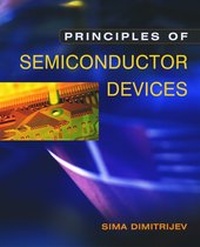
Principles of Semiconductor Devices
Published on 27. October 2005
Book
Hardback
606 pages
978-0-19-516113-7 (ISBN)
Description
Quantum mechanical phenomena - including energy bands, energy gaps, holes, and effective mass - constitute the majority of properties unique to semiconductor materials. Understanding how these properties affect the electrical characteristics of semiconductors, is vital for engineers working with today's nanoscale devices. Designed for upper-level undergraduate and graduate courses, "Principles of Semiconductor Devices" covers the dominant practical applications of semiconductor device theory, and applies quantum mechanical concepts and equations to develop the energy-band model. The text presents quantum mechanics through examples related to the energy-band model, providing students with a deeper understanding of the energy-band diagrams used to explain semiconductor device operation. The semiconductor theory is directly linked to the electronic layout and design of integrated circuits. The author has divided the text into four parts. Part I explains semiconductor physics, and Part II presents the principles of operation and modeling of the fundamental junctions and transistors. Part III discusses the diode, MOSFET, and BJT topics that are needed for circuit design.
Part IV introduces photonic devices, microwave FETs, negative-resistance diodes, and power devices. The chapters and the sections in each chapter are organized hierarchically. Core material is presented first, followed by advanced topics, allowing instructors to select more rigorous, design-related topics as they see fit.
Part IV introduces photonic devices, microwave FETs, negative-resistance diodes, and power devices. The chapters and the sections in each chapter are organized hierarchically. Core material is presented first, followed by advanced topics, allowing instructors to select more rigorous, design-related topics as they see fit.
More details
Language
English
Place of publication
New York
United States
Target group
College/higher education
Illustrations
438 Abbildungen
438 line illus.
Dimensions
Height: 233 mm
Width: 188 mm
ISBN-13
978-0-19-516113-7 (9780195161137)
Copyright in bibliographic data and cover images is held by Nielsen Book Services Limited or by the publishers or by their respective licensors: all rights reserved.
Schweitzer Classification
Other editions
New editions
Book
01/2012
2nd Edition
Oxford University Press Inc
€269.80
Shipment within 15-20 days
Sima Dimitrijev
Principles of Semiconductor Devices
Book
03/2011
2nd Edition
Oxford University Press Inc
€300.70
Shipment within 15-20 days
Content
ALL CHAPTERS END WITH A SUMMARY, PROBLEMS, AND REVIEW QUESTIONS; PART I: INTRODUCTION TO SEMICONDUCTORS; 1. Semiconductor Crystals: Atomic-Bond Model; 1.1. Crystal Lattices; 1.1.1. Unit Cell; 1.1.2. Planes and Directions; 1.1.3. Atomic Bonds; 1.2. Current Carriers; 1.2.1. Two Types of Current Carriers in Semiconductors; 1.2.2. N-Type and P-Type Doping; 1.2.3. Electroneutrality Equation; 1.2.4. Electron and Hole Generation and Recombination in Thermal Equilibrium; 2. Quantum Mechanics and Energy-Band Model; 2.1. Electrons as Waves; 2.1.1. De Broglie Relationship between Particle and Wave Properties; 2.1.2. Wave Function and Wave Packet; 2.1.3. Schrodinger Equation; 2.2. Energy Levels in Atoms and Energy Bands in Crystals; 2.2.1. Atomic Structure; 2.2.2. Energy Bands in Metals; 2.2.3. Energy Gap and Energy Bands in Semiconductors and Insulators; 2.3. Electrons and Holes as Particles; 2.4. Population of Electron States: Concentrations of Electrons and Holes; 2.4.1. Fermi-Dirac Distribution; 2.4.2. Maxwell-Boltzmann Approximation and Effective Density of States; 3. Drift; 3.1. Energy Bands with Applied Electric Field; 3.1.1. Energy-Band Presentation of Drift Current; 3.1.2. Resistance and Power Dissipation due to Carrier Scattering; 3.2. Ohm's Law, Sheet Resistance, and Conductivity; 3.2.1. Designing Integrated-Circuit Resistors; 3.2.2. Differential Form of Ohm's Law; 3.2.3. Conductivity Ingredients; 3.3. Carrier Mobility; 4. Diffusion; 4.1. Diffusion-Current Equation; 4.2. Diffusion Coefficient; 4.2.1. Einstein Relationship; 4.2.2. Haynes-Shockley Experiment; 4.2.3. Arrhenius Equation; 4.3. Basic Continuity Equation; 5. Generation and Recombination; 5.1. Generation and Recombination Mechanisms; 5.2. General Form of the Continuity Equation; 5.2.1. Recombination and Generation Rates; 5.2.2. Minority-Carrier Lifetime; 5.2.3. Diffusion Length; 5.3. Generation and Recombination Physics and Shockley-Read-Hall (SRH) Theory; 5.3.1. Capture and Emission Rates in Thermal Equilibrium; 5.3.2. Steady-State Equation for the Effective Thermal Generation/Recombination Rate; 5.3.3. Special Cases; 5.3.4. Surface Generation and Recombination; PART II: FUNDAMENTAL DEVICE STRUCTURES; 6. P-N Junction; 6.1.2. Reverse-Biased P-N Junction; 6.1.3. Forward-Biased P-N Junction; 6.1.4. Breakdown Phenomena; 6.1.4.1. Avalanche Breakdown; 6.1.4.2. Tunneling Breakdown; 6.2. DC Model; 6.2.1. Basic Current-Voltage (I-V) Equation; 6.2.2. Important Second-Order Effects; 6.2.3. Temperature Effects; 6.3. Capacitance of Reverse-Biased P-N Junction; 6.3.1. C-V Dependence; 6.3.2. Depletion-Layer Width: Solving the Poisson Equation; 6.3.3. SPICE Model for the Depletion-Layer Capacitance; 6.4. Stored-Charge Effects; 6.4.1. Stored Charge and Transit Time; 6.4.2. Relationship between the Transit Time and the Minority-Carrier Lifetime; 7. Metal-Semiconductor Contact and MOS Capacitor; 7.1. Metal-Semiconductor Contact; 7.1.1. Schottky Diode: Rectifying Metal-Semiconductor Contact; 7.1.2. Ohmic Metal-Semiconductor Contacts; 7.2. MOS Capacitor; 7.2.1. Properties of the Gate Oxide and the Oxide-Semiconductor Interface; 7.2.2. C-V Curve and the Surface-Potential Dependence on Gate Voltage; 8. MOSFET; 8.1. MOSFET Principles; 8.1.1. MOSFET Structure; 8.1.2. MOSFET as a Voltage-Controlled Switch; 8.2. Principal Current-Voltage Characteristics and Equations; 8.2.1. SPICE Level 1 Model; 8.2.2. SPICE Level 2 Model; 8.2.3. SPICE Level 3 Model: Principal Effects; 8.3. Second-Order Effects; 8.3.1. Mobility Reduction with Gate Voltage; 8.3.2. Velocity Saturation (Mobility Reduction with Drain Voltage); 8.3.4. Threshold-Voltage Related Short-Channel Effects; 8.3.5. Threshold Voltage Related Narrow-Channel Effects; 8.3.6. Subthreshold Current; 8.4. Nanoscale MOSFETs; 8.4.1. Down-Scaling Benefits and Rules; 8.4.2. Leakage Currents; 8.4.3. Advanced MOSFETs; 8.5. MOS-Based Memory Devices; 8.5.1. 1C1T DRAM Cell; 9. BJT; 9.1. BJT Principles; 9.1.1. BJT as a Voltage-Controlled Current Source; 9.1.2. BJT Currents and Gain Definitions; 9.1.4. The Four Modes of Operation: BJT as a Switch; 9.1.5. Complementary BJT; 9.1.6. BJT Versus MOSFET; 9.2. Principal Current-Voltage Characteristics: Ebers-Moll Model in Spice; 9.2.1. Injection Version; 9.2.2. Transport Version; 9.2.3. SPICE Version; 9.3. Second-Order Effects; 9.3.1. Early Effect: Finite Dynamic Output Resistance; 9.3.2. Parasitic Resistances; 9.3.3. Dependence of Common-Emitter Current Gain on Transistor Current: Low-Current Effects; 9.3.4. Dependence of Common-Emitter Current Gain on Transistor Current: Gummel-Poon Model for High-Current Effects; 9.4. Heterojunction Bipolar Transistor; PART III: DEVICE TECHNOLOGY AND ELECTRONICS; 10. Integrated-Circuit Technologies; 10.1. A Diode in IC Technology; 10.1.1. Basic Structure; 10.1.2. Lithography; 10.1.3. Process Sequence; 10.1.4. Diffusion Profiles; 10.2. MOSFET Technologies; 10.2.1. Local Oxidation of Silicon (LOCOS); 10.2.2. NMOS Technology; 10.2.3. Basic CMOS Technology; 10.2.4. Silicon-on-Insulator (SOI) Technology; 10.3. Bipolar IC Technologies; 10.3.1. IC Structure of NPN BJT; 10.3.2. Standard Bipolar Technology Process; 10.3.3. Implementation of PNP BJTs, Resistors, Capacitors, and Diodes; 10.3.4. Layer Merging; 10.3.5. BiCMOS Technology; 11. Device Electronics: Equivalent Circuits and Spice Parameters; 11.1. Diodes; 11.1.1. Static Model and Parameters in SPICE; 11.1.2. Large-Signal Equivalent Circuit in SPICE; 11.1.3. Parameter Measurement; 11.1.4. Small-Signal Equivalent Circuit; 11.2. MOSFET; 11.2.1. Static Model and Parameters: Level 3 in SPICE; 11.2.2. Parameter Measurement; 11.2.3. Large-Signal Equivalent Circuit and Dynamic Parameters in SPICE; 11.2.4. Simple Digital Model; 11.2.5. Small-Signal Equivalent Circuit; 11.3. BJT; 11.3.1. Static Model and Parameters: Ebers-Moll and Gummel-Poon Levels; IN SPICE; 11.3.2. Parameter Measurement; 11.3.3. Large-Signal Equivalent Circuit and Dynamic Parameters in SPICE; SMALL-SIGNAL EQUIVALENT CIRCUIT; 11.3.5. Parasitic IC Elements not Included in Device Models; 12. Photonic Devices; 12.1. Light Emitting Diodes (LED); 12.2. Photodetectors and Solar Cells; 12.2.1. Biasing for Photodetector and Solar-Cell Applications; 12.2.2. Carrier Generation in Photodetectors and Solar Cells; 12.3. Lasers; 12.3.1. Stimulated Emission, Inversion Population, and Other Fundamental Concepts; 12.3.2. A Typical Heterojunction Laser; 13. Microwave FETs and Diodes; 13.1. Gallium Arsenide versus Silicon; 13.1.1. Dielectric-Semiconductor Interface: Enhancement versus Depletion FETs; 13.1.2. Energy Gap; 13.1.3. Electron Mobility and Saturation Velocity; 13.1.4. Negative Dynamic Resistance; 13.2. JFET; 13.2.1. JFET Structure; 13.2.2. JFET Characteristics; 13.2.3. SPICE Model and Parameters; 13.3. MESFET; 13.3.1. MESFET Structure; 13.3.2. MESFET Characteristics; 13.3.3. SPICE Model and Parameters; 13.4. HEMT; 13.4.1. Two-Dimensional Electron Gas (2DEG); 13.4.2. HEMT Structure and Characteristics; 13.5. Negative Resistance Diodes; 13.5.1. Amplification and Oscillation by Negative Dynamic Resistance; 13.5.2. Gunn Diode; 13.5.3. IMPATT Diode; 13.5.4. Tunnel Diode; 14. Power Devices; 14.1. Power Diodes; 14.1.1. Drift Region in Power Devices; 14.1.2. Switching Characteristics; 14.1.3. Schottky Diode; 14.2. Power MOSFET; 14.3. IGBT; 14.4. Thyristor; BIBLIOGRAPHY; ANSWERS TO SELECTED PROBLEMS; INDEX